What is Ad Fraud? The complete 2026 Guide.
Every day, billions of dollars flow through the digital advertising ecosystem and a staggering portion of that money is stolen.
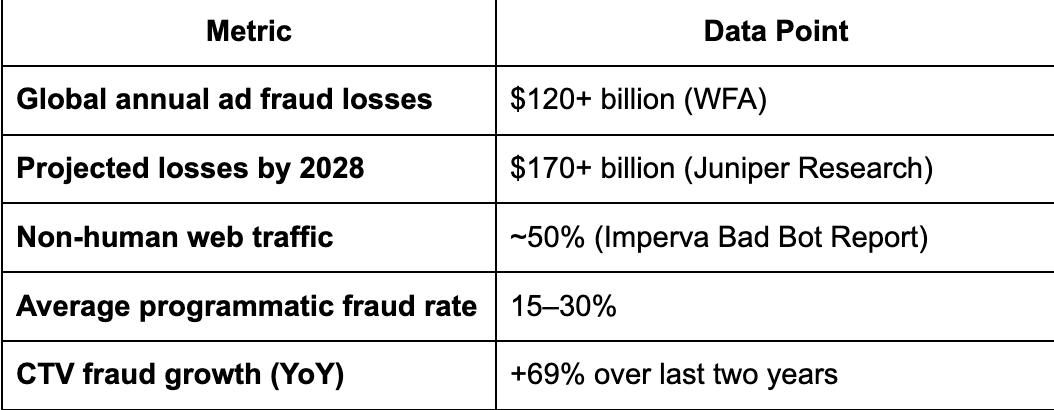
Ad fraud is not a minor inconvenience. It is a global criminal enterprise that now costs advertisers over $120 billion annually, according to the World Federation of Advertisers. That number is projected to exceed $170 billion by 2028 as fraudsters adopt generative AI, exploit connected TV (CTV) channels, and find new ways around evolving privacy frameworks.
If you run paid campaigns on any platform, ad fraud is silently draining your budget, corrupting your data, and undermining every marketing decision you make. This guide explains what ad fraud is, how to detect it, and exactly how to stop it.
What is Ad Fraud?
Ad fraud is any deliberate activity that prevents the proper delivery of ads to real human audiences. It uses bots, scripts, click farms, and other deceptive techniques to generate fake impressions, clicks, conversions, or app installs that advertisers pay for but receive zero value from.
You pay for 10,000 clicks. You expect 10,000 real people visiting your website. With ad fraud, a significant percentage of those clicks come from automated bots or click farm workers who will never become customers. You paid real money for fake engagement.
Ad fraud affects every channel:
- Search ads (Google Ads, Bing Ads)
- Social media ads (Meta, TikTok, LinkedIn)
- Programmatic display and video
- Connected TV (CTV) — one of the fastest-growing fraud vectors today
- Mobile app install campaigns
- Affiliate and lead generation campaigns
Why Does Ad Fraud Exist?
The digital advertising model pays for actions — impressions, clicks, leads, installs. Fraudsters fake those actions at scale and collect the revenue. The ecosystem's complexity, with ads bought and sold in milliseconds through dozens of intermediaries, creates the blind spots they exploit.
How Big is the Problem?

The Most Common Types of Ad Fraud
1. Click Fraud
Bots, competitors, or scripts repeatedly click your PPC ads with no intent to buy. Your budget is drained on worthless clicks, your CPA skyrockets, and your data becomes unreliable.
Common forms: Competitor click fraud (draining your daily budget), publisher click fraud (inflating ad revenue), and botnets (networks of malware-infected devices clicking at scale).
2. Impression Fraud
Fake ad views that no human ever sees. Techniques include ad stacking (layering multiple ads in one slot), pixel stuffing (cramming ads into a 1x1 pixel), and hidden ads (zero-dimension iframes). Your CPM campaigns generate zero actual awareness.
3. Domain Spoofing
A fraudulent website disguises itself as a premium publisher in programmatic exchanges. You pay premium prices, but your ad appears on a junk site filled with bot traffic. Your reporting shows a trusted publisher; reality is very different.
4. Conversion and Lead Fraud
Fraudsters fake the final action — filling out lead forms, faking app installs, or completing purchases with stolen credentials. GenAI has made this dramatically worse: bots now generate realistic names, emails, and even qualifying answers that fool sales teams.
ClearTrust Insight: In our analysis of over 1 billion daily sessions across 100+ brands, lead gen campaigns show the highest fraud rates — with verticals like insurance, finance, and education seeing invalid lead rates of 25–40%.
5. Attribution Fraud
Instead of creating fake engagement, fraudsters steal credit for organic conversions. Click injection fires a fake click milliseconds before an app install completes; click flooding sends massive fake click volumes hoping to be the last touch before a real conversion.
6. CTV and Streaming Fraud
The fastest-growing fraud category. Fraudsters spoof SSAI servers, fake CTV device IDs, and disguise bot traffic as premium streaming app inventory. With CTV CPMs at $20–$50+, this is extremely lucrative for criminals and expensive for advertisers.
7. GenAI-Powered Fraud
The new frontier. Fraudsters use AI to generate hyper-realistic fake leads, create entire fake publisher websites with AI-written content, evade CAPTCHAs by mimicking human behaviour, and scale fraud operations that would previously require hundreds of human workers. Traditional rule-based detection cannot keep pace.

How Ad Fraud Destroys Your Business
The damage goes far beyond wasted dollars.
Wasted Budget
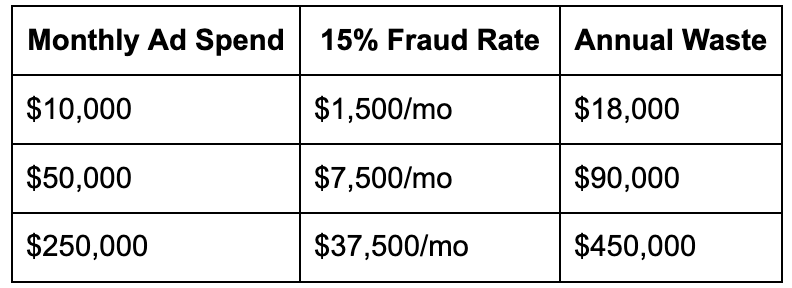
How much is fraud costing you? Use ClearTrust's free Lead Fraud ROI Calculator to find out.
Poisoned Data
Bots inflate your CTR, deflate your conversion rates, and pollute your retargeting audiences. You end up optimising campaigns based on fraudulent signals — systematically making your marketing worse over time.
Contaminated Sales Pipeline
Your sales team wastes hundreds of hours calling fake leads. Close rates drop. Marketing-sales trust erodes. One ClearTrust client discovered 34% of their "marketing qualified leads" were fraudulent; their sales team had been spending 450+ hours per quarter pursuing leads that could never convert.
Brand Safety Risks
Through domain spoofing, your ads can appear on sites with pirated content, misinformation, or hate speech without you ever knowing.

How to Detect Ad Fraud: The Warning Signs
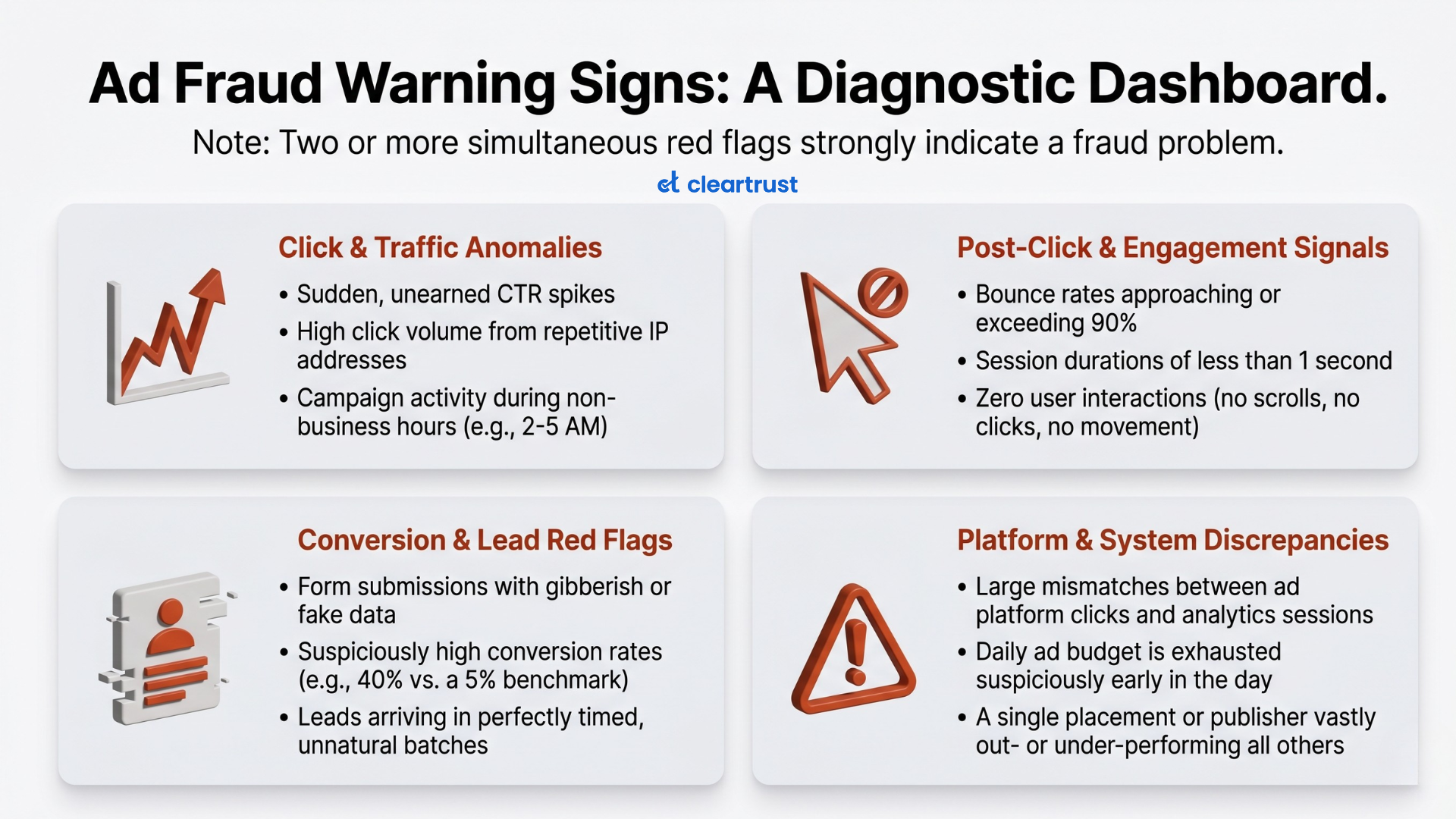
Use this as your monitoring checklist. Two or more simultaneous red flags likely indicate a fraud problem.
- Sudden CTR spikes without campaign changes
- Repetitive clicks from the same IP addresses
- High click volumes during off-hours (2–5 AM for a local business)
Post-Click Signals
- Bounce rates above 90% on paid traffic
- Near-zero time on site (sub-1-second sessions)
- No scroll depth, mouse movement, or page interactions
Conversion Red Flags
- Form submissions with fake data (gibberish names, sequential emails)
- Conversion rates that are suspiciously high (40% when your benchmark is 5%)
- Leads that all arrive within seconds of each other
- High volume of "conversions" that never become real customers
Platform Discrepancies
- Google Ads reports 1,000 clicks but Analytics shows only 600 sessions
- Daily budget exhausted within the first few hours
- Specific placements driving wildly different performance than the rest of your campaign.
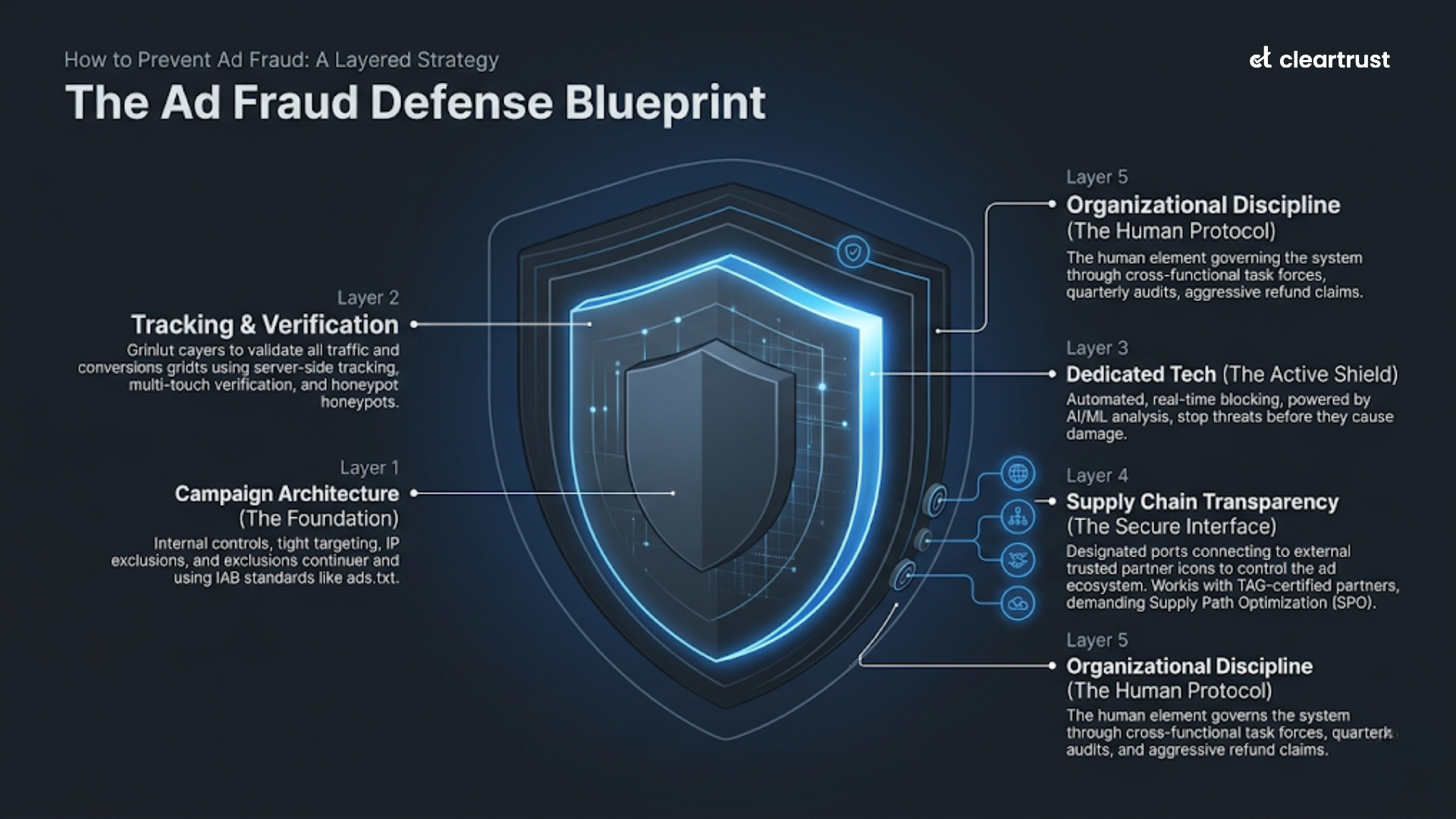
How to Prevent Ad Fraud: A Layered Strategy
No single tactic stops ad fraud. You need a layered approach that addresses fraud at every stage of the funnel.
Layer 1: Campaign Architecture
Tighten targeting. Restrict geographies to your actual service areas. Exclude suspicious placements. Use dayparting to limit delivery during off-hours. Set strict frequency caps on display and video.
Use ads.txt and sellers.json. These IAB standards verify authorised sellers and prevent domain spoofing. In 2026, the expanded ads.cert 2.0 standard adds cryptographic verification that your DSP supports it.
Implement IP exclusions. Block IPs that show suspicious patterns. Google Ads allows up to 500 exclusions per campaign. For broader protection, automate this with a fraud prevention tool.
Layer 2: Tracking and Verification
Deploy server-side tracking. Send conversion data server-to-server (via Google's sGTM, Meta's Conversions API, or ClearTrust), bypassing the browser entirely. This makes it dramatically harder for bots to spoof conversions.
Use multi-touch verification. Don't rely on a single signal. Validate the click → verify on-page behaviour → check form submission patterns → confirm post-conversion lead quality. Each layer catches fraud the previous one missed.
Add honeypot fields and risk-based CAPTCHA. Hidden form fields catch unsophisticated bots. Risk-based CAPTCHA (like reCAPTCHA v3) only challenges suspicious users, minimising friction for real humans. Neither is sufficient alone — use both as part of a layered stack.
Layer 3: Dedicated Fraud Prevention Technology
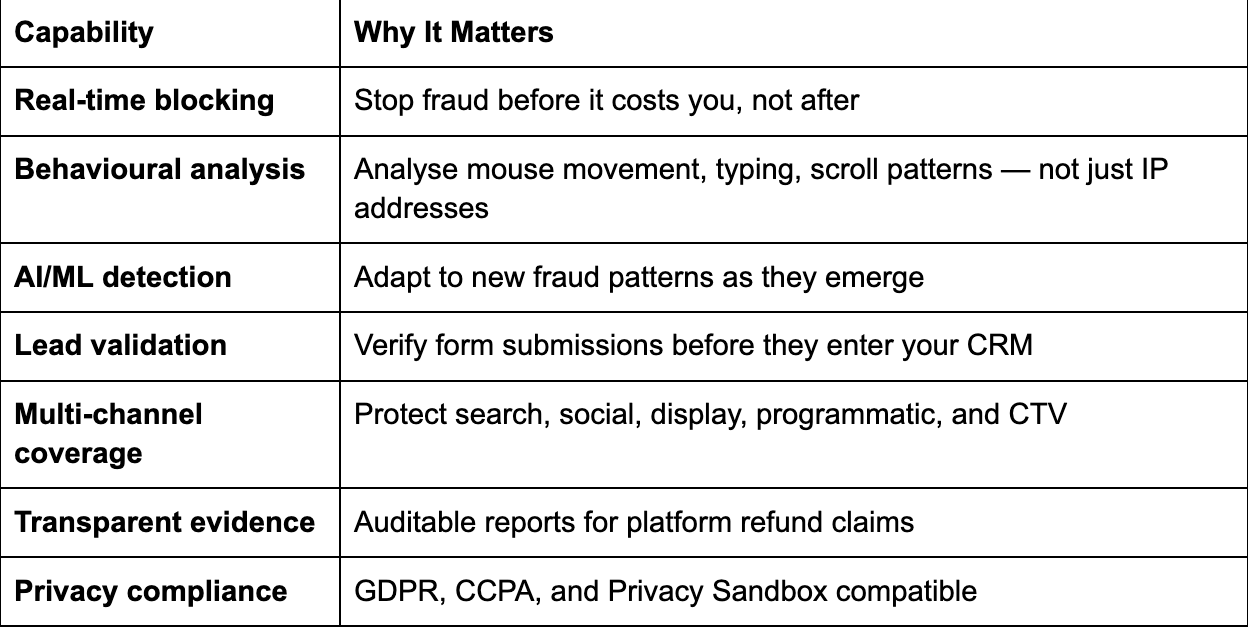
For any business spending meaningful amounts on ads, manual detection is not sufficient. You need automated, real-time protection.
What to look for in a solution:
How ClearTrust Protects Your Ad Spend
ClearTrust was built from the ground up for modern ad fraud prevention — not retrofitted from generic web security.
- 200+ signal analysis per click and session, blocking fraud in real time before it costs you money.
- Lead Protect validates every form submission for bot behaviour, fake contact data, velocity anomalies, and GenAI-generated content patterns.
- Smart Exclusion Engine automatically syncs fraudulent IPs, placements, and segments back to your ad platforms.
- CTV Fraud Shield detects SSAI spoofing, device fabrication, and app misrepresentation.
- Cross-channel dashboard with unified reporting and exportable evidence for refund claims.
- Privacy-first architecture — detection operates on behavioural signals, not personal data.
See it in action: Schedule a free fraud audit and discover exactly how much of your ad spend is being wasted.
Layer 4: Supply Chain Transparency
Work with TAG-certified partners. Only buy inventory through DSPs and SSPs certified by the Trustworthy Accountability Group.
Demand Supply Path Optimisation (SPO). Fewer intermediaries between you and the publisher means fewer fraud opportunities. Eliminate duplicate bid requests and remove vendors with quality issues.
Use Private Marketplaces (PMPs). Negotiate direct deals with premium publishers for greater transparency, pre-negotiated pricing, and direct relationships that open exchanges cannot provide.
Layer 5: Organisational Discipline
Build a cross-functional fraud task force spanning marketing, sales, analytics, IT, and finance. Ad fraud prevention is not one team's responsibility.
Conduct quarterly fraud audits. Review traffic quality, lead validity, supply paths, and tool effectiveness. Update exclusion lists and targeting parameters.
Pursue refund claims aggressively. Google, Meta, and most platforms will credit invalid traffic — but they rarely do it proactively. You must provide evidence and submit claims. ClearTrust's reporting provides the documentation required.
Next Steps: Start Protecting Your Ad Spend Today
Ad fraud is not going away. It is growing, evolving, and becoming more sophisticated every year. The advertisers who thrive will be the ones who treat fraud prevention not as an afterthought, but as a core component of their marketing infrastructure.
Here is what to do right now:
- Audit your current campaigns using the detection checklist above.
- Estimate your fraud exposure with ClearTrust's free Lead Fraud ROI Calculator.
- Implement the quick wins — tighten targeting, add IP exclusions, deploy honeypot fields, and set up server-side tracking.
- Deploy real-time fraud prevention with a purpose-built tool like ClearTrust.
- Establish a quarterly audit cadence and build fraud awareness across your team.
The cost of inaction is not just the money you lose to fraud today. It is every bad decision you make tomorrow based on data that was never real.
Ready to see what clean traffic looks like? Schedule a demo with ClearTrust and get a free fraud audit of your campaigns.

Frequently Asked Questions
Is ad fraud illegal?
In many jurisdictions, yes. Click fraud and botnet operations have been prosecuted under computer fraud and wire fraud statutes. However, enforcement is difficult because operations are often based in jurisdictions with limited legal cooperation, and the ecosystem's complexity makes attribution challenging.
Can Google detect ad fraud on its own?
Google's Invalid Traffic (IVT) system filters many types of known bot traffic and issues automatic credits. However, it primarily catches general invalid traffic (GIVT), not sophisticated fraud (SIVT). Relying solely on Google to police its own inventory is an inherent conflict of interest. Independent, third-party verification is essential.
What is invalid traffic (IVT)?
Invalid traffic is any ad traffic that does not come from a genuine user with real interest. It is classified into two categories:
- GIVT (General Invalid Traffic): Known bots, spiders, and crawlers that can be identified through routine detection methods (e.g., data-centre traffic, known bot user agents).
- SIVT (Sophisticated Invalid Traffic): Harder-to-detect fraud that requires advanced analysis — including botnets mimicking human behaviour, click injection, device spoofing, and cookie stuffing.
What is the difference between ads.txt and sellers.json?
ads.txt is hosted by publishers and lists which companies are authorised to sell their inventory. sellers.json is hosted by exchanges and SSPs, mapping seller IDs to business names. Together, they create a transparency chain that helps prevent domain spoofing and unauthorised inventory reselling.
How do I report ad fraud to Google?
You can report suspected invalid clicks through your Google Ads account by filing an Invalid Clicks Contact Form. Provide as much evidence as possible, including timestamps, IP data, and behavioural analysis from your fraud detection tools. Google will investigate and issue credits if the claim is validated.
How much does ad fraud prevention cost?
It varies widely based on ad spend volume and the solution you choose. Many tools, including ClearTrust, offer tiered pricing based on the number of clicks or sessions analysed. The cost of a fraud prevention tool is almost always a fraction of the budget it saves. If you're spending $50,000/month on ads and your fraud rate is 15%, you're losing $7,500/month. Even a $500–$1,000/month tool that cuts that loss in half pays for itself many times over.