Ad-Tech fraud is the manipulation of digital advertising systems to generate invalid traffic, misrepresent inventory, manipulate device or user identity, or otherwise cause advertisers to pay for advertising activity that doesn't deliver genuine value. In 2026, the risks surrounding digital advertising are moving beyond traditional bots into compromised devices, AI-driven behavior, programmatic supply quality, and auction mechanics.
Ad fraud used to be easier to recognize. A bot generated clicks, a script inflated impressions, and a suspicious IP address gave your fraud team something obvious to investigate.
That's no longer enough. AdTech fraud and related AdTech risks are moving deeper into the layers of the ecosystem: the devices bidding into your campaigns, the identities those devices claim to be, the behavior that convinces your detection filters a click is human, the inventory in your programmatic supply paths, and the pricing logic of the auctions you're bidding into. The IAB/MRC's Sophisticated Invalid Traffic guidance recognizes that some forms of invalid traffic require advanced analytics and multi-point corroboration to detect, rather than relying only on routine list-based checks.Each example below comes from a real, documented 2026 incident, not a hypothetical. Here's what each means for AdTech fraud detection, media quality, or advertising transparency and what to check in your own stack.
1.Compromised Devices Are Becoming AdTech Fraud Infrastructure

Kaspersky researchers documented the first case of malware with an infection chain specifically designed for Android-based automotive head units. The malware spreads through the built-in update mechanisms of Android-based automotive head-unit firmware, requiring no user action. Kaspersky identified the malware as a multi-stage downloader whose ultimate purpose is ad fraud and the creation of a proxy botnet, and attributed the activity with high confidence to the MoYu Group, which is linked to the BADBOX botnet.
Why this is an AdTech fraud problem, specifically: A key function of the proxy botnet is to route fraudulent ad requests through what looks like an ordinary residential IP address. That directly undermines one of the oldest fraud signals in the bidstream: IP reputation. GreyNoise's April 2026 analysis of 4 billion sessions found that 78% of residential IPs were observed at most twice before rotating, meaning they could disappear before reputation systems had an opportunity to flag them.
Because the malware includes dedicated ad-clicking functionality, a compromised head unit can be used to generate fraudulent advertising activity while its proxy component makes the associated network traffic harder to distinguish using IP reputation alone. Kaspersky's analysis found that the malware's infrastructure included both the ad-clicking functionality and a proxy component, allowing the compromised devices to serve as both a source of fraudulent advertising activity and proxy infrastructure.
What to check in your stack:
- Whether your fraud detection stack can identify device and infrastructure anomalies beyond IP reputation
- Whether your CTV and mobile fraud detection use shared connected-device signals, since compromised hardware doesn't respect that boundary
- Sudden shifts in the geographic or device distribution of "residential" traffic
2. Device ID Spoofing Turns Cheap Hardware Into Premium Inventory

Bitsight researchers uncovered an operation - dubbed "Fuyao" - running on cheap Android TV boxes sold under the H96 brand. The boxes disguise themselves as flagship Samsung, Huawei, Xiaomi, or Vivo phones, then use computer-vision models to locate and tap on ads automatically. In a single 24-hour window, researchers logged roughly 38,000 unique device identities tied to the operation, with estimated potential fraud revenue of about $47,500 per day.
Why this is an AdTech fraud problem, specifically: the device identity fed into the bid request is fabricated, which can change how the impression gets classified and priced. This is a direct version of the equation every media buyer should know: fake device identity → premium inventory classification → higher CPM → wasted spend. Industry sources note that swapping an identity specifically to command a higher CPM falls squarely within the Media Rating Council's definition of Sophisticated Invalid Traffic, since it involves manipulating or falsifying the signals used to represent a user or device to a buyer. Standard campaign reporting may not flag it because the reported device string can look completely legitimate.
What to check in your stack:
- A device-model breakdown across mobile campaigns, flagged for disproportionate volume from unfamiliar manufacturers
- Device fingerprints cross-referenced against expected hardware profiles, not the reported device string alone
- Unusually cheap mobile inventory combined with device-identity anomalies or inconsistent hardware signals
3. AI-Powered Click Fraud Is Defeating Behavioral Detection

Dr.Web identified a family of Android trojans using TensorFlow.js - an open-source machine learning library - to visually analyze on-screen ad elements and tap them the way a real person would, instead of firing scripted, rule-based clicks.
Why this is an AdTech fraud problem, specifically: Behavioral signals such as timing, sequence, repetition, and interaction patterns are commonly used to distinguish automated activity from human engagement. This type of malware is designed to make that layer of detection less reliable . The Media Rating Council's own Sophisticated Invalid Traffic (SIVT) standard exists precisely because this class of activity requires "advanced analytics, multi-point corroboration and human intervention" to catch - it's built for traffic engineered to clear the basic checks that once separated bots from people. "Does this click look robotic?" becomes a weaker signal once the click is generated by a model trained to visually interpret and interact with a page the way a person would.
What to check in your stack:
- Whether your fraud vendor's detection leans on click-timing rules alone, or also weighs IP reputation, proxy indicators, and session consistency
- Engagement metrics against downstream business value - not just against each other
- How your system handles visually-driven, AI-generated interaction specifically, not just "unnatural click patterns" in general
4. AI Is Accelerating Low-Quality Programmatic Inventory
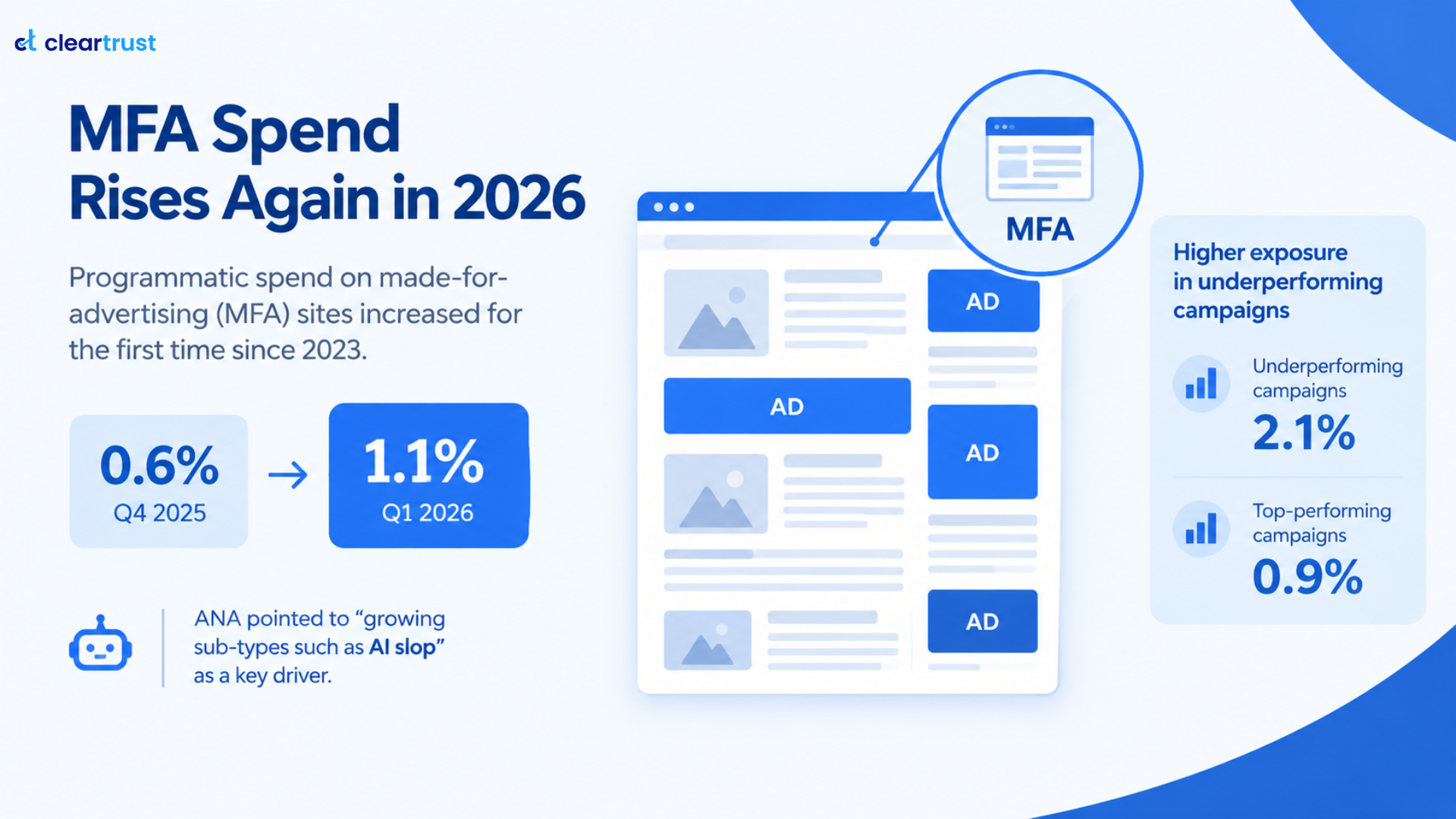
The Association of National Advertisers' Q1 2026 programmatic benchmark report found that member spend flowing to made-for-advertising (MFA) sites rose to 1.1% in Q1 2026, after remaining between 0.4% and 0.6% throughout 2025. The ANA also pointed to growing sub-types such as “AI slop” as a factor in the changing MFA landscape. The exposure isn't evenly distributed: underperforming advertisers spent 2.1% of their budget on MFA, compared with 0.9% among top-performing campaigns.
Why this is an AdTech risk, specifically: MFA inventory isn't always technically fraudulent - no bot is required, and the impressions can be genuinely viewable. But generative AI makes it easier to produce low-quality, ad-cluttered content at scale, increasing the amount of inventory that advertisers and their supply partners need to evaluate. That inventory can drain media budgets without delivering proportional business value, even when it doesn't trigger traditional invalid-traffic detection. That's why MFA belongs in a broader AdTech risk assessment alongside traffic-quality metrics, supply-path analysis, and campaign performance. For more, see our MFA sites explainer - this is the fresh 2026 data behind that trend.
What to check in your stack:
- Whether your supply partners vet new domains before allowing them into the bidstream, and what those checks include
- MFA exposure segmented by campaign performance tier - ANA's data shows higher exposure among lower-performing campaigns
- Sudden growth in unfamiliar, low-cost open-web inventory as a trigger to re-check supply path filters, not just price
Source: AdExchanger, "MFA Ad Spend Is Increasing. Is AI Slop To Blame?"
5. Auction Manipulation Is Becoming an AdTech Risk
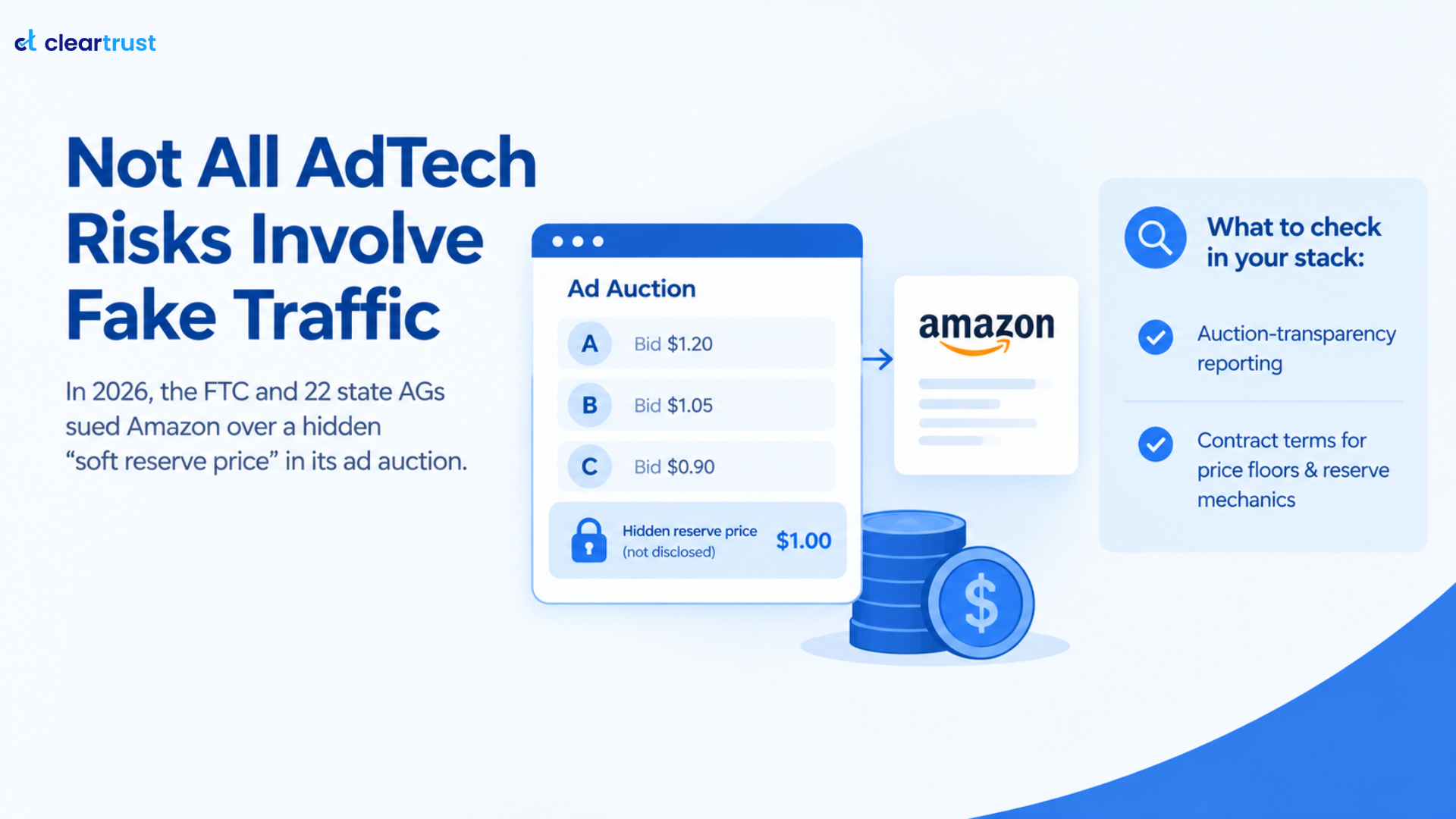
Not every AdTech risk involves fake traffic. On August 31, 2026, the FTC and 22 state attorneys general sued Amazon, alleging the company secretly altered its sponsored-ad auction pricing over more than seven years by inserting an undisclosed "soft reserve price" - a hidden price floor advertisers weren't told about - which the FTC estimates could have extracted tens of billions of dollars from more than a million brands and sellers. Amazon disputes the allegations.
Why this is an AdTech risk, specifically: It's the one risk on this list that traffic-quality tools, however comprehensive, cannot detect on their own - because nothing about the traffic itself is necessarily invalid. This is a transparency and contract-integrity risk in the auction logic that sets what you pay per click, which is exactly why it belongs with legal and procurement review rather than a fraud filter.
What to check in your stack:
- Auction-transparency reporting from your DSP or SSP partners as part of routine contract review
- Whether your platform contracts specify exactly how price floors and reserve mechanics work
Why AdTech Fraud Detection Needs More Than One Signal
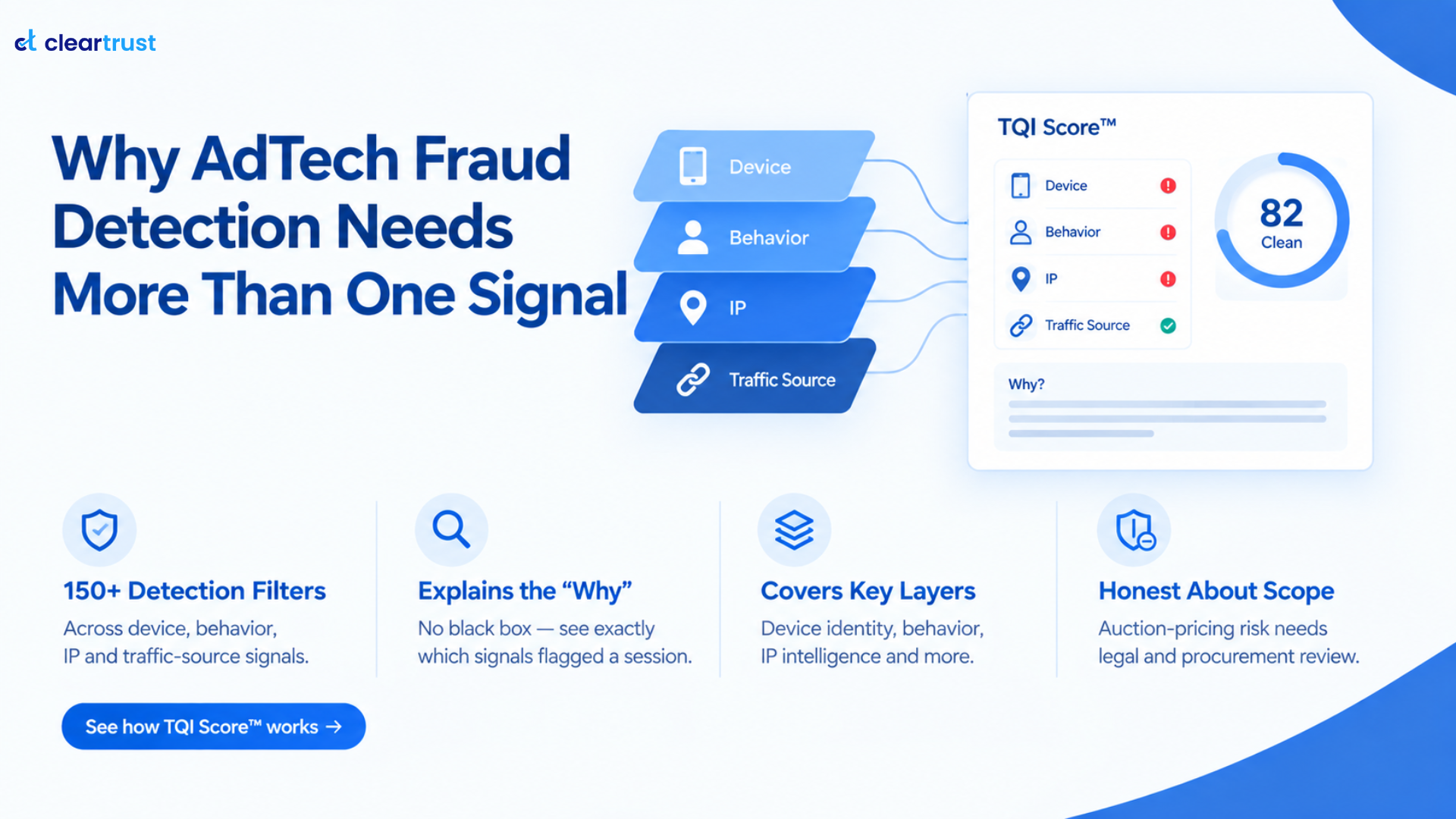
These five developments expose different layers of the same advertising ecosystem. Compromised devices attack infrastructure. Device spoofing attacks identity. AI-powered clicks attack behavior. AI-generated inventory creates a programmatic quality problem. Auction manipulation raises pricing and transparency concerns. The first three cases show why a single-signal approach isn't enough to give advertisers real visibility into traffic quality. The suspicious activity can sit in device identity, infrastructure, or behavioral signals that traditional IP blocklists and basic rules may not capture on their own.
This is the traffic-quality gap ClearTrust's TQI Score™ is built to address:
- Uses 150+ detection filters across device characteristics, behavioral patterns, IP intelligence, and traffic-source indicators to evaluate every session in real time
- Explains the "why," not just the score - instead of a black-box pass/fail, you see exactly which signals flagged a session as suspicious, so decisions stay auditable
- Covers several of the layers this article walks through - including device identity, behavior, IP intelligence, and traffic-source signals. Our CTV traffic-quality work with Cuedart shows this in practice, cutting invalid traffic by 60%.
- Stays honest about scope — auction-pricing risk, like the Amazon case above, sits outside what any traffic-quality tool can catch; that one belongs with legal and procurement, not a fraud filter
The Bigger Shift in AdTech Fraud and AdTech Risk
Ad fraud in 2026 is no longer confined to obvious bots clicking ads. The bigger challenge is activity and inventory that can look legitimate long enough to enter campaign reporting, influence optimization, and consume budget. CTR can look good. CPM can look competitive. Traffic can come from a residential IP. A device can report a legitimate model. And the traffic can still be fraudulent.
The question is no longer whether your campaign has traffic. It's whether the traffic, inventory, and supply path deserve to be trusted.
FAQs
What is AdTech fraud? AdTech fraud is the deliberate manipulation of digital advertising systems to generate invalid impressions, clicks, conversions, or other fraudulent activity. Common examples include bot traffic, click fraud, device spoofing, and manipulated user identities.
What are the biggest AdTech fraud risks in 2026? Major AdTech fraud risks include compromised devices generating fraudulent traffic, device ID spoofing, and AI-powered click fraud that makes malicious activity harder to distinguish from legitimate users. Advertisers also need to monitor adjacent AdTech risks such as MFA inventory, supply-path quality, and opaque auction mechanics.
Why is AI-generated click fraud harder to detect than traditional bots? Traditional click bots follow scripted patterns that timing-based filters can catch. AI-driven malware, like the TensorFlow.js-based trojans identified in 2026, visually interprets a page and clicks the way a real person would — effective detection needs to weigh infrastructure, device, network, and behavioral signals together.
Is made-for-advertising (MFA) inventory the same as ad fraud? Not exactly. MFA sites monetize advertising aggressively, often by attracting inexpensive traffic and creating ad-heavy pages. They can drain media budgets even when the impressions themselves are technically valid, which is why advertisers should evaluate MFA exposure alongside traffic-quality, supply-path, and performance signals.
What should I ask an AdTech fraud prevention vendor after reading this? Ask whether their detection combines device identity, behavior, IP and proxy intelligence, and traffic-source signals rather than relying on a single indicator. Also ask how the system explains why traffic was flagged, how frequently detection data is refreshed, and which channels it supports across web, mobile, CTV, and paid marketing.