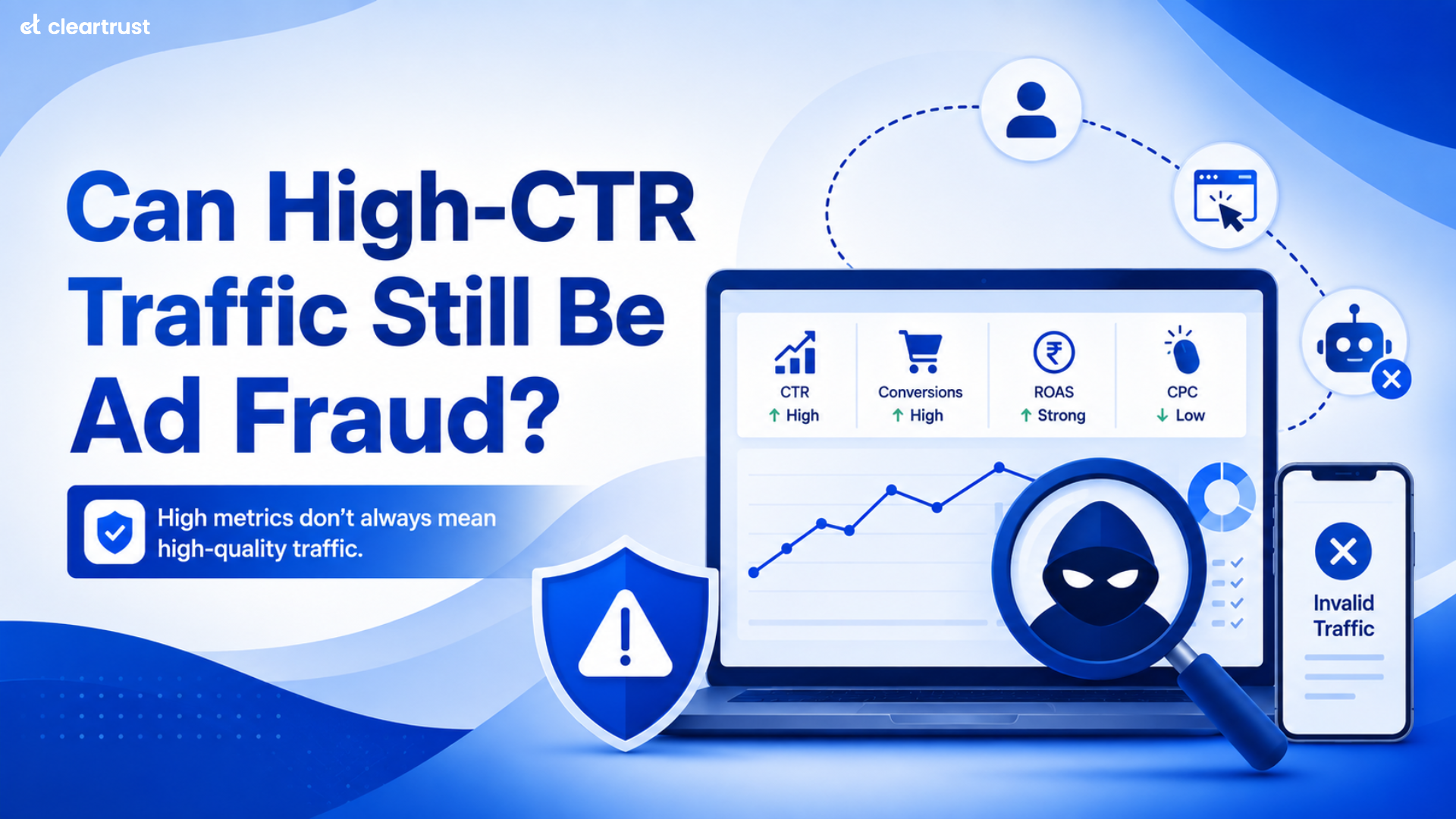
Your dashboard looks great. CTR is strong. Conversions are up. ROAS is healthy. CPC is low. Every instinct says: don't touch it - this campaign is working.
But high-performing traffic isn't automatically high-quality traffic. Bot traffic can generate clicks, sessions, form submissions, and even conversion events that appear legitimate in campaign reporting - which is exactly what makes it so hard to catch downstream.
That instinct to leave a good-looking campaign alone is exactly what fraudsters count on.
Ad fraud doesn't stop at the click. Increasingly, fraudulent activity can extend downstream into form fills, app installs, lead submissions, and other conversion events that marketers use to measure campaign success. When fraud fakes the metric you trust most, it doesn't just waste CPC budget - it teaches your optimization algorithms to chase more of the same fake website traffic.
Here's how high-converting traffic can still be ad fraud, and what to check before you scale a campaign that looks too good.
What Counts as Invalid Traffic
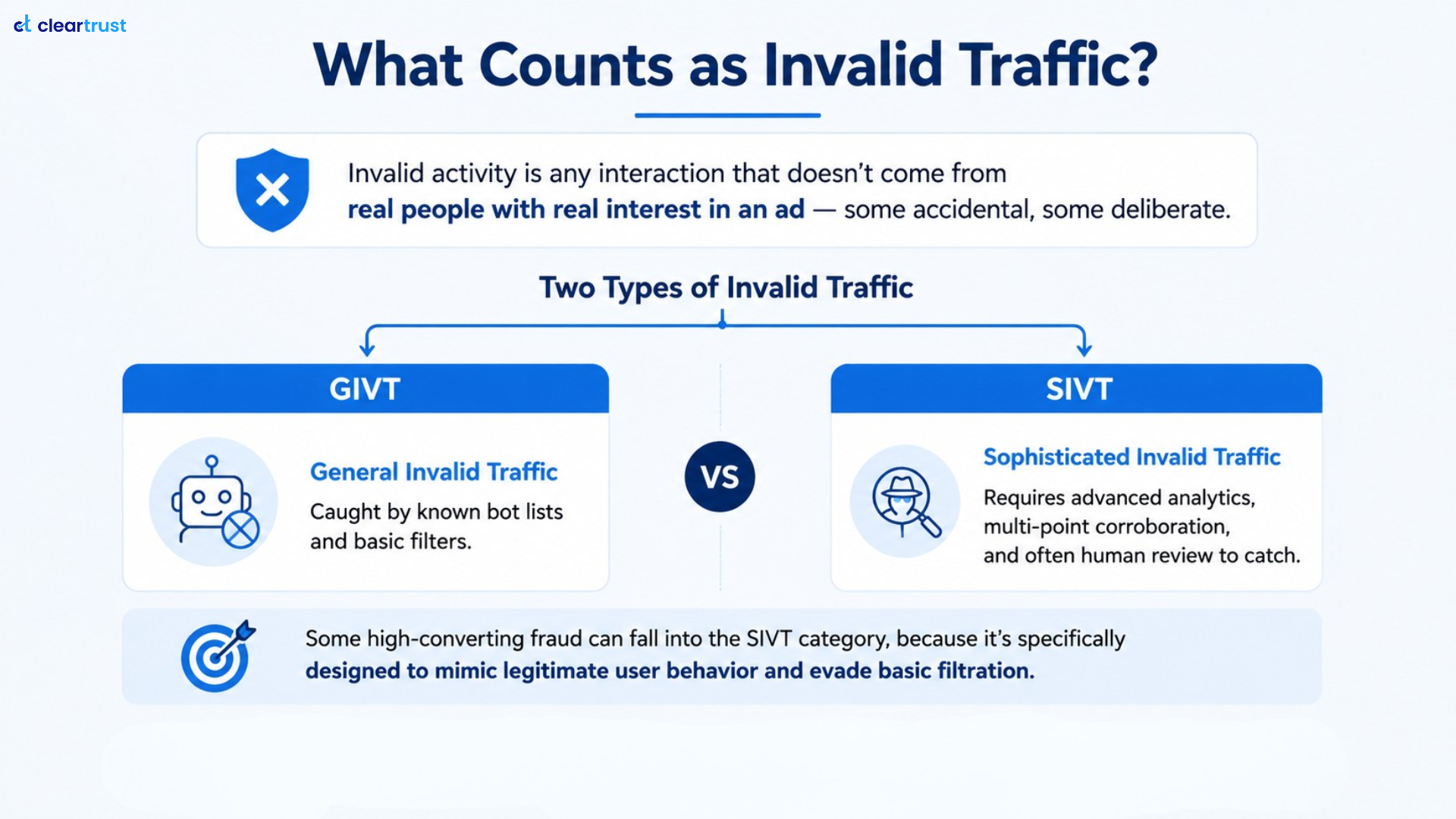
Per Google's Ad Traffic Quality team, invalid activity is any interaction that doesn't come from real people with real interest in an ad - some accidental, some deliberate. The Media Rating Council (MRC) and IAB split invalid traffic further: general invalid traffic (GIVT), caught by known bot lists and basic filters, and sophisticated invalid traffic (SIVT), which requires advanced analytics, multi-point corroboration, and often human review to catch. Some high-converting fraud can fall into the SIVT category, because it's specifically designed to mimic legitimate user behavior and evade basic filtration. For a full breakdown, see our deep dive on Sophisticated Invalid Traffic and our Invalid Traffic glossary.
How Fraud Fakes a Conversion, Not Just a Click
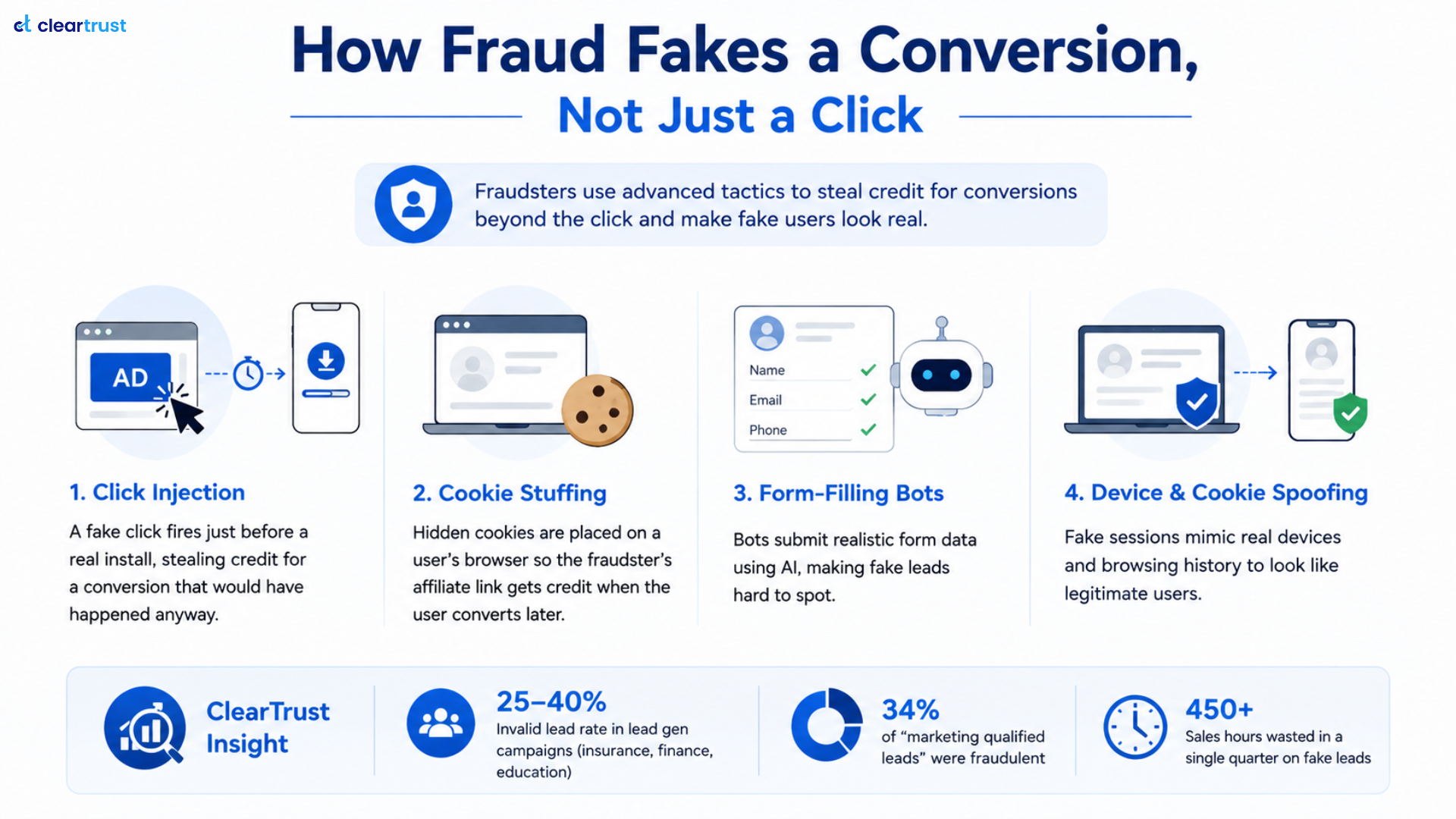
Click fraud remains a major problem, but it is only one layer of the broader fraud landscape. More sophisticated schemes can extend beyond the click into the conversion funnel.
Click injection. A fake click fires milliseconds before a real, organic app install completes - stealing attribution credit for a conversion that would have happened anyway. It shows up as a legitimate install in your reporting.
Cookie stuffing. Fraudsters drop tracking cookies on a user's browser without their knowledge, so when that user later converts organically, the fraudster's link - often within an affiliate network - gets the credit and the commission instead of the source that actually earned it.
Form-filling bots. These increasingly avoid obvious garbage data. Automated systems, increasingly assisted by generative AI, can produce realistic names, plausible email formats, and passable answers to qualifying questions, making simple validation checks less reliable. This is particularly important in lead generation, where a form submission is often the entire conversion event a campaign is judged on.
Device and cookie spoofing. Fraudsters simulate real devices and browsing histories so a fake session looks, technically, like a returning or engaged user.
None of these show up as an obvious anomaly. They're designed to look like your best traffic.
ClearTrust Insight: In ClearTrust's internal analysis across more than 1 billion daily sessions spanning 100+ brands, lead gen campaigns consistently show the highest fraud concentration - with invalid lead rates of 25–40% in verticals like insurance, finance, and education. In one client case, 34% of "marketing qualified leads" were later identified as fraudulent through session-level review, after the sales team had already spent 450+ hours in a single quarter pursuing leads that could never convert.
Why Your Best Metrics Reward This
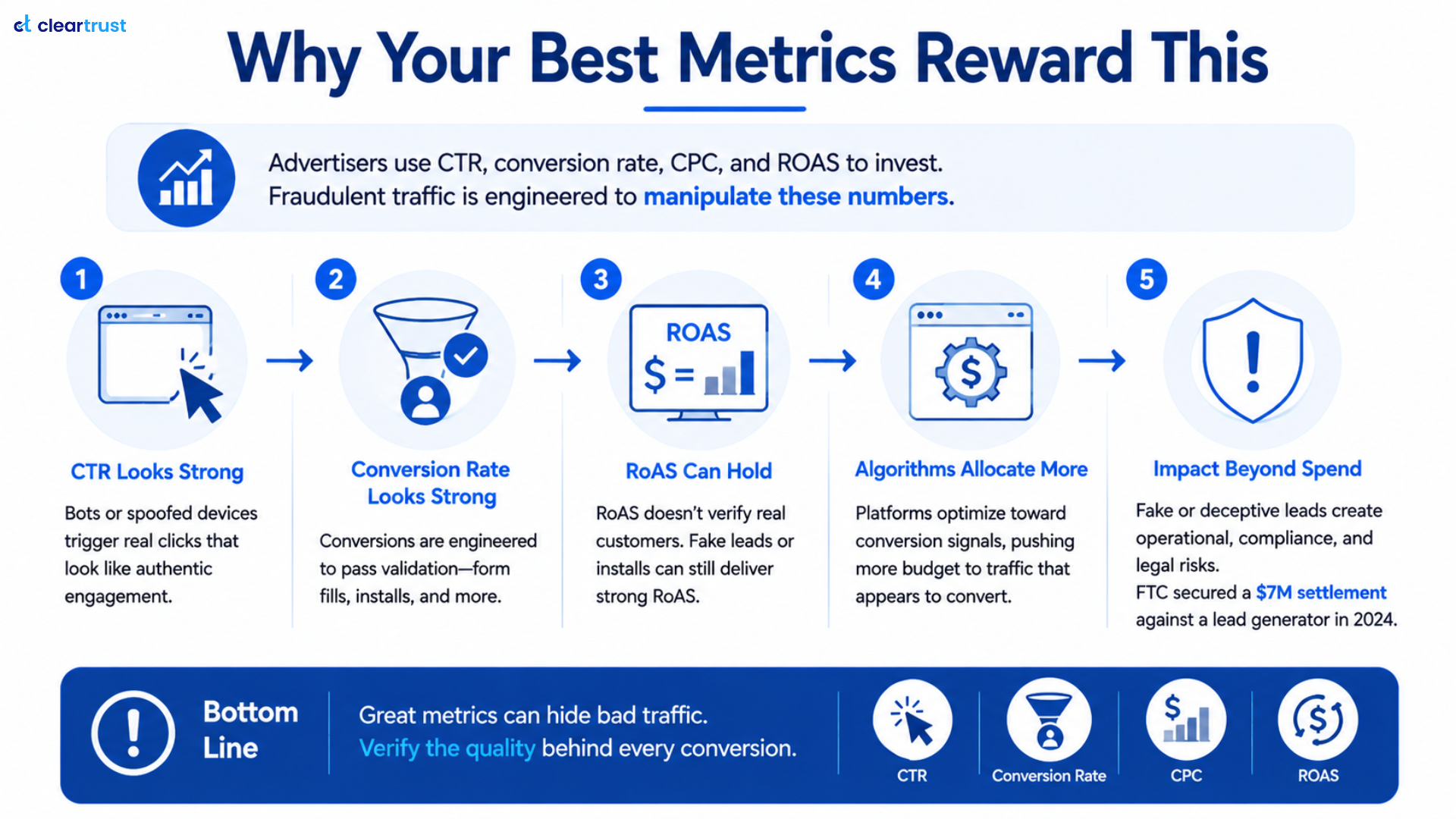
CTR, conversion rate, CPC, and ROAS measure different stages of campaign performance. But advertisers often use these metrics together to decide which traffic sources deserve more budget - which is exactly why fraudulent traffic is valuable when it can manipulate them. For performance marketing teams, this creates a difficult problem: the numbers that normally justify scaling a campaign are the same numbers fraud is engineered to satisfy.
- CTR looks strong because the click is real - a bot or spoofed device genuinely triggers the click event, so the metric registers as authentic engagement.
- Conversion rate looks strong because the "conversion" is engineered to pass validation - form fills, install events, and other completion triggers are built specifically to clear the same checks a real user would.
- RoAS can hold even when the underlying conversion isn't real business value. RoAS measures revenue against spend, but it doesn't verify that the tracked "conversion" - a lead, a signup, an install represents an actual customer. A campaign can report strong RoAS while the conversion events behind it are fake leads or fraudulent installs that never translate into revenue. A conversion event confirms that an action was recorded; it doesn't necessarily confirm the authenticity of the user behind it.
- When advertising platforms use conversion events as optimization signals, fraudulent conversions can influence automated budget allocation toward the traffic sources generating those events. The result can be a feedback loop: more budget flows toward traffic that appears to convert, even when the underlying users or leads provide little genuine business value.
- The impact can extend beyond wasted media spend. In lead-generation campaigns specifically, fraudulent or misleading submissions can also create operational and compliance concerns when sales teams process inaccurate or improperly sourced contact data. Fake and deceptively collected leads have already drawn direct FTC enforcement - in a 2024 case, the FTC secured a $7 million settlement against lead generator Response Tree LLCfor operating "consent farm" websites that collected and sold leads without proper consumer consent, in violation of the Telemarketing Sales Rule.
Signs of Fraudulent Traffic in High-Performing Campaigns
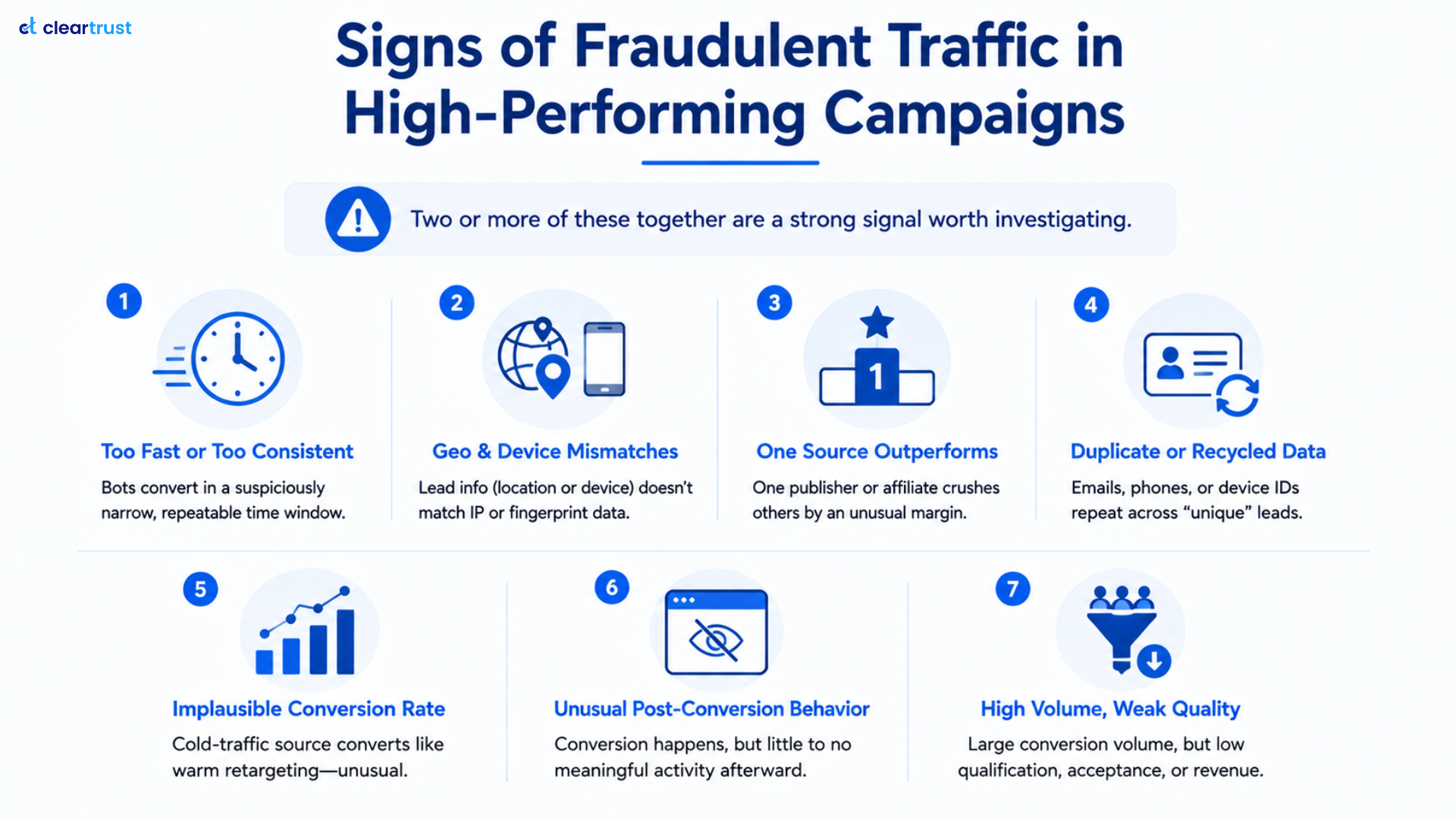
Two or more of these together are a strong signal worth investigating:
- Conversion timing is too consistent or too fast. Real users take variable time to convert. Bots often complete a funnel in a suspiciously narrow, repeatable window.
- Geo and device mismatches. A lead claims to be a specific city or device type, but IP and technical fingerprint data disagree.
- One publisher or affiliate outperforms everyone else. A single source driving unusually strong conversion numbers relative to the rest of your campaign deserves a closer look, not a bigger budget.
- Duplicate or recycled contact data. Emails, phone numbers, or device IDs repeating across "unique" conversions.
- Conversion rate is statistically implausible for the channel. If a cold-traffic source is converting like a warm retargeting list, something upstream is off.
- Unusual post-conversion behavior. A conversion happens, but the user shows little or no meaningful activity afterward.
- High conversion volume with weak downstream quality. A source generates large numbers of conversions, but those leads have unusually low qualification rates, sales acceptance, retention, or revenue.
Detection Requires Continuous Monitoring, Not a One-Time Check
Pre-bid filtering can help prevent known or identifiable sources of invalid traffic from entering the auction in the first place. It's necessary - but it can't provide complete visibility into everything that happens after an impression is served. Post-bid and session-level analysis add another layer of visibility, evaluating behavior, device signals, conversion patterns, and other indicators over time rather than at a single point. Website traffic should be evaluated not only by volume and conversion rate, but by the quality and behavior behind those outcomes.
Tracking sessions, conversions, and engagement data accurately in the first place is the foundation this kind of scoring builds on - fraud detection is only as good as the underlying measurement it's checking.
How ClearTrust Catches Fraud That Passes Every Other Check
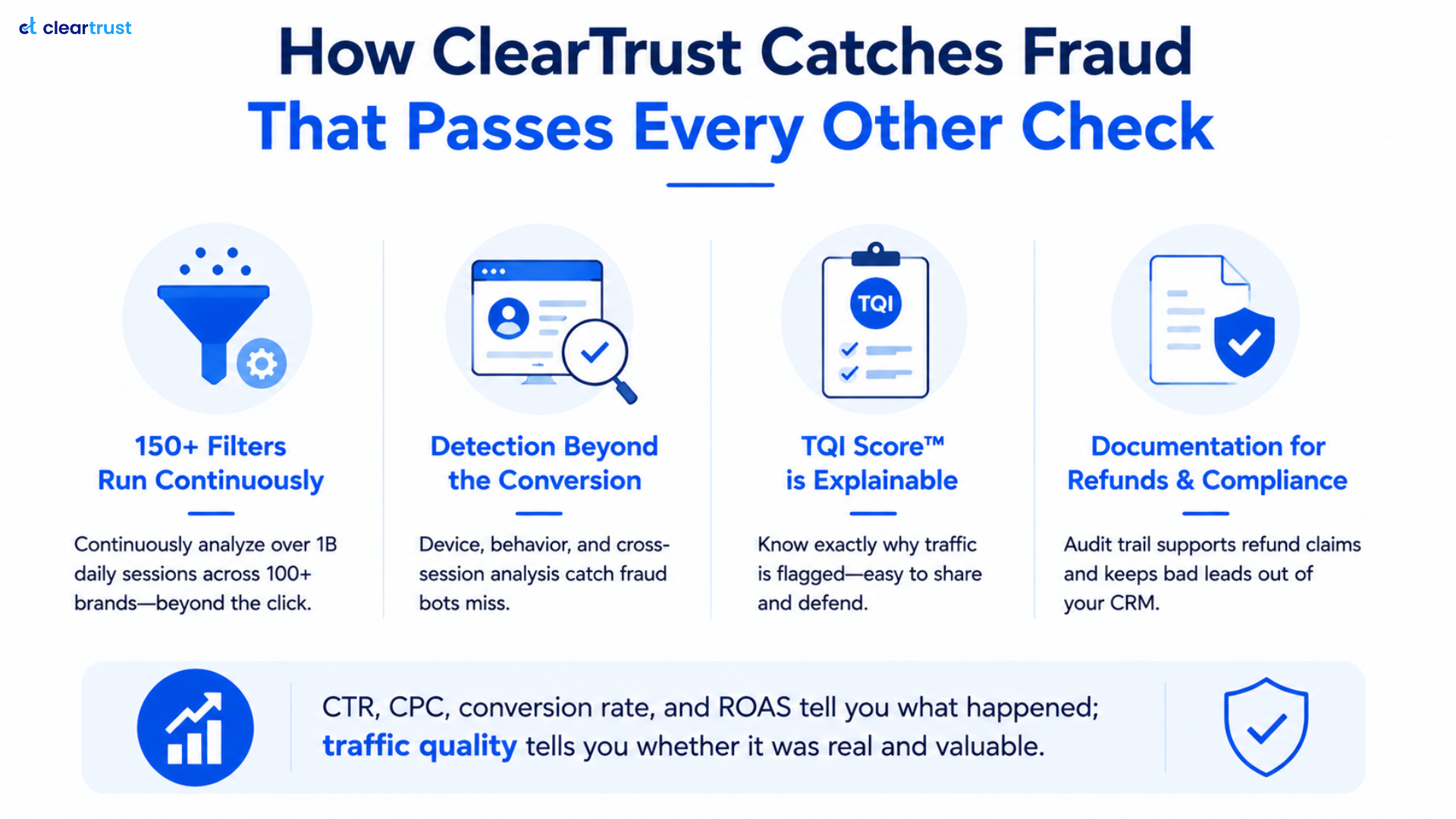
High-converting fraud is built to survive a single checkpoint. That's exactly why a single checkpoint isn't enough.
- 150+ filters run continuously, not just at click or bid - evaluating over 1 billion daily sessions across 100+ brands through the full session, not a single point in time.
- Detection extends past the conversion event itself - device fingerprinting, behavioral consistency checks, and cross-session pattern analysis flag traffic that technically completed a form or install but doesn't behave like a real customer around it.
- TQI Score™ is explainable, not a black box - your team sees why a session was flagged, making it possible to defend fraud disputes to sales, finance, or a publisher partner.
- Documentation supports refund claims and compliance - for lead gen specifically, that audit trail backs claims with ad platforms and helps keep fraudulent leads out of your CRM before they create downstream compliance exposure.
A campaign that looks like it's working isn't the same as one that is working. High-converting traffic deserves the same scrutiny as a suspicious traffic spike - sometimes more. CTR, CPC, conversion rate, and ROAS tell you what happened; traffic quality helps you understand whether the activity behind those numbers was genuine and valuable.
Run your own numbers through ClearTrust's Lead Fraud ROI Calculator to see what invalid conversions may already be costing you, or explore how TQI Score™ evaluates traffic quality across your full funnel - not just the click.
FAQs
Why do fraudulent leads convert so well? Because they're engineered to. Fraudsters study what a real conversion looks like - timing, form data, device behavior and reverse-engineer traffic to match it. The goal isn't volume, it's passing your validation checks.
How can you detect fake conversions in ad campaigns? Look beyond the conversion event itself. Compare conversion timing, geo and device data, duplicate contact information, source-level performance, post-conversion behavior, and downstream lead quality. No single signal proves fraud; clusters of anomalies are more meaningful.
Can bots pass conversion tracking? Yes. Sophisticated bots can complete forms, trigger install events, and simulate the technical signals platforms use to confirm a conversion. Standard conversion tracking wasn't built to distinguish a real outcome from a well-simulated one.
Why doesn't high RoAS mean clean traffic? RoAS measures revenue against spend - it doesn't verify that the tracked conversion behind that revenue was a real customer. A fake lead or fraudulent install can still register as a "conversion" that never produces genuine business value.
How can bots generate fake leads and app installs? Form-filling bots use automation (increasingly GenAI-assisted) to generate plausible names, emails, and answers. App install fraud typically relies on click injection or click flooding to claim credit for installs that were going to happen anyway, or occasionally to trigger fake ones outright.
What is conversion fraud? Conversion fraud occurs when an invalid or manipulated interaction is recorded as a legitimate conversion - a form fill, purchase, app install, or lead - so it appears in reporting as a legitimate outcome when no real customer action occurred.
How can you tell if a conversion is fraudulent? No single signal proves fraud on its own. Look for a cluster of indicators together: unnatural timing consistency, mismatched geo/device data, duplicate contact information, weak downstream lead quality, or one traffic source dramatically outperforming the rest of a campaign.
Can fraudulent conversions affect ad platform optimization? Yes. Most ad platforms automatically shift budget toward whatever appears to convert best. When fraudulent conversions are counted alongside real ones, platforms optimize toward more of the fraudulent traffic reinforcing the problem rather than correcting it.
Can high-CTR traffic still be fraudulent? Yes. A high CTR only tells you that clicks are occurring; it doesn't establish that those clicks came from genuine users or that the resulting conversions represent real business value. Traffic quality requires additional behavioral, device, source, and conversion-level signals.