Your affiliate program's dashboard is glowing. ROAS is up. Commissions are flowing. One partner is suddenly your best performer, and every instinct says: pour more budget into what's working.
That instinct can be exactly what fraudulent partners exploit.
One pattern is particularly easy to miss: fraudulent affiliate traffic rarely looks broken. It can look like the best-performing traffic in the account. Affiliate marketing fraud is often designed to avoid obvious alarms and pass the metrics advertisers use to evaluate and scale partners. That's what makes it dangerous, and why "why can affiliate ROAS look too good to be true" is a question more performance teams should be asking before they increase a payout, not after a quarter of wasted spend.
This isn't a reason to distrust affiliate marketing as a channel - affiliate spend continues to grow year over year as one of the most cost-efficient ways to acquire customers. It's a reason to look at how a strong result was produced before you reward it with more budget.
Why Affiliate Programs Are Uniquely Exposed
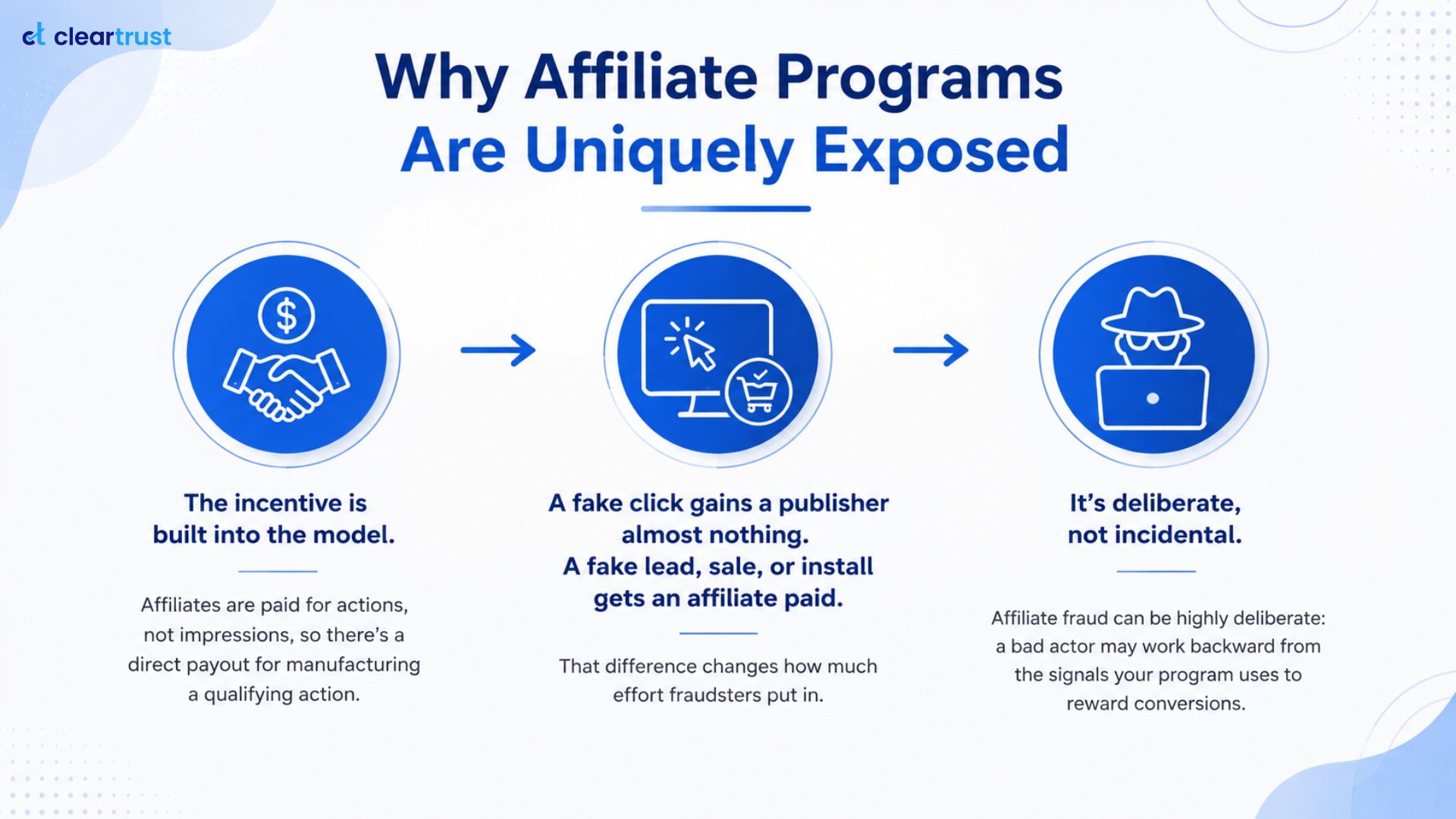
Most ad fraud has to work around a metric. Affiliate fraud gets to work with one - commission.
- The incentive is built into the model. Affiliates are paid for actions, not impressions, so there's a direct payout for manufacturing a qualifying action.
- A fake click gains a publisher almost nothing. A fake lead, sale, or install gets an affiliate paid. That difference changes how much effort fraudsters put in.
- It's deliberate, not incidental. Affiliate fraud can be highly deliberate: a bad actor may work backward from the signals your affiliate program uses to reward conversions, rather than generating opportunistic noise on top of a campaign.
Why ROAS Alone Can't Catch This
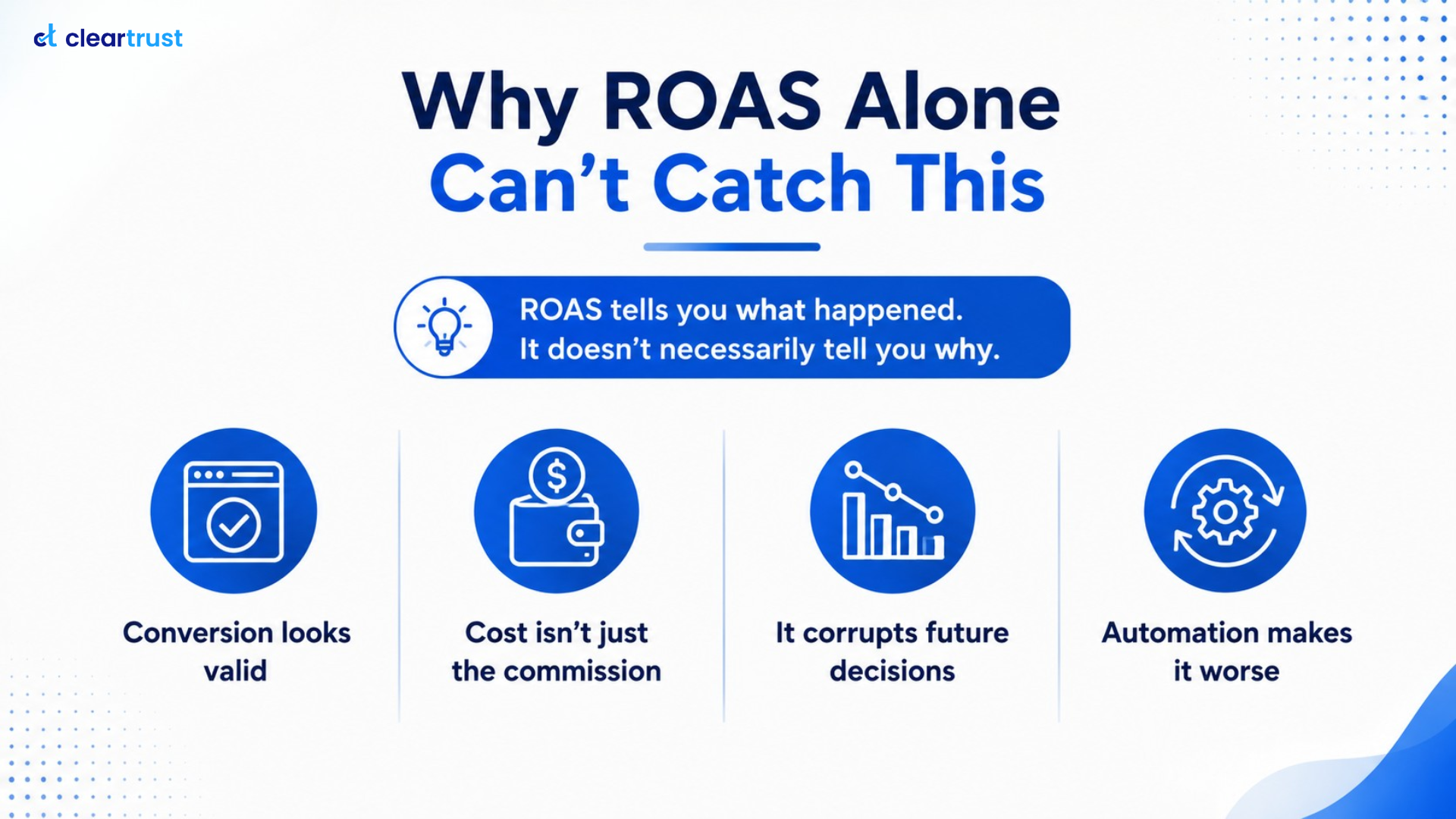
ROAS measures revenue generated against spend. It does not verify that the "conversion" behind that revenue came from a real customer with real intent. A fraudulent lead or a manipulated attribution event can register as a sale just as easily as a genuine one - at least until it unwinds.
ROAS tells you what happened. It doesn't necessarily tell you why it happened.
- The conversion looks valid because it can pass basic checks. A fraudulent lead or sale can pass the same basic tracking checks as a genuine one, especially when those checks focus only on whether a conversion event occurred.
- The cost isn't just the commission. Chargebacks, returns, and wasted sales follow-up all show up later, off the ROAS dashboard.
- It corrupts future decisions, not just this one. Once a fraudulent partner's data feeds your reporting, your team trusts a source it shouldn't.
- Automation makes it worse. If conversion data feeds automated bid or budget rules, fraud pulls more spend toward the fake source and away from affiliates actually driving your business.
7 Signs Your Affiliate Partners Are Sending Fraudulent Traffic
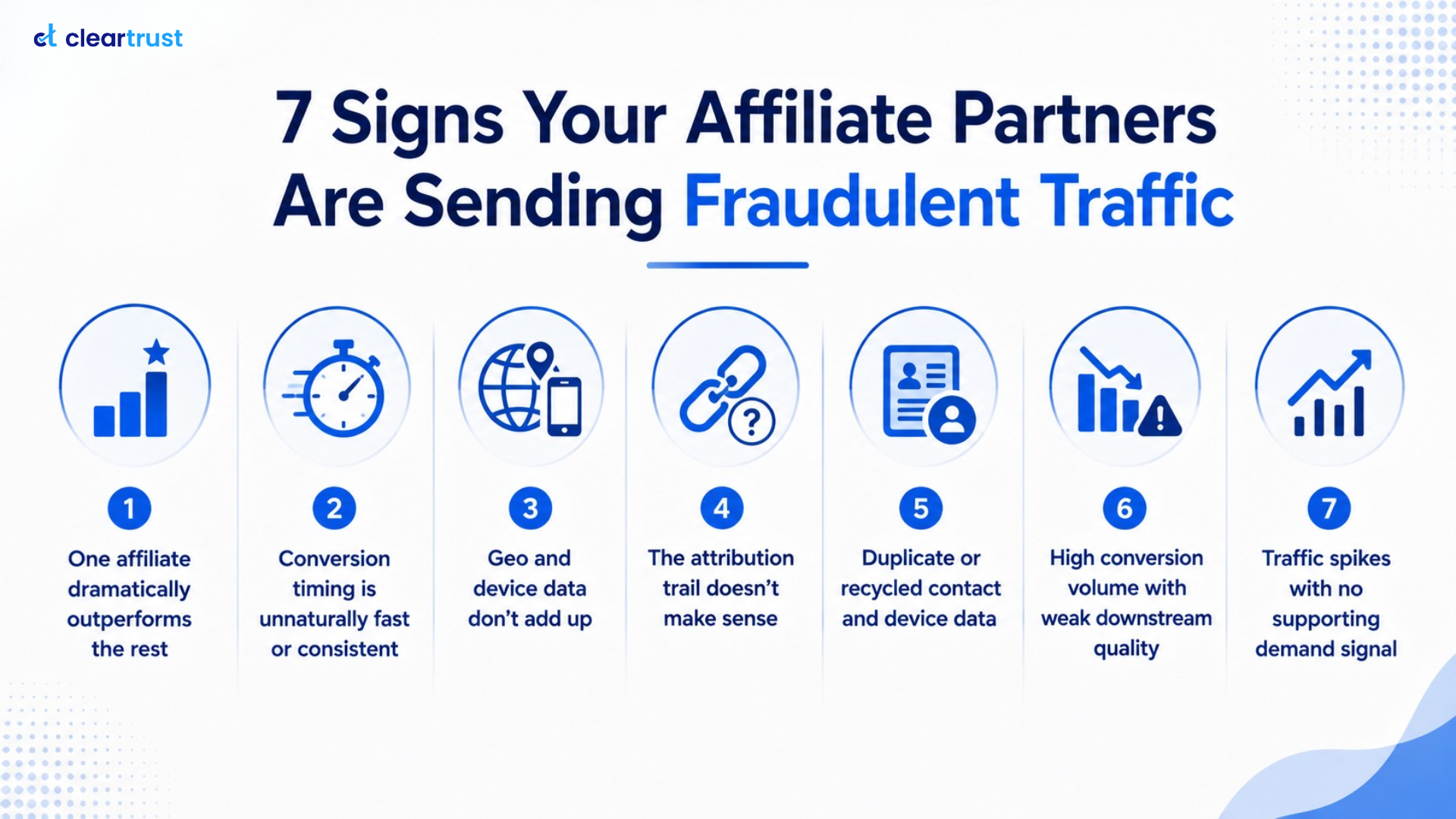
No single signal below proves fraud on its own. But when two or more show up together around the same affiliate, that's a strong reason to pause further scaling and dig into the traffic before increasing the payout or budget.
1. One affiliate dramatically outperforms the rest of your network. A single partner suddenly converting at two or three times the rate of everyone else deserves scrutiny before celebration. Real performance variance exists - a genuinely excellent affiliate can outperform the network - but an outlier this extreme is one of the clearest signals that an affiliate's traffic deserves closer investigation before you scale the budget, not automatic proof of bot traffic.
2. Conversion timing is unnaturally fast or consistent. Real users take a variable amount of time to browse, decide, and convert. When an affiliate's conversions complete in a tight, repeatable window - the same few seconds, every time - that level of consistency can be a signal of automation and warrants closer investigation.
3. Geo and device data don't add up. Traffic geography or device characteristics don't align with the audience or placements the affiliate reports. IP geolocation isn't perfect - VPNs, mobile networks, and shared IP ranges are all legitimate reasons for some mismatch - but learning how to check IP address data against a claimed location is still one of the simplest and most effective first checks in any affiliate traffic analysis, especially when mismatches cluster around one partner.
4. The attribution trail doesn't make sense. Watch for conversions credited to an affiliate interaction the customer doesn't remember, unusually short click-to-purchase windows across many "different" users, or a sudden rise in credited sales that isn't supported by the affiliate's content or audience. One possible explanation is cookie stuffing - dropping or setting an affiliate tracking cookie without a meaningful user interaction, so the affiliate receives credit for a conversion it didn't genuinely drive.
5. Duplicate or recycled contact and device data. Emails, phone numbers, IP ranges, or device IDs repeating across conversions that are supposed to be unique customers is one of the stronger signals to investigate in affiliate tracking data. Bots and click farms reuse infrastructure because building fresh identities at scale is expensive; real customer bases don't overlap this way as often.
6. High conversion volume with weak downstream quality. A conversion isn't necessarily a customer. An affiliate can drive strong top-line numbers while the resulting leads or sales show low retention, high return and chargeback rates, or get flagged as unqualified by sales. Commission fraud is frequently engineered to pass the initial conversion check and nothing beyond it - the fraud only becomes visible once you track what happens after the sale.
7. Traffic spikes with no supporting demand signal. A sudden jump in an affiliate's referred traffic that isn't matched by any corresponding lift in brand search volume, direct traffic, or social mentions can indicate that the reported increase isn't being driven by genuine audience demand. A spike can also be a legitimate new promotion or placement - the point is to check, not assume either way. Ongoing traffic monitoring across your affiliate links, not just a one-time audit, is what surfaces this kind of mismatch early enough to act on it.
Detection Is a Process, Not a One-Time Check
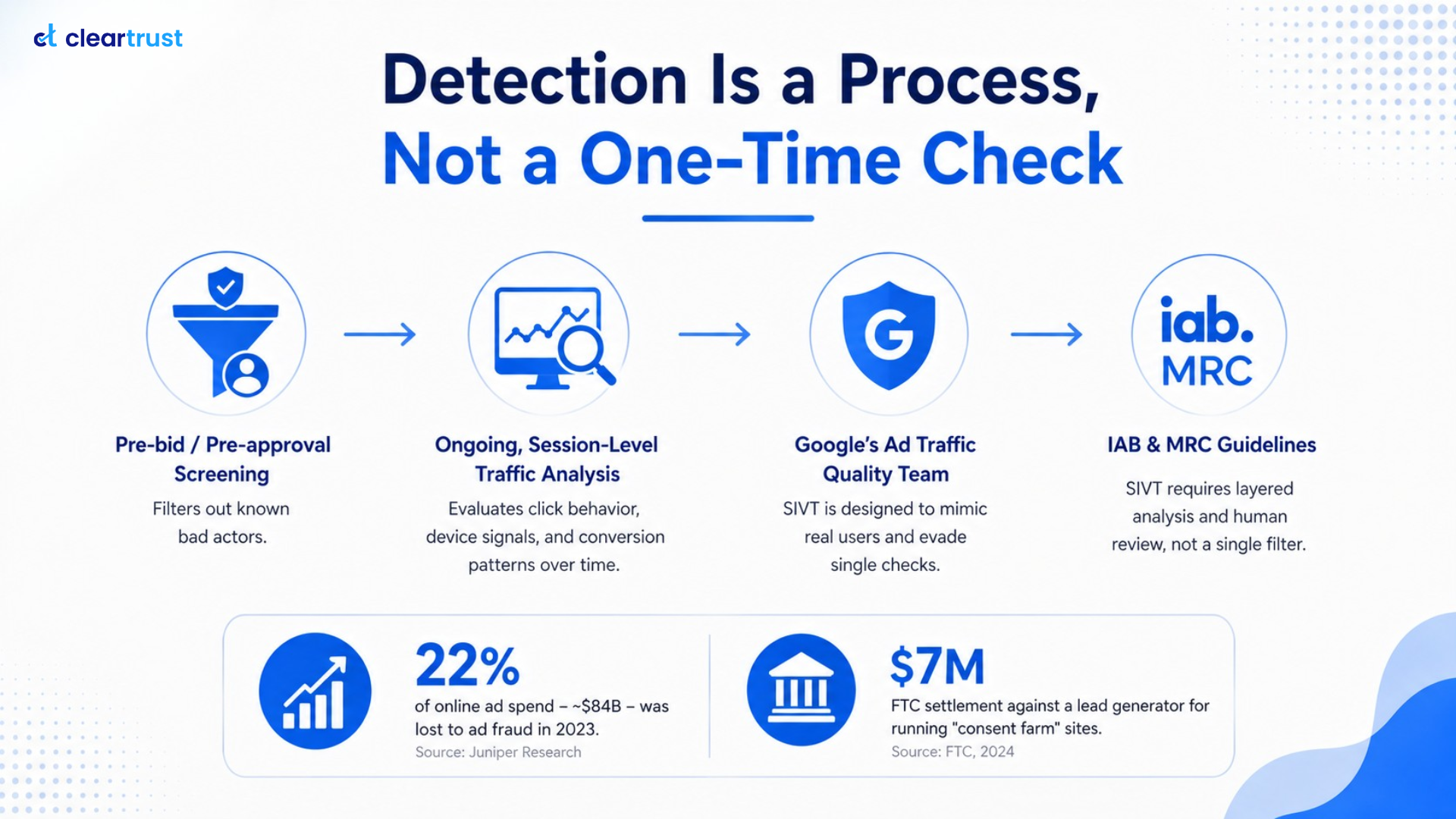
Affiliate fraud tactics evolve specifically to defeat whatever check catches them first, which is why traffic monitoring has to be continuous rather than a single audit at onboarding.
- Pre-bid or pre-approval screening filters out known bad actors - but it can't see what happens after a partner is live.
- Ongoing, session-level traffic analysis - evaluating click behavior, device signals, and conversion patterns over time - is what catches fraud specifically built to pass a single checkpoint.
- Google's Ad Traffic Quality team notes that invalid traffic spans everything from accidental clicks to deliberately fraudulent activity, with the most sophisticated end of that spectrum specifically designed to mimic real user behavior.
- The IAB and Media Rating Council's invalid traffic guidelines classify this harder-to-catch category as Sophisticated Invalid Traffic (SIVT) - traffic that requires layered analysis and human review, not a single filter, to identify.
The financial stakes back this up:
- Juniper Research's global ad fraud study estimated that 22% of online ad spend - roughly $84 billion was lost to ad fraud in 2023, highlighting the scale of the broader invalid-traffic problem affiliate programs are part of.
- In a 2024 enforcement action, the FTC secured a $7 million settlement against lead generator Response Tree LLCfor running "consent farm" sites that collected and sold leads without proper consumer consent - a reminder that fraudulent affiliate traffic can create compliance exposure well beyond a marketing budget line.
ClearTrust Insight: Looking beyond reported conversions and evaluating traffic at the session level can reveal quality differences that headline affiliate metrics don't show. ClearTrust applies this approach across 1B+ daily sessions spanning 100+ brands - evaluating device signals, behavioral consistency, and conversion patterns over time rather than at a single point.
How ClearTrust Helps Tackle Affiliate Fraud
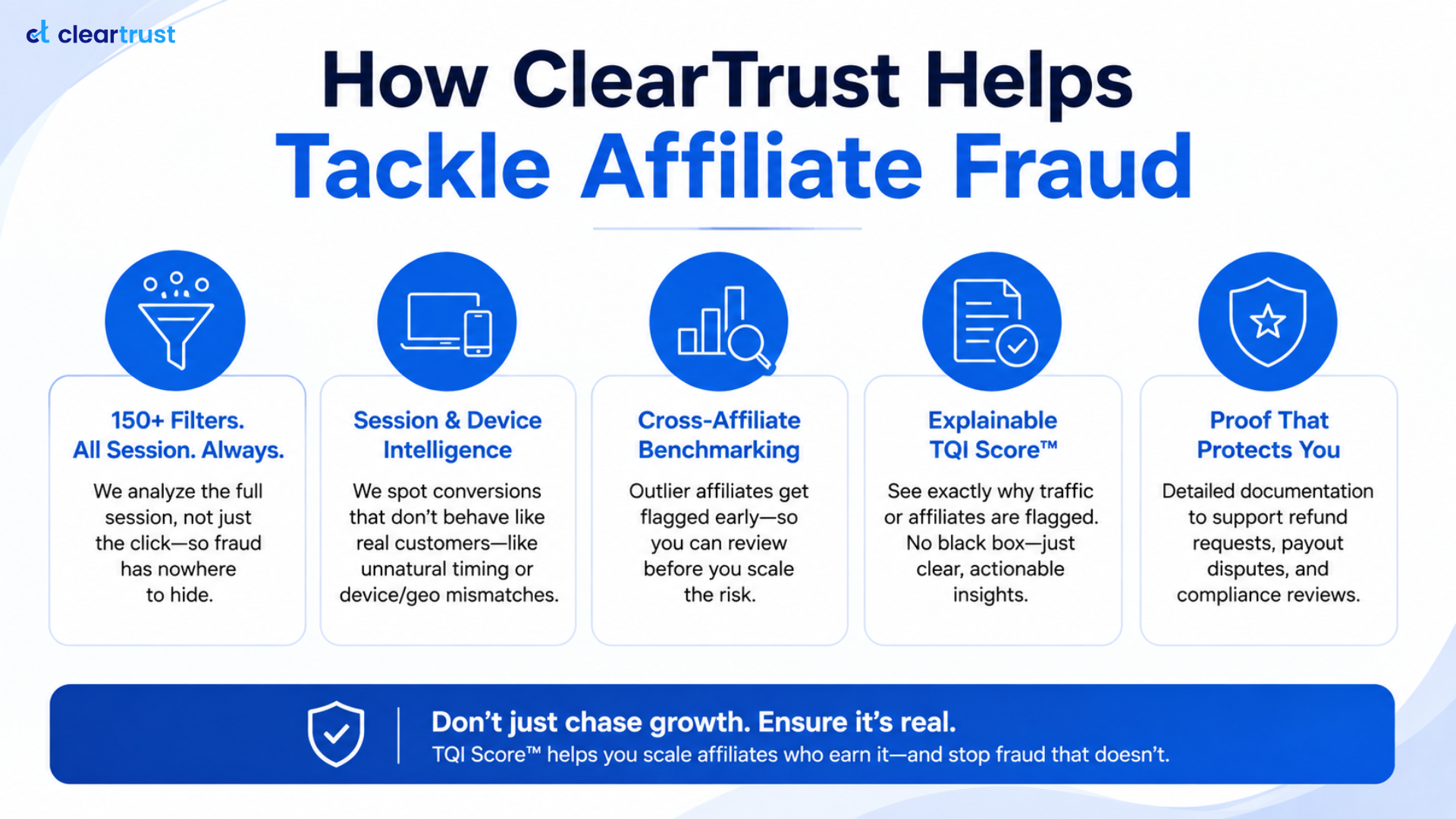
Fraud built to survive a single checkpoint needs more than a single checkpoint to catch it. That's the gap ClearTrust's TQI Score™ is built to close for affiliate programs specifically:
- 150+ filters run continuously across the full session - not just at click or bid - so an affiliate's traffic is evaluated on behavior over time, not a single event that's easy to fake.
- Session-level and device-signal analysis flags traffic that technically completed a conversion but doesn't behave like a real customer around it - the pattern behind signs like unnatural timing consistency and geo/device mismatches.
- Cross-affiliate benchmarking surfaces outlier partners automatically, so a single affiliate dramatically outperforming the rest of your network gets flagged for review before it gets a bigger budget.
- TQI Score™ is explainable, not a black box - your team sees why a session or an affiliate was flagged, which matters when you need to dispute a payout or defend a decision to a partner, finance, or leadership.
- Documentation can support refund discussions, payout disputes, and compliance reviews - for affiliate and lead gen programs, that audit trail helps keep fraudulent conversions out of your CRM and backs disputes with networks and partners.
The goal isn't to distrust every high-performing affiliate. It's to make sure the ones you scale earned it.
The Bottom Line
A strong ROAS number tells you a partner converted. It doesn't tell you who or what did the conversion. The affiliates worth scaling are the ones whose performance holds up when you look past the top-line metric: consistent, well-distributed traffic; conversions that behave like real customers; and results that don't depend on being taken at face value.
Treat an unusually strong-performing affiliate the way you'd treat a suspicious spike - as something to verify, not simply reward. Run your numbers through ClearTrust's Lead Fraud ROI Calculator to see what invalid affiliate traffic may already be costing you, or explore how TQI Score™ evaluates affiliate traffic quality across the full customer journey not just the click.
Check your affiliate traffic today - before you scale that budget.
FAQs
How do you detect affiliate fraud in ROAS reports? Look past the headline number. Compare conversion timing, geo and device consistency, duplicate contact data, and downstream customer quality across affiliates. A partner with strong ROAS but conversions clustered in narrow time windows or shared device fingerprints deserves closer review before you scale their budget.
What are the signs an affiliate partner is sending bot traffic? Key signs include conversion rates far above the rest of your network, unnaturally consistent conversion timing, and traffic spikes with no matching rise in brand search or direct visits. No single sign confirms fraud, but two or more together are worth investigating.
Why can affiliate ROAS look too good to be true? Because fraud is engineered to satisfy the exact metric you use to judge success. Fraudulent affiliates replicate real conversion timing, form data, and device behavior closely enough to pass standard checks, while producing no genuine business value behind the revenue.
How can you check IP address data for affiliate click fraud? Compare the IP address behind each conversion against the affiliate's claimed location, device type, and audience. Mismatched geography and repeated IP ranges across "unique" conversions are common indicators of click farm or bot-driven traffic.
What are common cookie stuffing signs in affiliate marketing programs? Watch for conversions credited to a link the customer doesn't recall clicking, unusually short click-to-purchase windows, and a sudden rise in credited sales that an affiliate's actual content or audience doesn't support.
Does high affiliate ROAS mean the traffic is legitimate? No. High ROAS only shows reported revenue is strong relative to cost. It doesn't verify traffic quality, user intent, or whether the affiliate genuinely caused the conversion that requires session-level analysis, not just the revenue number.
How can advertisers monitor affiliate traffic quality on an ongoing basis? Track conversion timing, device and geo consistency, duplicate contact data, and downstream customer quality continuously across every affiliate, not just at onboarding. Pre-approval screening alone can't catch fraud built specifically to pass a one-time check.