For most publishers, yield managers, and ad networks, the most stressful moment of the month happens between the 1st and the 2nd.
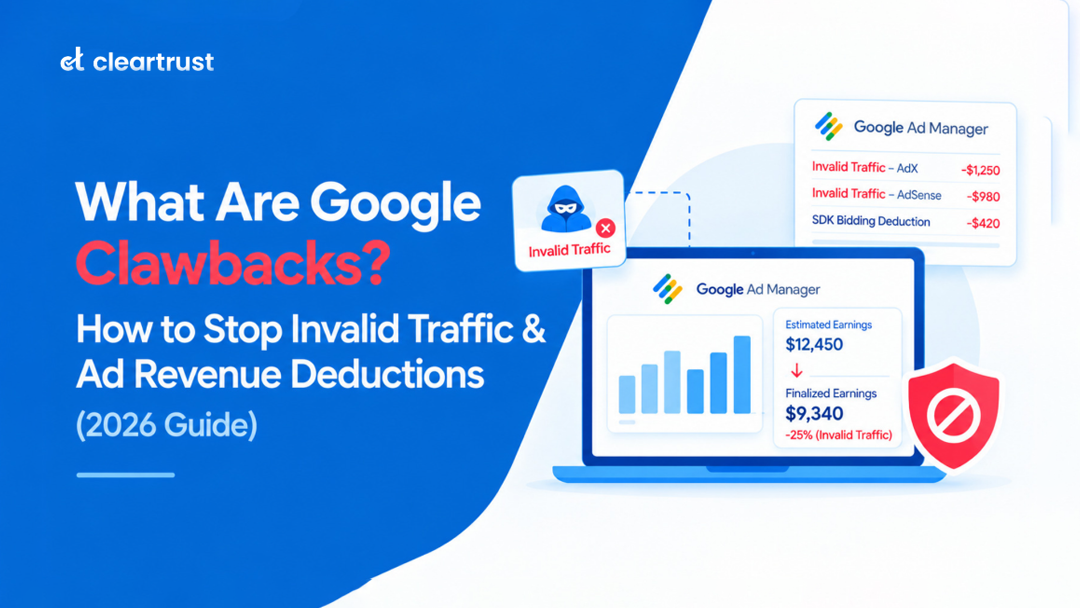
All month long, your Google Ad Manager (GAM) or Google AdSense dashboard displays healthy estimated earnings. Then month-end reconciliation finishes, your payment statement generates, and 10% to 30% of your ad revenue vanishes under a single line item: "Invalid Traffic." In programmatic advertising, these retroactive adjustments are known as Google clawbacks (or invalid traffic deductions).
With automated click fraud, residential proxy networks, and paid traffic arbitrage scaling rapidly in 2026, clawbacks are hitting publishers harder than ever. According to Google’s Ads Safety Report, Google restricted or blocked ads on more than 480 million publisher pages and took site-level enforcement action against over 245,000 publisher sites in a single year.
Here is a clear breakdown of how Google clawbacks work across Google Ad Manager, Ad Exchange (AdX), and Google AdSense, why invalid activity gets flagged weeks after an ad serves, and how to stop bad sessions before they ever reach your ad server.
What Are Google Clawbacks (Invalid Traffic Deductions)?
A Google clawback occurs when Google’s Ad Traffic Quality systems retroactively audit a publisher’s impressions and clicks, determine that a portion of that traffic violated Google’s Invalid Traffic (IVT) policy, and deduct those earnings at month-end to refund every affected Google advertiser.
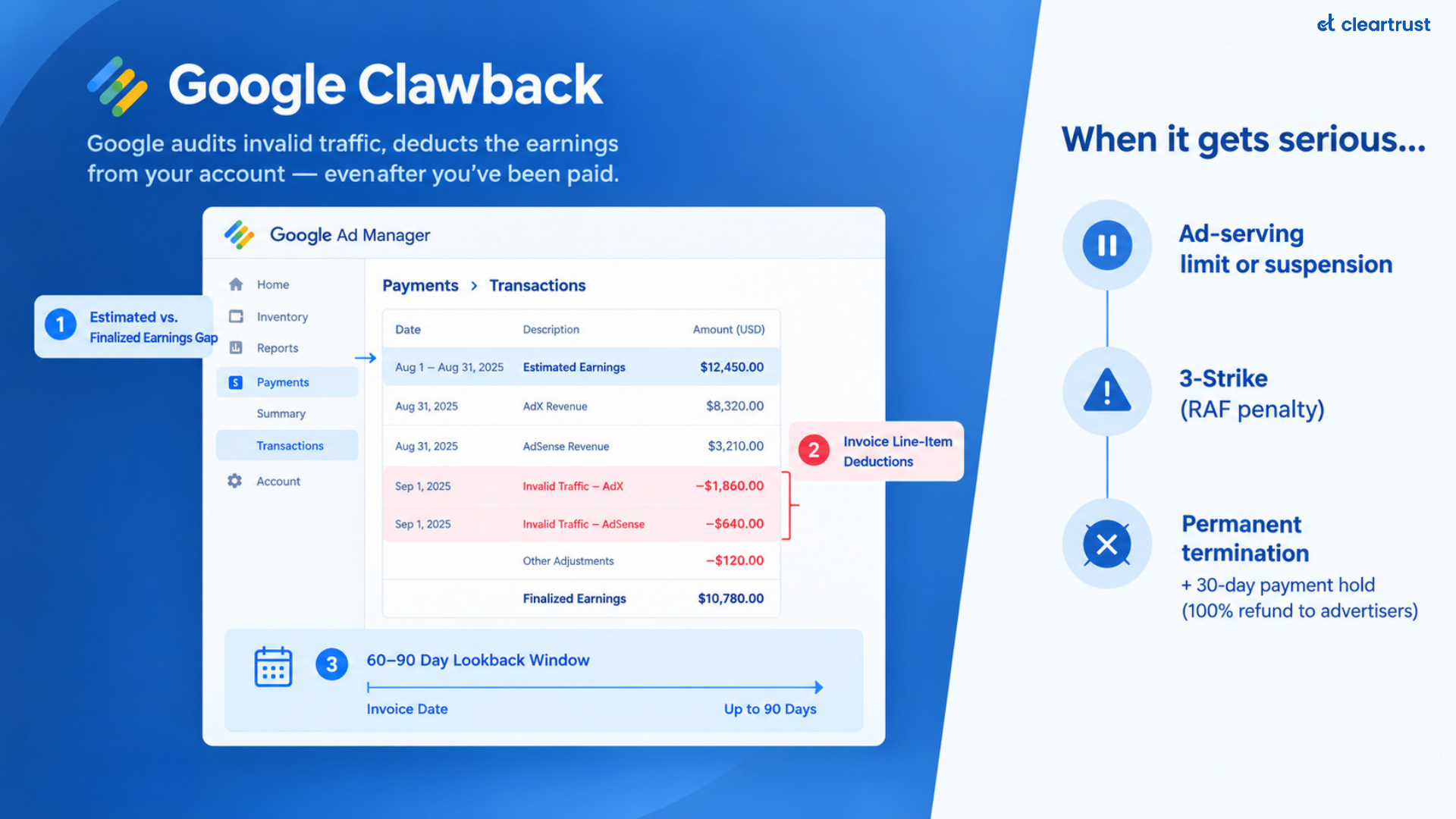
Inside your Google Ad Manager (GAM) or Google AdSense account, these deductions show up in three ways:
- The Estimated vs. Finalized Earnings Gap: According to Google Ad Manager’s official guide on Estimated vs. Finalized Earnings, Google displays preliminary earnings throughout the month. Between the last day of the month and the 2nd of the following month, Google runs deeper invalid traffic audits before posting Finalized Earnings.
- Invoice Line-Item Deductions: Under Payments > Transactions, you will see negative adjustments labeled "Invalid Traffic – AdX", "Invalid Traffic – AdSense", or third-party SDK bidding deductions as outlined in the Google Ad Manager Payment Guide.
- The 60-to-90-Day Lookback Window (Post-Payout Clawbacks): Many publishers assume that once an invoice is paid, that revenue is safe. However, under Google’s terms, Google can claw back earnings for invalid traffic detected up to 60 to 90 days after the invoice date - even after a payout has already hit your bank account, resulting in a negative carry-forward balance on your next statement.
When invalid traffic crosses Google’s internal risk thresholds, the penalty goes far beyond a partial revenue deduction. Google can place your account under a 30-day ad-serving limit or suspension, trigger a Ratio Actionable Framework (RAF) 3-Strike penalty, or permanently terminate the account with a 30-day payment hold - refunding 100% of your unpaid advertising balance back to advertisers. Beyond losing last month’s payout, repeated clawbacks also hurt future buyer demand: programmatic supply-rating platforms (such as Pixalate’s Media Ratings Terminal across 17.5M+ properties) now flag domains and apps with a rolling 12-month history of buyer clawbacks, causing DSPs to bid-shade or exclude your inventory.
Why Does Google Deduct Ad Revenue Weeks After the Impression Served?
The most common question AdOps teams ask is simple: "If Google has real-time filters, why did it let the ad serve on the 10th of the month and deduct my ad revenue on the 2nd of next month?"
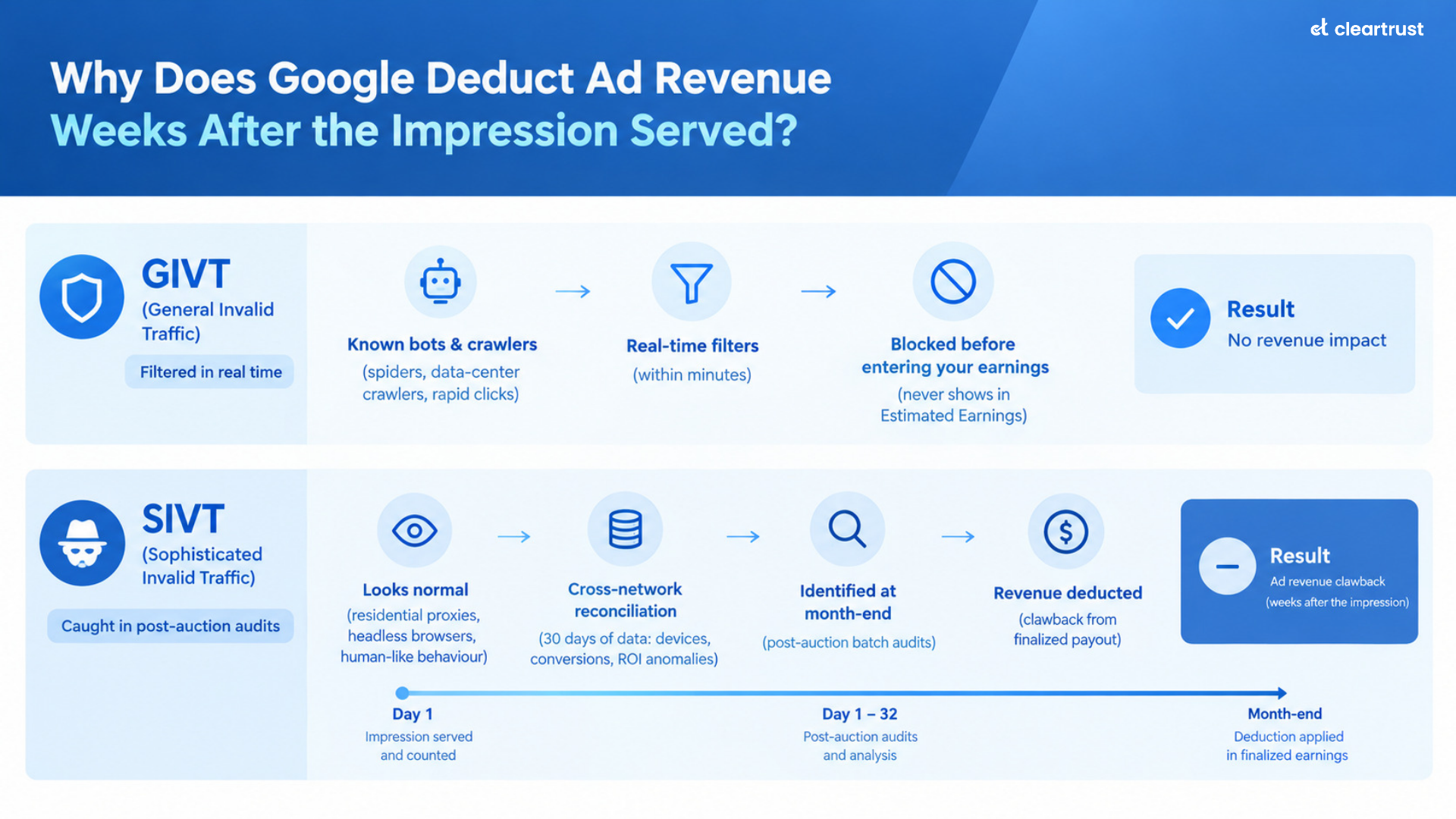
The answer comes down to how ad platforms separate General Invalid Traffic (GIVT) from Sophisticated Invalid Traffic (SIVT) under MRC and IAB Invalid Traffic Detection Guidelines:
- Real-Time Filtering Catches GIVT (Within Minutes): Basic spiders, known data-center crawlers, and obvious rapid double-clicks on CPC or display ads are filtered out in real time. These never enter your Estimated Earnings.
- Post-Auction Batch Audits Catch SIVT (Triggers Month-End Clawbacks): Modern SIVT uses residential proxies, headless browsers, and human-like mouse movements. A single pageview looks completely normal in isolation.
- Cross-Network Reconciliation: When Google’s Ad Traffic Quality systems analyze 30 days of cross-network conversion data, device fingerprints, and advertiser ROI anomalies at the end of the month, they identify coordinated bot sessions retroactively.
Because the impression was already served and counted in your estimated dashboard, Google’s only way to make the advertiser whole is to claw back that amount from your finalized payout.
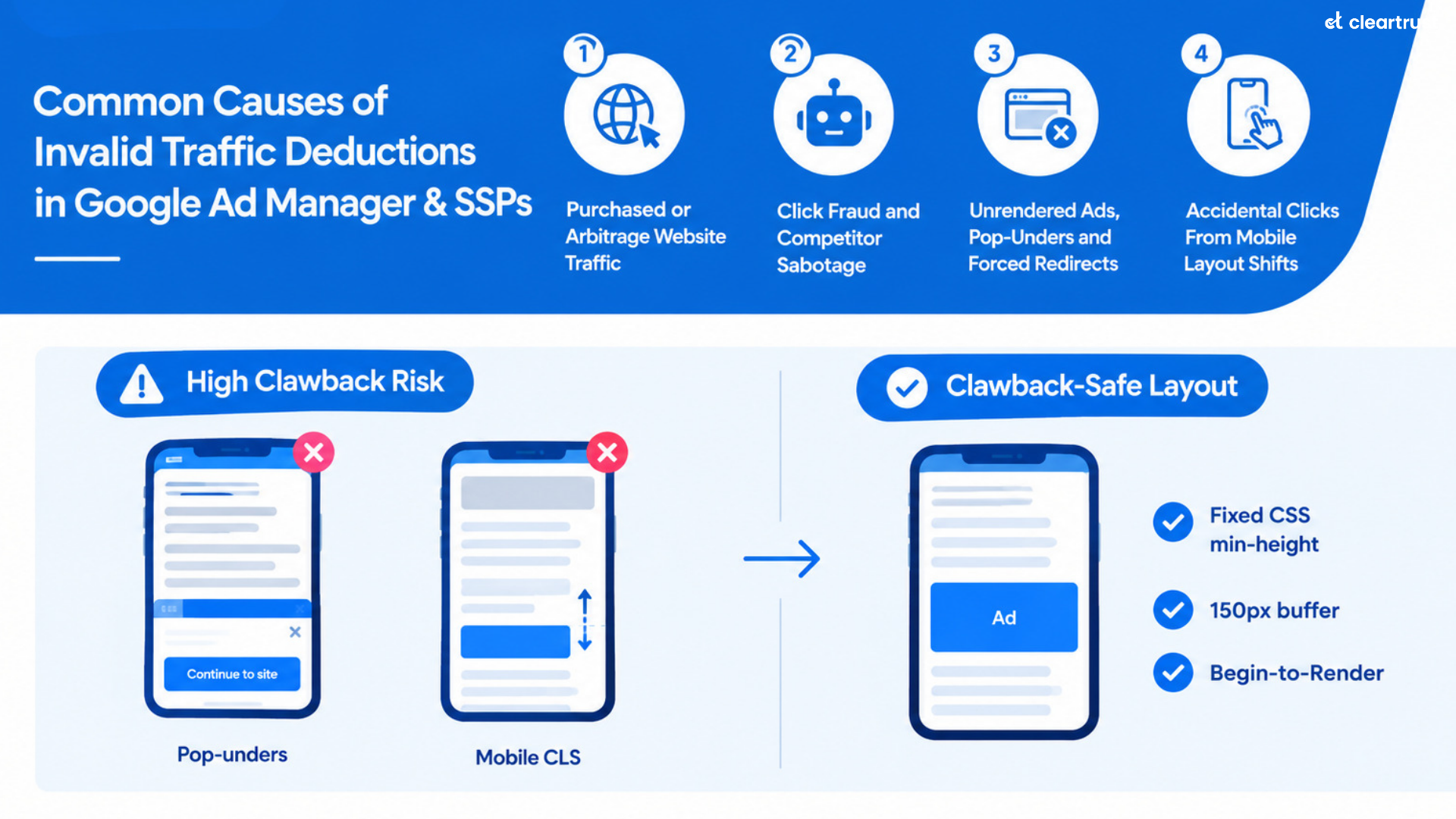
5 Common Causes of Invalid Traffic Deductions in Google Ad Manager & SSPs
According to Google Ad Manager’s official Invalid Traffic policy, almost all month-end clawbacks trace back to five specific traffic and layout issues:
1. Purchased or Arbitrage Website Traffic
In its official documentation on Preventing Invalid Traffic, Google explicitly warns that publishers buying website traffic from third-party networks, native widgets, or paid social campaigns face the highest deduction rates. Even when you buy paid social or search traffic in good faith, low-quality sub-networks frequently mix in headless bots and click farms to hit their traffic delivery targets.
2. Click Fraud and Competitor Sabotage
Bad actors or automated bots sometimes repeatedly load a publisher's site and click on cost-per-click (CPC) or high-CPM display units to drain advertiser budgets or trigger publisher penalties. In its policy on Sabotage and How to Prevent It, Google states clearly: "Ultimately it is the publisher’s responsibility to ensure that the activity on their ads is valid."
3. Unrendered Ads, Pop-Unders, and Forced Redirects
When an ad network or publisher monetizes traffic from pop-unders, auto-refreshing hidden iframes, or heavy pages where users bounce before ads load, clawbacks spike. This is becoming even stricter: Google confirmed that on February 17, 2027, Google Ad Manager and AdSense are moving display impression counting from Count-on-Download to Begin-to-Render (BTR), matching buy-side billing standards across DV360 and CM360. Fast-bouncing bot traffic that leaves before an ad begins rendering will no longer count as a billable impression.
4. Accidental Clicks From Mobile Layout Shifts
Cumulative Layout Shift (CLS), sticky ads placed too close to navigation buttons, or ads styled to look like site menus cause real users to click by mistake. Google’s post-click algorithms measure landing-page dwell time. When users click an ad and immediately hit the "Back" button in under two seconds, Google flags the clicks as invalid and deducts the resulting ad earnings.
5. Unscreened Child Publishers in MCM & SSP Networks
If you operate an ad network, SSP, or Multiple Customer Management (MCM) parent account, you inherit the risk of your supply partners. A single child publisher sending spoofed search arbitrage (RSOC/AFD) or display traffic can trigger clawbacks across your entire parent Google Ad Manager account. (See our related guide: IVT in Ad Networks and SSPs: When Billable Engagement Isn’t Genuine.)
Diagnostic Guide: Matching Your Deduction Symptom to the Root Fix
Use this symptom-to-fix breakdown to quickly identify what is driving your month-end Google Ad Manager or AdSense deductions:
Symptom 1: 10%–30% Drop Between Estimated & Finalized Earnings on the 2nd
- Most Likely IVT Source: Sophisticated Invalid Traffic (SIVT) from paid social, native widgets, or traffic arbitrage.
- Why Google Flags It Post-Auction: Bots mimic human pageviews initially, but fail month-end conversion and session-depth audits.
- How to Fix It Immediately: Gate Google Publisher Tags (GPT) behind a real-time pre-bid IVT check so bots never call the ad server.
Symptom 2: Sudden CTR Spike (>5%) + "Ad Serving Limit" Warning
- Most Likely IVT Source: Click fraud, sabotage bots, or accidental mobile clicks from layout shift (CLS).
- Why Google Flags It Post-Auction: High click volume with near-zero dwell time (<2 seconds) on the advertiser landing page.
- How to Fix It Immediately: Add a 150px buffer around mobile ads, lock CSS slot heights, and suppress ad tags on suspicious sessions.
Symptom 3: Deductions Isolated to Specific MCM Child Domains or UTM Campaigns
- Most Likely IVT Source: Sub-affiliate traffic laundering or residential proxy bots.
- Why Google Flags It Post-Auction: Residential IPs pass basic firewall checks but fail browser and device integrity telemetry.
- How to Fix It Immediately: Score every incoming session by UTM, publisher ID, and placement using 150+ behavioral and device filters.
Symptom 4: High Ad Requests vs. Low Rendered Impressions
- Most Likely IVT Source: Fast-bouncing scrapers, hidden slots, or heavy lazy-loading.
- Why Google Flags It Post-Auction: Fails Begin-to-Render (BTR) and Active View viewability standards.
- How to Fix It Immediately: Block automated scrapers pre-impression and remove unrendered off-screen placements.
How to Audit a Google Clawback Inside GAM & GA4 (3-Step Forensics)
Before you can stop future deductions, you need to isolate which traffic slice triggered the clawback:
- Compare Estimated vs. Billed Impressions by Child Publisher & Ad Unit: In Google Ad Manager, pull a historical report comparing Total Code Served Count and Total Impressions against your month-end invoice. Look for specific ad units or MCM child domains with disproportionate deduction ratios.
- Inspect the GAM Policy Center & Ad Experience Report: Check Admin > Policy Center in GAM or AdSense to see if specific URLs are flagged for invalid activity, forced redirects, abusive experiences, or a Google Confirmed Click penalty (which forces users to click twice to visit an advertiser landing page and severely depresses CTR). Also note that Invalid Traffic – AdX/AdSense deductions on a current invoice can reflect delayed reconciliation from the prior billing month.
- Cross-Reference GA4 Traffic Sources With GAM Ad Requests: In Google Analytics 4 (GA4), segment traffic by sessionSourceMedium, campaign, and country. Any paid or referral source with a 90%+ bounce rate, <5-second average engagement time, or an abnormally high ad-request-to-pageview ratio is a primary clawback culprit.
A 5-Step Checklist to Prevent Invalid Traffic Deductions Before Ads Serve
Once Google deducts your revenue at the end of the month, you cannot appeal the deduction. The only permanent solution is to stop invalid traffic before your Google Publisher Tag (GPT) or AdSense script fires an ad request.
- Gate All Paid and Arbitrage Traffic Before Firing Ad Tags: Never send paid social, native, or search arbitrage traffic straight to unprotected ad units. Run a real-time JavaScript pixel verification check first, and dynamically suppress the ad call whenever a bot or proxy is detected.
- Track Invalid Traffic by UTM Source and Sub-ID: Standard analytics tools count pageviews, not bot telemetry. Evaluate publisher and source traffic quality by UTM campaign, referral source, and child publisher ID so you can pause bad sources in hours rather than waiting 30 days for Google’s invoice.
- Eliminate Mobile Layout Shifts (CLS): Reserve fixed CSS heights (min-height) for every Ad Exchange and AdSense container, and maintain at least 150 pixels of spacing between navigation controls and ad units.
- Audit ads.txt, app-ads.txt, and sellers.json Monthly: Remove unauthorized resellers to ensure spoofed programmatic domains cannot associate fraudulent traffic with your publisher ID.
- Optimize for Begin-to-Render (BTR): Filter out fast-bouncing scrapers and bots ahead of time so your render rate and Active View viewability remain high ahead of Google's February 2027 BTR billing transition, protecting both your payout and your eCPMs.
How ClearTrust Helps Publishers and Ad Networks Eliminate Clawbacks
Waiting until the 2nd of the month to discover that 20% of your website traffic was invalid puts both your monthly cash flow and your Google Ad Manager account at risk.
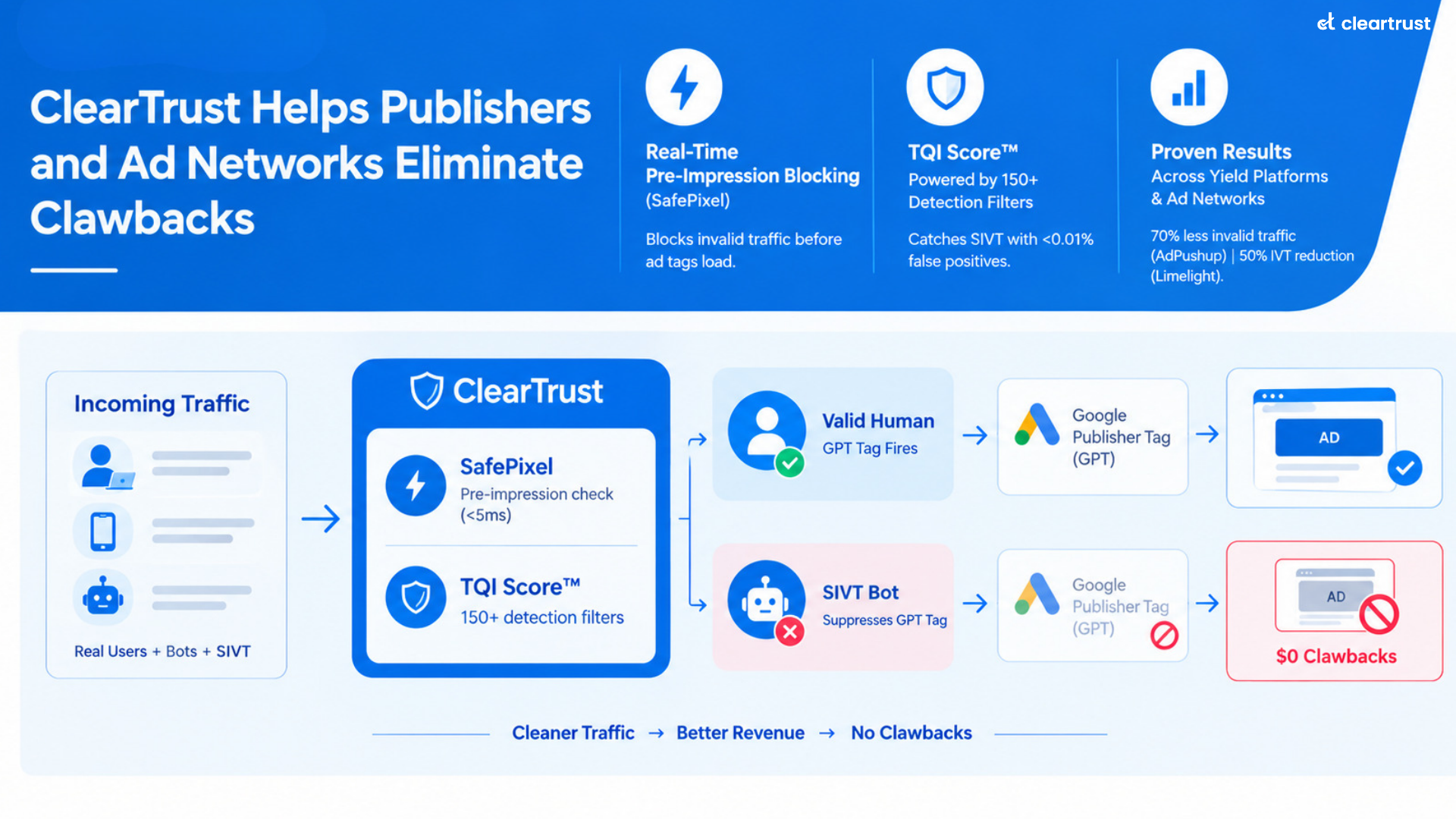
ClearTrust for Publishers and ClearTrust for Platforms give publishers, yield managers, and SSPs a real-time defense layer that blocks invalid traffic before the ad request ever reaches Google:
- Real-Time Pre-Impression Blocking (SafePixel): ClearTrust’s lightweight JavaScript pixel evaluates every visitor in milliseconds—before your Google Publisher Tag (GPT) or header bidding wrapper loads. If a session is flagged as invalid, ad tags are suppressed automatically.
- TQI Score™ Powered by 150+ Detection Filters: Unlike legacy IP-blocking tools that fail against modern residential proxies and CGNAT mobile networks, ClearTrust’s TQI Score™ continuously scores device telemetry, browser integrity, network anomalies, and user behavior to catch SIVT with less than 0.01% false positives.
- Proven Results Across Yield Platforms & Ad Networks: Leading monetization platforms like AdPushup used ClearTrust to cut invalid traffic by 70% and stop revenue leakage, while Limelight achieved a 50% IVT reduction and restored advertiser confidence across its supply.
Key Takeaways
- Google clawbacks are retroactive month-end deductions: Google reconciles traffic between the 1st and 2nd of each month (and up to 60–90 days post-invoice), deducting SIVT earnings from publishers to refund affected advertisers.
- Post-auction audits catch what basic filters miss: Residential proxies, click farms, and arbitrage bots often pass initial pre-bid checks, only to be flagged weeks later during Google’s batch reconciliation.
- Publishers carry 100% of the liability: Under Google policy, invalid activity from purchased traffic, MCM child publishers, or external click sabotage is deducted directly from the publisher’s balance.
- Pre-impression suppression is the only permanent fix: Blocking Google Publisher Tags (GPT) and AdSense scripts from loading on invalid sessions keeps bad traffic out of Google’s billing ledger completely.
Stop Google clawbacks before they impact your revenue. Discover how to detect invalid traffic early and protect your ad earnings with ClearTrust.
Frequently Asked Questions (FAQs)
1. What are Google clawbacks in Google Ad Manager and AdSense?
Google clawbacks - officially listed as Invalid Traffic Deductions - are month-end adjustments where Google deducts ad revenue generated by bots, click fraud, or policy-violating traffic from a publisher’s payout to refund every affected Google advertiser.
2. Why do my finalized earnings drop from estimated earnings in Google Ad Manager?
Estimated earnings only filter out basic bots (GIVT) in near real time. Between the end of the month and the 2nd of the following month, Google runs deep multi-signal audits for Sophisticated Invalid Traffic (SIVT) and deducts those amounts before posting Finalized Earnings on your Transactions page.
3. Can you appeal an invalid traffic deduction from Google?
No. While you can appeal an account suspension or ad-serving limit, monthly Invalid Traffic – AdX and Invalid Traffic – AdSense revenue deductions cannot be appealed or reversed because those funds have already been credited back to advertisers.
4. How does buying website traffic cause invalid traffic clawbacks?
Many third-party traffic vendors, native widgets, and social arbitrage networks blend headless bots, pop-unders, or incentivized clicks into their delivery. When those visitors land on your site, Google’s post-auction telemetry flags the abnormal session patterns and claws back the resulting revenue.
5. How do publishers stop invalid traffic before Google serves an ad?
Publishers deploy real-time verification tools like ClearTrust to scan incoming visitors across 150+ behavioral, network, and device filters in milliseconds. When a session fails the TQI Score™ threshold, the page dynamically prevents the Google Ad Manager or AdSense tag from firing, eliminating clawbacks before they happen.