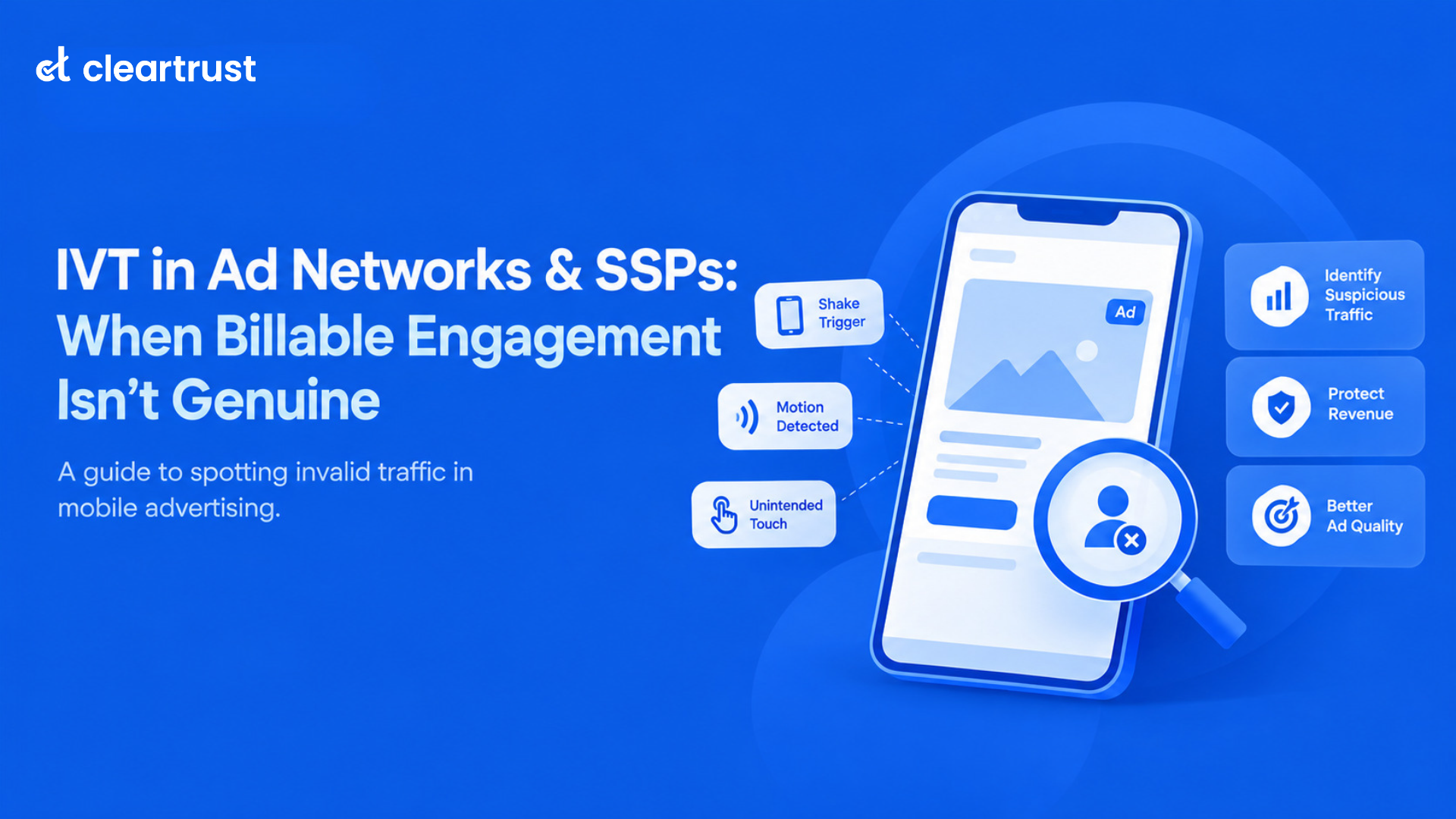
Invalid traffic (IVT) is advertising traffic that does not meet the criteria for valid human or legitimate activity under applicable measurement standards. It includes general invalid traffic (GIVT) and sophisticated invalid traffic (SIVT). But some questionable engagement is harder to identify: an ad interaction can be recorded and billed even when the user didn’t deliberately initiate it.
A study posted to arXiv on September 9, 2026 shows how this can happen inside the network itself. Here’s what it found, what it means for ad fraud detection in mobile advertising, and what ad network and SSP teams can check in their own stack.
1. Billable Ad Engagement Isn’t Always Genuine
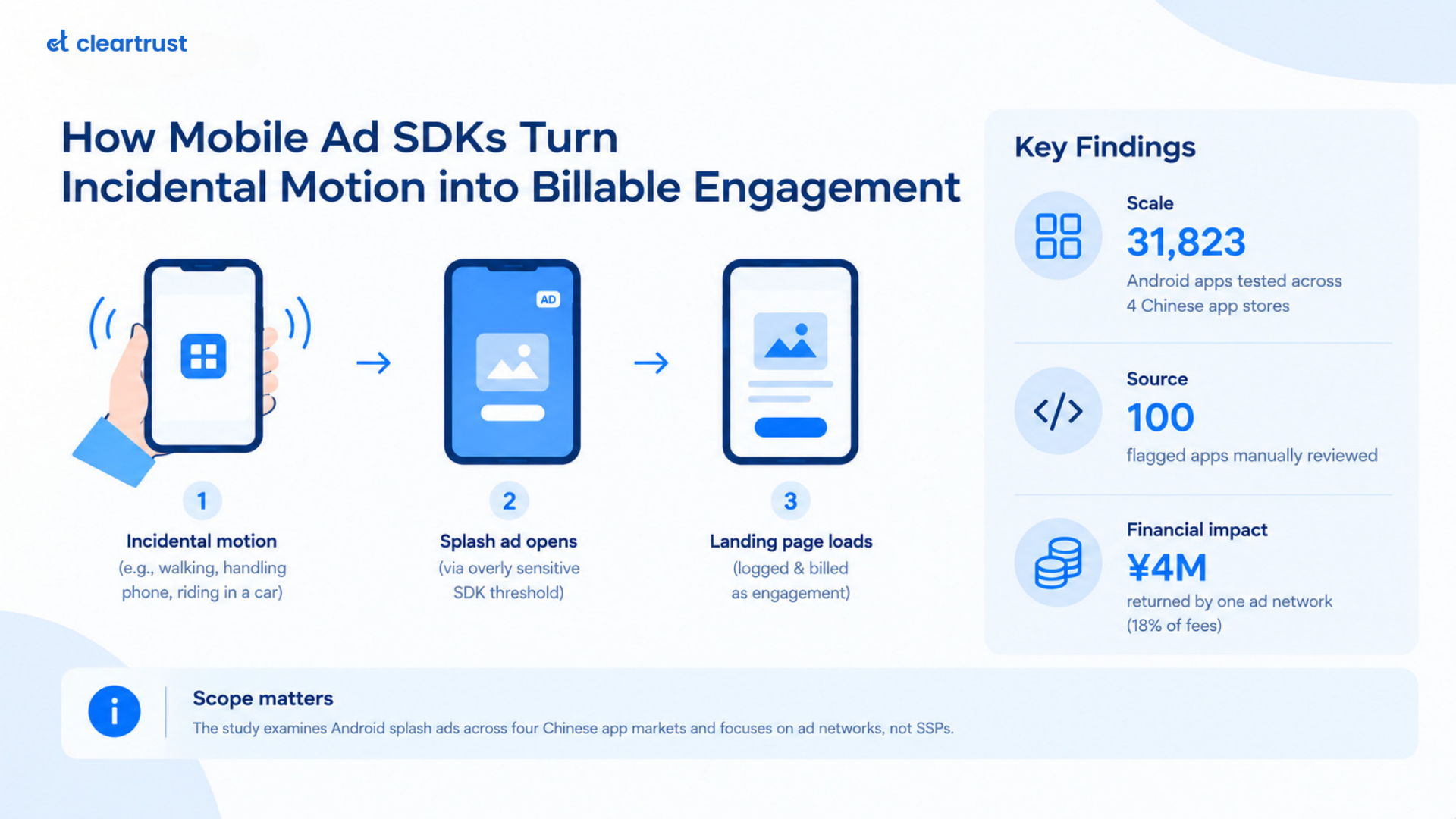
In When Ad Networks Misbehave, researchers Song Wu, Bo Wang, Yifan Zhang, Yinfeng Cao and Xueqiang Wang studied splash ads, the full-screen ads shown when a mobile app launches. They describe semi-drive-by ads: ads whose landing page opens because of incidental motion or unrelated touches, yet are still logged and billed as engagement. The clearest example is shake-to-trigger, where an overly sensitive SDK threshold can read walking, handling the phone or riding in a car as an intentional shake.
Key findings:
- Scale: 31,823 Android apps from four Chinese app stores were tested, and the behavior appeared in 1.70% to 4.96% of apps, depending on the store.
- Source: in a manual review of 100 flagged apps, the triggering logic was located in the ad SDKs, not in developer-written code.
- Financial impact: In the case reported by the researchers, one ad network returned about ¥4 million (roughly US$600,000), equivalent to 18% of the fees paid to that network during the relevant period.
Why this matters for IVT detection, specifically: the interaction was recorded, but deliberate intent may not have been there. Whether such events count as IVT depends on the measurement framework. The Media Rating Council’s Invalid Traffic Detection and Filtration Guidelines provide an industry reference for distinguishing general invalid traffic (GIVT) from sophisticated invalid traffic (SIVT). These cases highlight why reported engagement alone may not be enough to establish traffic quality.
Scope matters: the study examines Android splash ads across four Chinese app markets and focuses on ad networks, not SSPs. Its findings should not be treated as a global prevalence estimate.
2. Why Problematic Mobile Ad SDK Behavior Is Hard to Spot
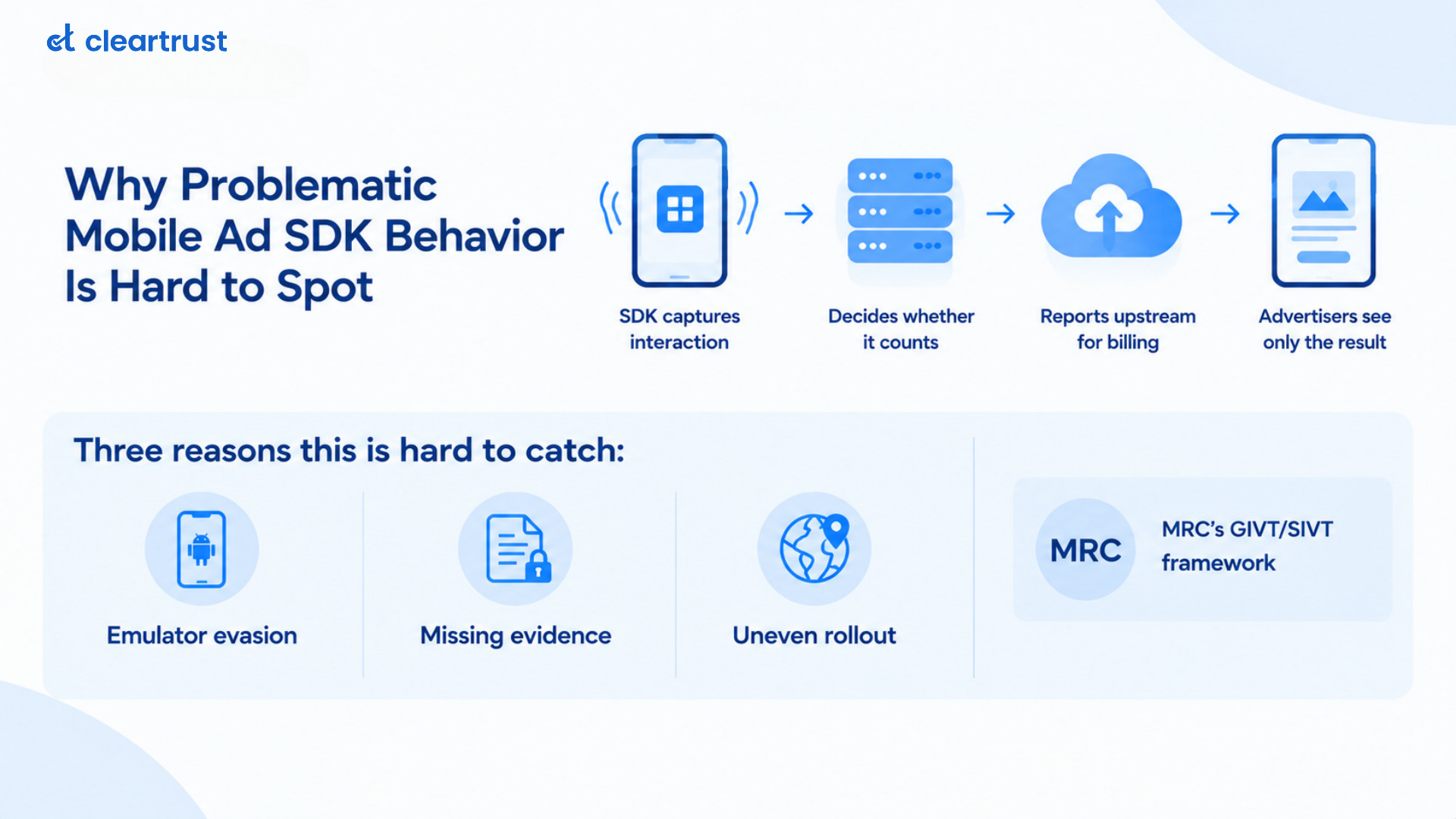
Ad networks hold a rare position. Their SDK captures the interaction, decides whether it counts, and reports it upstream for billing. Advertisers usually see the reported result, not the original on-device event. The paper points to three reasons this is hard to catch:
- Emulator evasion: In the authors’ experiments, the flagged ads appeared at rates of 0%–26% on commonly used emulators, compared with 100% on a real device under the tested conditions. This suggests that testing only in a conventional emulator may miss behavior that appears on physical phones.
- Missing evidence: the paper notes that several ad SDKs’ privacy policies describe sensor data as used on the device and not uploaded, leaving little proof of whether a reported shake was deliberate.
- Uneven rollout: behavior varied by region and app store, which makes sporadic audits hard to reproduce.
The MRC's GIVT/SIVT framework provides a useful classification starting point, but suspicious interaction patterns still require investigation before traffic is blocked or classified as invalid.
For examples of how spoofed devices and AI-driven clicks defeat single-signal checks, see our post on 5 threats advertisers need to watch in 2026.
3. How to Detect Invalid Traffic in Mobile Advertising Without Over-Flagging
Not every unusual interaction is fraud. The authors acknowledge that threshold choices involve trade-offs, and that tighter rules risk false positives. Investigate patterns first, then confirm.
What to check in your stack:
- Engagement vs. outcome: Compare click-through and landing-page rates with post-click behavior and conversions. Rising engagement with flat value deserves a closer look.
- Segment by SDK and app: Break results down by app, SDK version, region and device model. In the study, the same app could behave differently across stores.
- Interaction type: Track the share of engagement triggered by motion rather than touch.
- Launch-to-landing timing: Look for landing-page opens that follow app launch with no plausible user input.
- Documentation: Ask SDK partners how an interaction is defined, including any sensor thresholds.
- Review before blocking: Flag for review and give publishers a chance to respond.
Most of these checks work best side by side, because an anomaly in one app or publisher only stands out against the rest of your traffic. If you need a second signal alongside SDK audits, TQI Score™ rolls scores up by publisher and creative, so you can see which sources to investigate first.
4. SSP Traffic Quality: What This Means for Supply-Side Teams
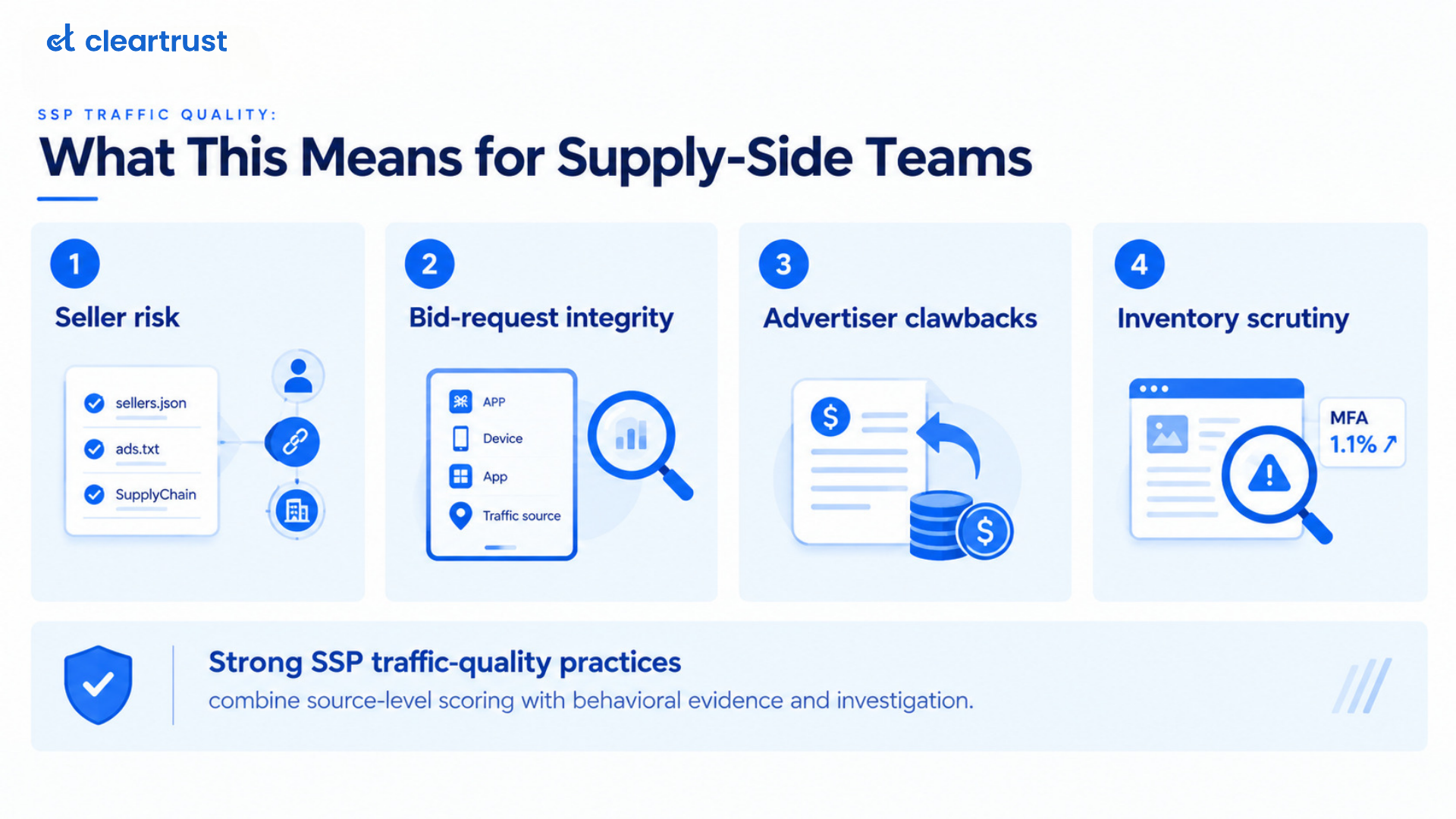
This section is our analysis. The study examined ad networks, not SSPs. But the lesson carries over: if reported engagement can mislead upstream, supply-side teams shouldn’t rely on it alone.
- Seller risk: IAB Tech Lab’s sellers.json helps buyers verify seller identities, while ads.txt helps identify authorized sellers and the SupplyChain object provides visibility into the parties involved in a programmatic transaction. These mechanisms improve supply-path transparency, but they do not prove that every interaction is genuine. SSP teams should pair authorization and supply-path checks with independent traffic-quality signals and behavioral investigation rather than automatically treating every anomaly as fraud.
- Bid-request integrity: Declared device, app and traffic-source information does not, by itself, establish that an interaction was intentional. Where data is available, compare reported information with independent behavioral and technical signals to identify inconsistencies worth investigating.
- Advertiser clawbacks: The refund in the study shows how quickly a quality dispute becomes money. Advertiser clawbacks can put publisher revenue at risk and strain relationships across the supply chain.
- Inventory scrutiny: Buyers continue to scrutinize the quality of programmatic supply. The ANA’s Q1 2026 benchmark reported that made-for-advertising (MFA) exposure rose to 1.1%, after remaining between 0.4% and 0.6% throughout 2025. MFA exposure is not the same as IVT, but the finding reinforces the importance of examining inventory quality beyond headline performance metrics.
Strong SSP traffic-quality practices combine source-level scoring with behavioral evidence and investigation.
5. How ClearTrust Helps Ad Networks and SSPs Detect IVT
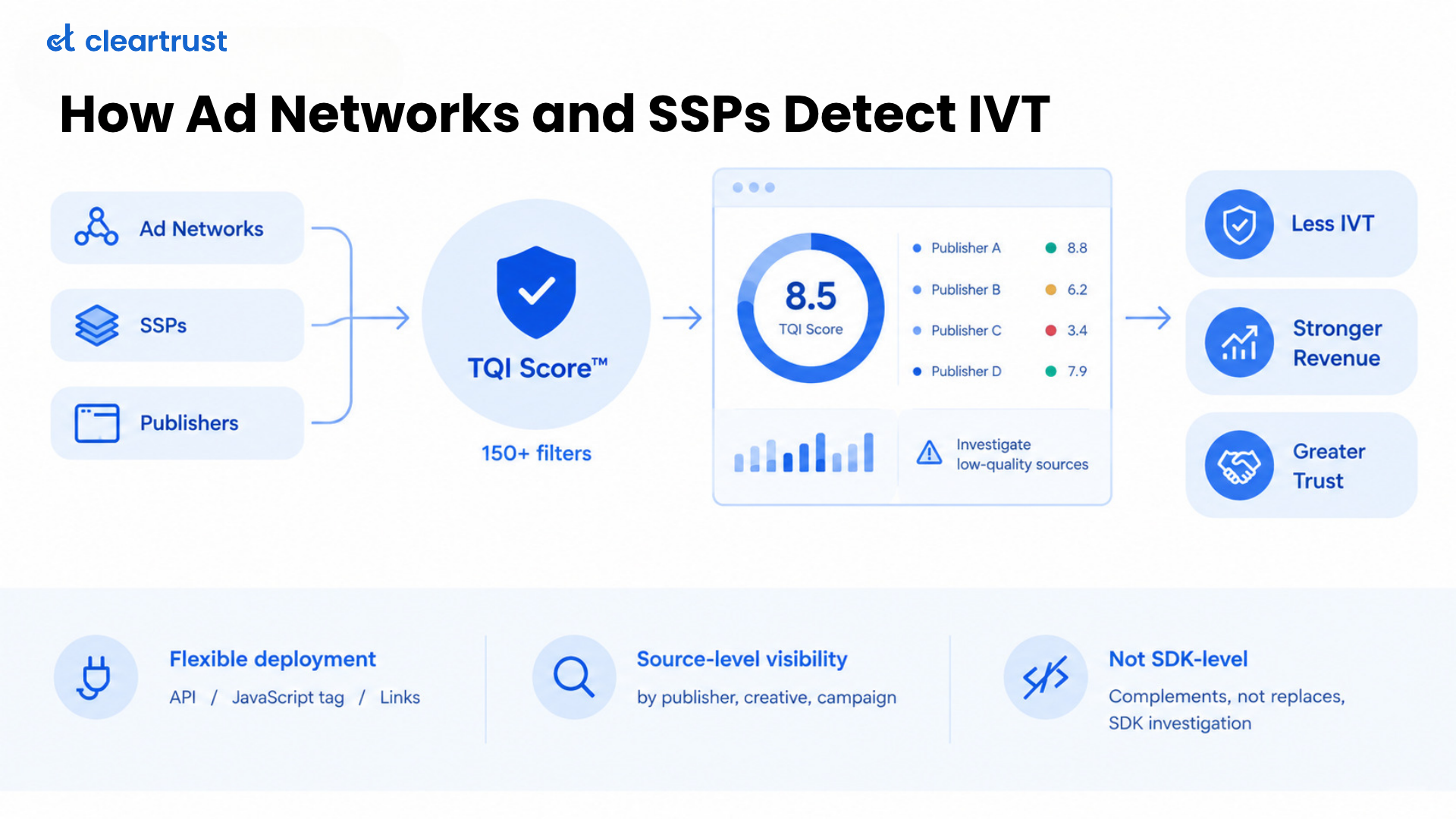
ClearTrust’s TQI Score™ helps ad networks and SSPs assess traffic quality using signals beyond reported engagement:
- 150+ filters, one score: TQI Score™ uses 150+ customizable fraud filters and traffic-quality signals, including technical and behavioral indicators, to help identify suspicious traffic and prioritize sources for investigation.
- Source-level visibility: scores roll up by campaign dimensions such as publisher and creative, helping you spot low-quality sources and decide where to investigate. ClearTrust reports a 60% reduction in invalid traffic in its CTV work with Cuedart.
- Flexible deployment: measure via API, JavaScript tag or links, and see how it fits ad-tech platforms.
- Clear scope: ClearTrust analyzes traffic-quality signals to help identify suspicious patterns and prioritize sources for investigation. It does not directly inspect an ad SDK’s source code or reconstruct on-device sensor events, so its findings should complement, not replace, SDK-level investigation when that evidence is required.
The Bigger Shift in Ad Fraud and IVT
The question is no longer only whether traffic is human. It’s whether the interaction reflects intent. Ad networks and SSPs that verify engagement, rather than just record it, protect advertiser trust, publisher reputation and their own revenue.
Suspicious engagement deserves more than a surface-level check. See how ClearTrust’s TQI Score™ helps teams assess traffic quality and investigate potentially invalid traffic.
Ready to see it on your own traffic?
FAQs
What is IVT in ad networks?
Invalid traffic (IVT) is traffic that doesn’t meet the criteria for valid human or legitimate activity under applicable measurement standards, spanning general (GIVT) and sophisticated (SIVT) types. Some questionable interactions, such as ones the user didn’t deliberately initiate, can be harder to classify.
How can ad networks detect invalid traffic in mobile advertising?
Compare reported engagement with downstream outcomes, segment by app, SDK version and region, and combine device, behavioral, IP and traffic-source signals instead of relying on one metric.
What is a semi-drive-by splash ad?
In the cases described by the study, it’s a splash ad whose landing page opens from incidental motion or touches, such as walking with a phone, rather than deliberate action, yet is still logged and billed as engagement.
Why does SSP traffic quality matter for ads monetization?
Buyers favor supply they trust. Poor quality can lead to advertiser clawbacks and lost demand, which affects revenue for the SSP and its publishers.
Is every unusual ad interaction ad fraud?
No. Some interactions are accidental or reflect aggressive but legitimate design. Treat anomalies as signals for review, then confirm with multiple data points before blocking.