.png)
Two publishers. Both offer 100 million impressions. One charges $2 CPM. The other charges $6 CPM.
Most media buyers see a pricing gap. Experienced ones see a traffic quality gap - and once you run the numbers, the "cheap" option is usually the more expensive mistake.
This guide walks through a repeatable framework for evaluating publisher traffic quality before you commit spend: the four signals that matter, the formula that reveals true cost per real impression, and a pre-buy checklist you can run on any publisher, ad network, or programmatic supply source.
Why Identical Impression Counts Deliver Wildly Different Value
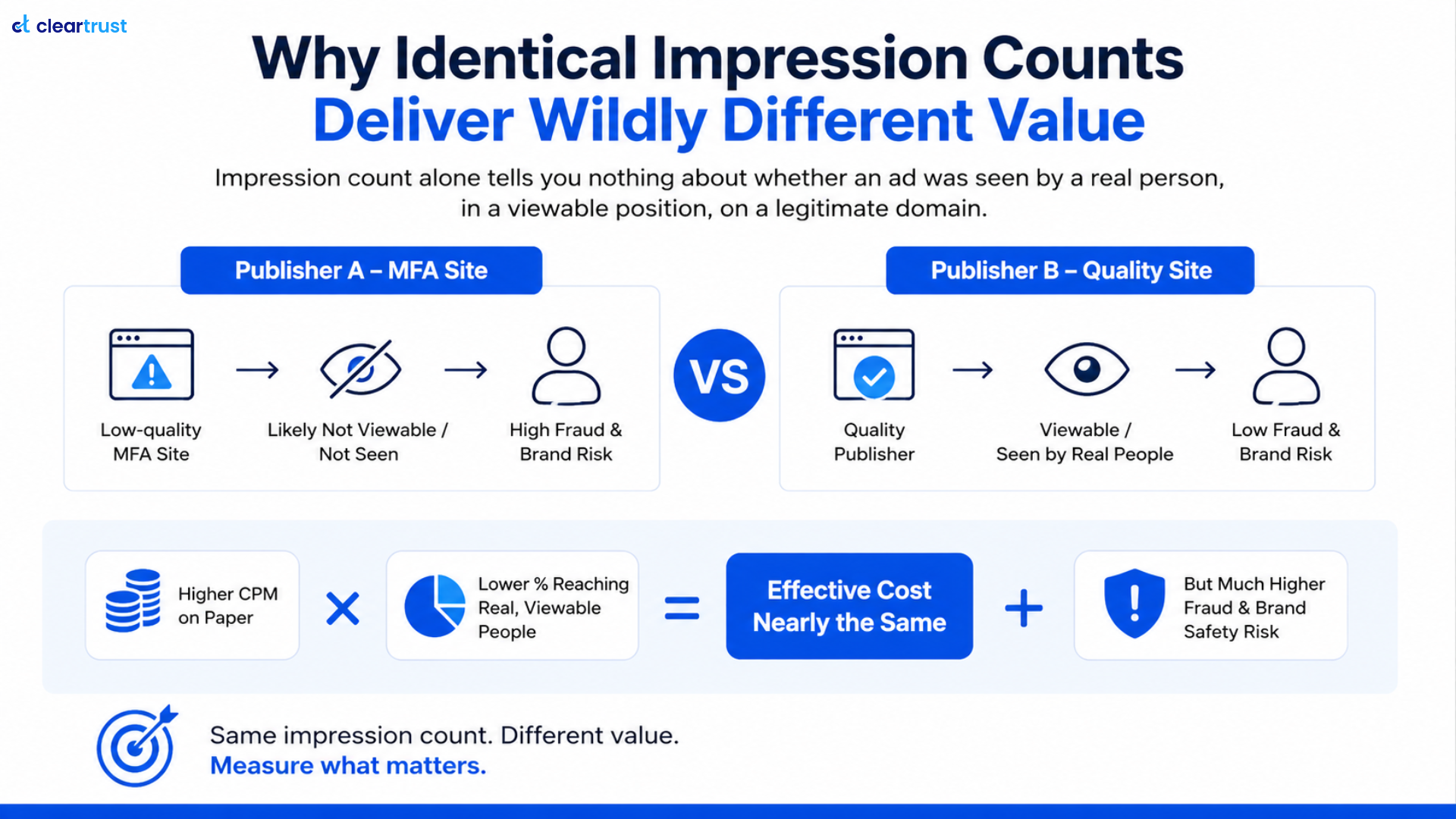
Impression count alone tells you nothing about whether an ad was seen by a real person, in a viewable position, on a legitimate domain.
According to the Association of National Advertisers' Programmatic Media Supply Chain Transparency Study, a meaningful share of programmatic impressions land on Made-for-Advertising (MFA) sites - low-quality domains built primarily to arbitrage ad revenue rather than serve real audiences. That single issue accounts for a significant portion of total programmatic waste industry-wide.
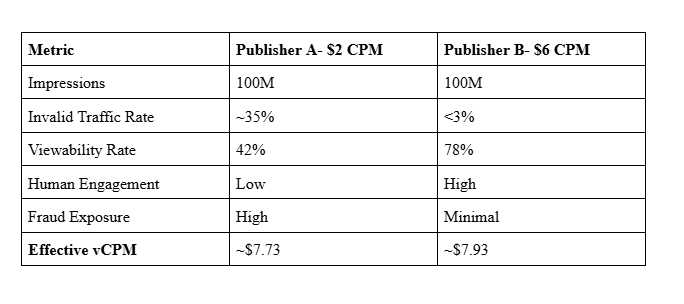
The headline CPM gap looks large. The effective cost gap, once you adjust for what actually reached a real, viewable human, nearly disappears and Publisher A still carries far higher fraud and brand-safety risk for roughly the same real cost. We'll walk through exactly how that number is calculated below.
The 4 Pillars of Publisher Traffic Quality
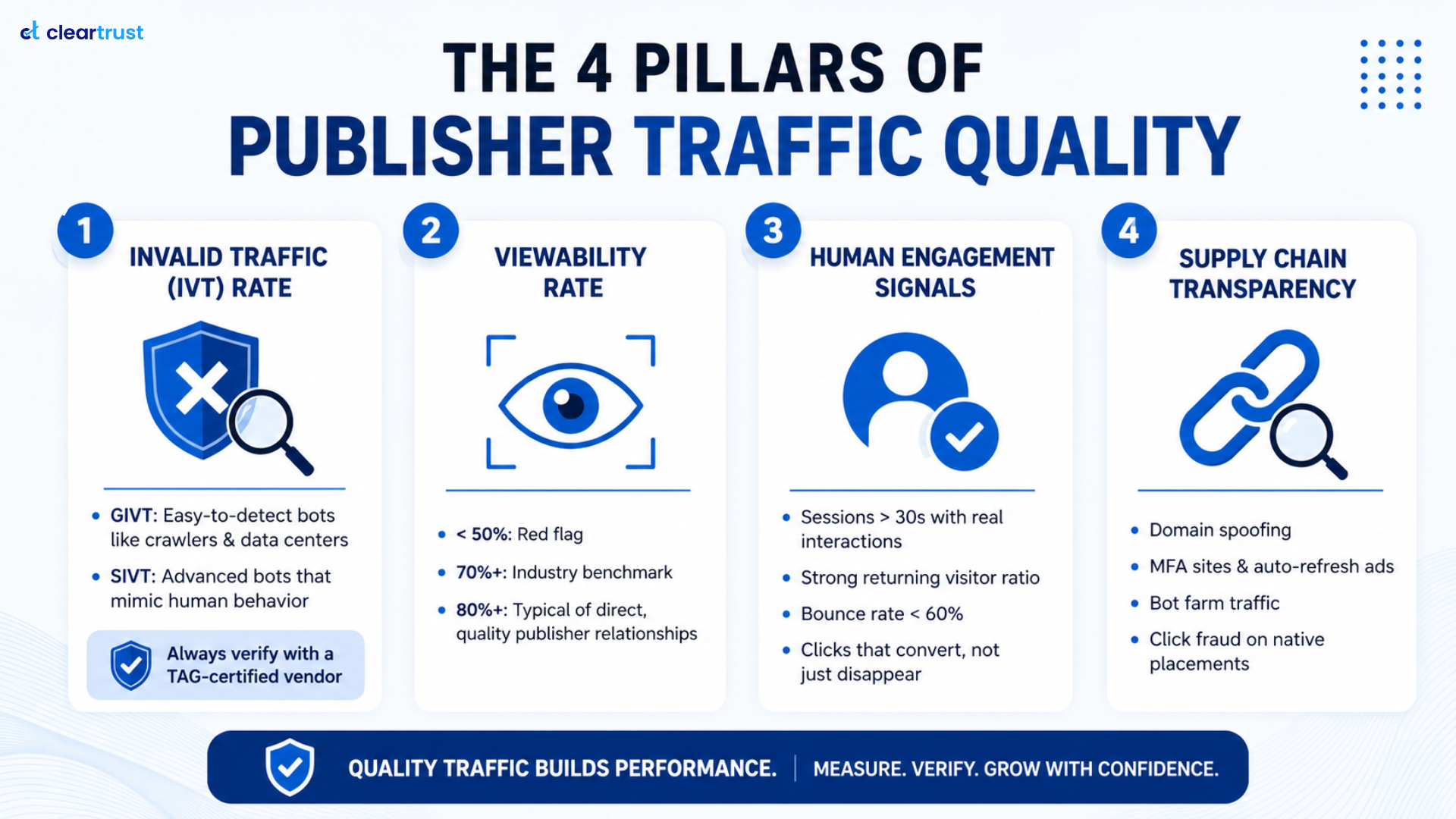
1. Invalid Traffic (IVT) Rate
Invalid traffic is the formal industry term, defined by TAG and the Media Rating Council (MRC), for any traffic not generated by a genuine human user. It splits into two categories:
- General Invalid Traffic (GIVT): Known data-center traffic, search crawlers, and flagged bot signatures - filterable with standard IP and user-agent blocklists.
- Sophisticated Invalid Traffic (SIVT): Advanced bots engineered to mimic human behavior - mouse movement, scroll depth, variable session length - specifically built to evade basic detection. SIVT is where most ad budgets quietly leak, because a publisher can pass a surface-level audit while still serving a significant share of impressions to bots that look human in standard dashboards.
What to check: Require third-party IVT measurement from a TAG-certified vendor. A publisher confident in its traffic shares this without hesitation or delay.
2. Viewability Rate
Per MRC Viewability Standards, a display impression is considered viewable when at least 50% of pixels are visible for a minimum of one continuous second (two seconds for video).
- Below 50%: Red flag for ad-stack manipulation or stacked placements
- 70%+: Industry benchmark for premium display inventory
- 80%+: Typical of direct, well-managed publisher relationships
3. Human Engagement Signals
Viewability tells you an ad was visible. It does not tell you a real person was paying attention. Conflating the two is one of the costlier mistakes in media buying. Look for:
- Sessions over 30 seconds with active scroll, hover, or click behavior
- A healthy returning-visitor ratio - a signal of organic, loyal readership rather than a synthetic traffic spike
- Bounce rate consistently under 60%; rates above 85% typically signal low-intent or incentivized traffic
- Post-click conversion alignment - does traffic from this publisher actually reach your landing page and convert, or drop off immediately?
4. Supply Chain Transparency and Fraud Exposure
Ad fraud isn't always a publisher's fault, but it's always their responsibility to address. The most common fraud vectors:
- Domain spoofing: Fraudulent networks impersonate premium publishers in bid requests, serving low-quality inventory disguised as premium domains.
- MFA sites: Built to arbitrage programmatic revenue via auto-refreshing ad slots and thin, often AI-generated content.
- Bot farm traffic: Publishers purchase cheap traffic to hit impression guarantees, blending real audiences with bot visits.
- Click fraud on native placements: Inflated CTRs that simulate engagement but produce no downstream conversions.
What to check: Verify ads.txt compliance against the IAB Tech Lab specification, and run a supply path check to count intermediaries between your bid and the actual impression.
ClearTrust Insight: Across more than 1 billion sessions scanned daily for 100+ protected brands, lead gen and native placements consistently show the widest gap between self-reported and independently measured invalid traffic rates - often 2–3x higher than what publishers disclose upfront. Third-party verification isn't optional for these formats; it's the only way to catch the gap before it hits your budget.
A fifth signal worth adding: Content Adjacency and Audience Fit
Traffic quality isn't only about fraud - it's also about whether the audience matches your campaign. A publisher can post excellent IVT and viewability numbers while still delivering traffic with no genuine interest in your category. Before buying:
- Confirm the publisher's core content vertical aligns with your product or service
- Check whether the majority of traffic is contextually relevant or arrives through unrelated referral/recommendation networks
- Weight first-party data depth - publishers with logged-in, identifiable audiences generally offer more reliable targeting than anonymous open-exchange traffic
The Effective Viewable CPM Formula
Use this to see what you actually pay per real, viewable human impression:
Effective vCPM = Stated CPM ÷ ((1 − IVT Rate) × Viewability Rate)
Publisher A ($2.00 CPM, 35% IVT, 42% viewability): $2.00 ÷ (0.65 × 0.42) = $2.00 ÷ 0.273 = $7.33
Publisher B ($6.00 CPM, 3% IVT, 78% viewability): $6.00 ÷ (0.97 × 0.78) = $6.00 ÷ 0.7566 = $7.93
Once fraud and non-viewability are priced in, the two publishers are nearly identical on a real-cost basis but Publisher A carries substantially more brand-safety and fraud risk to get there. The "premium" publisher isn't a markup. It's the safer buy at effectively the same price.
Pre-Buy Checklist: How to Detect Invalid Traffic From a Publisher
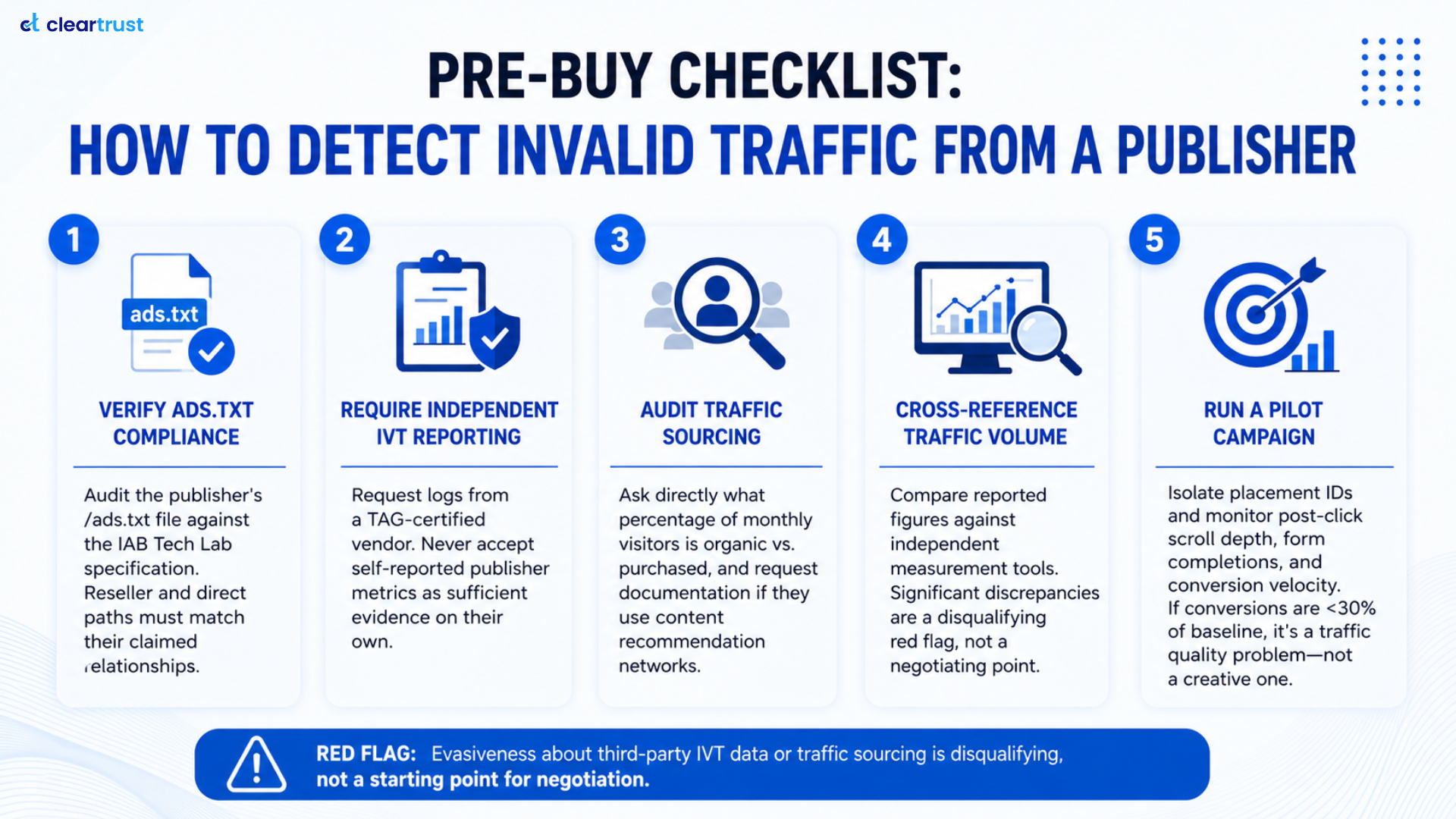
- Verify ads.txt compliance. Audit the publisher's /ads.txt file against the IAB Tech Lab specification. Reseller and direct paths must match their claimed relationships.
- Require independent IVT reporting. Request logs from a TAG-certified vendor. Never accept self-reported publisher metrics as sufficient evidence on their own.
- Audit traffic sourcing. Ask directly what percentage of monthly visitors is organic versus purchased, and request documentation if they use content recommendation networks.
- Cross-reference traffic volume. Compare reported figures against independent measurement tools. Significant discrepancies are a disqualifying red flag, not a negotiating point.
- Run a pilot campaign. Isolate the publisher's placement IDs and monitor post-click scroll depth, form completions, and conversion velocity against your existing channel baseline. If a publisher converts at less than 30% of that baseline, treat it as a traffic quality problem not a creative one.
Red flag: Evasiveness about third-party IVT data or traffic sourcing is disqualifying, not a starting point for negotiation.
Signs a Publisher Is Buying Low-Quality Traffic to Inflate Impressions
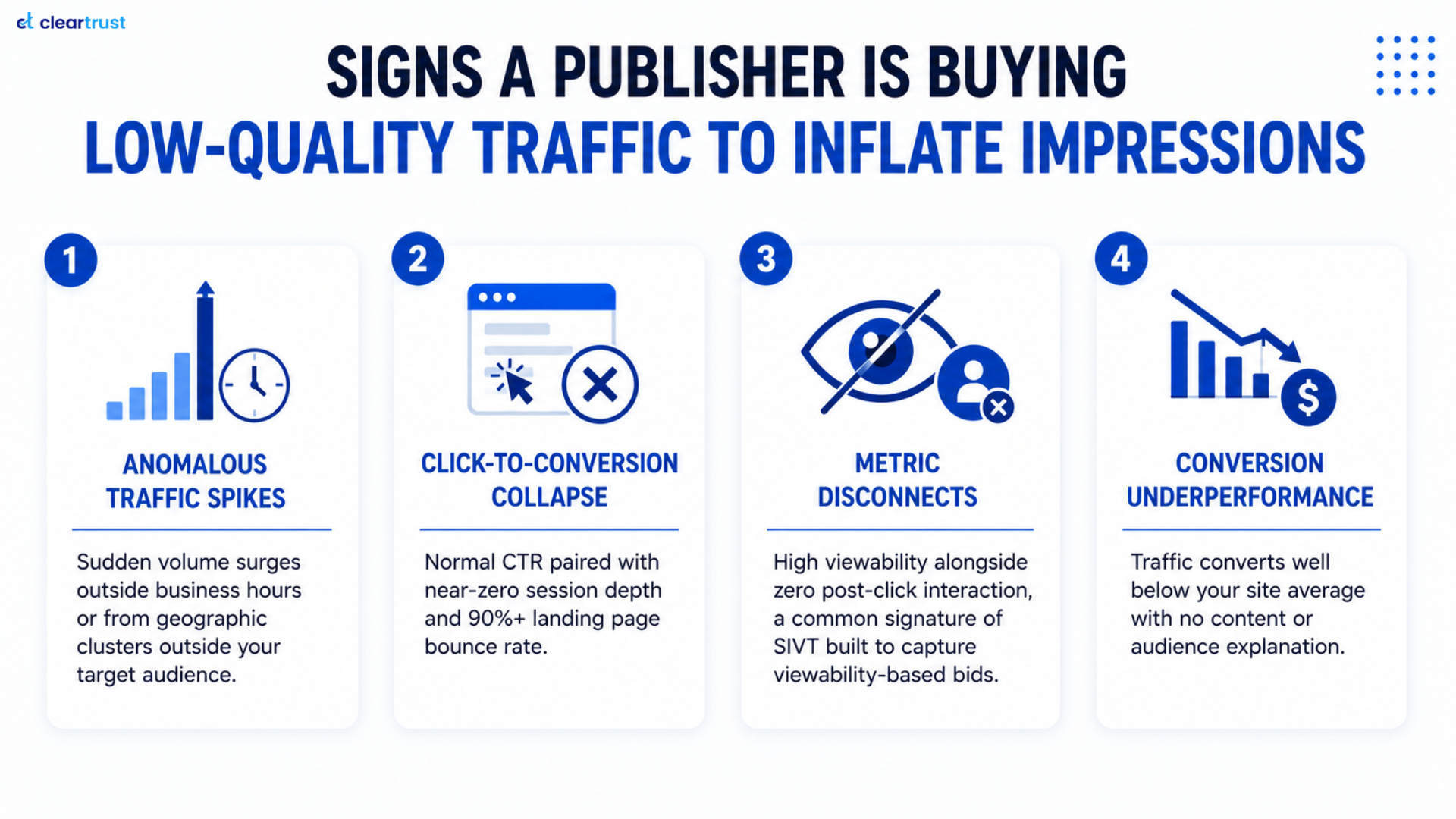
- Anomalous traffic spikes - sudden volume surges outside business hours or from geographic clusters outside your target audience
- Click-to-conversion collapse - normal CTR paired with near-zero session depth and 90%+ landing page bounce rate
- Metric disconnects - high viewability alongside zero post-click interaction, a common signature of SIVT built to capture viewability-based bids
- Conversion underperformance - traffic converts well below your site average with no content or audience explanation
Note that some of these signals appear on legitimate publishers whose traffic has been infiltrated by bots without their knowledge. A publisher actively investigating and addressing bot infiltration is a different risk profile than one knowingly buying it.
Protecting Your Media Budget: Before, During, and After the Campaign
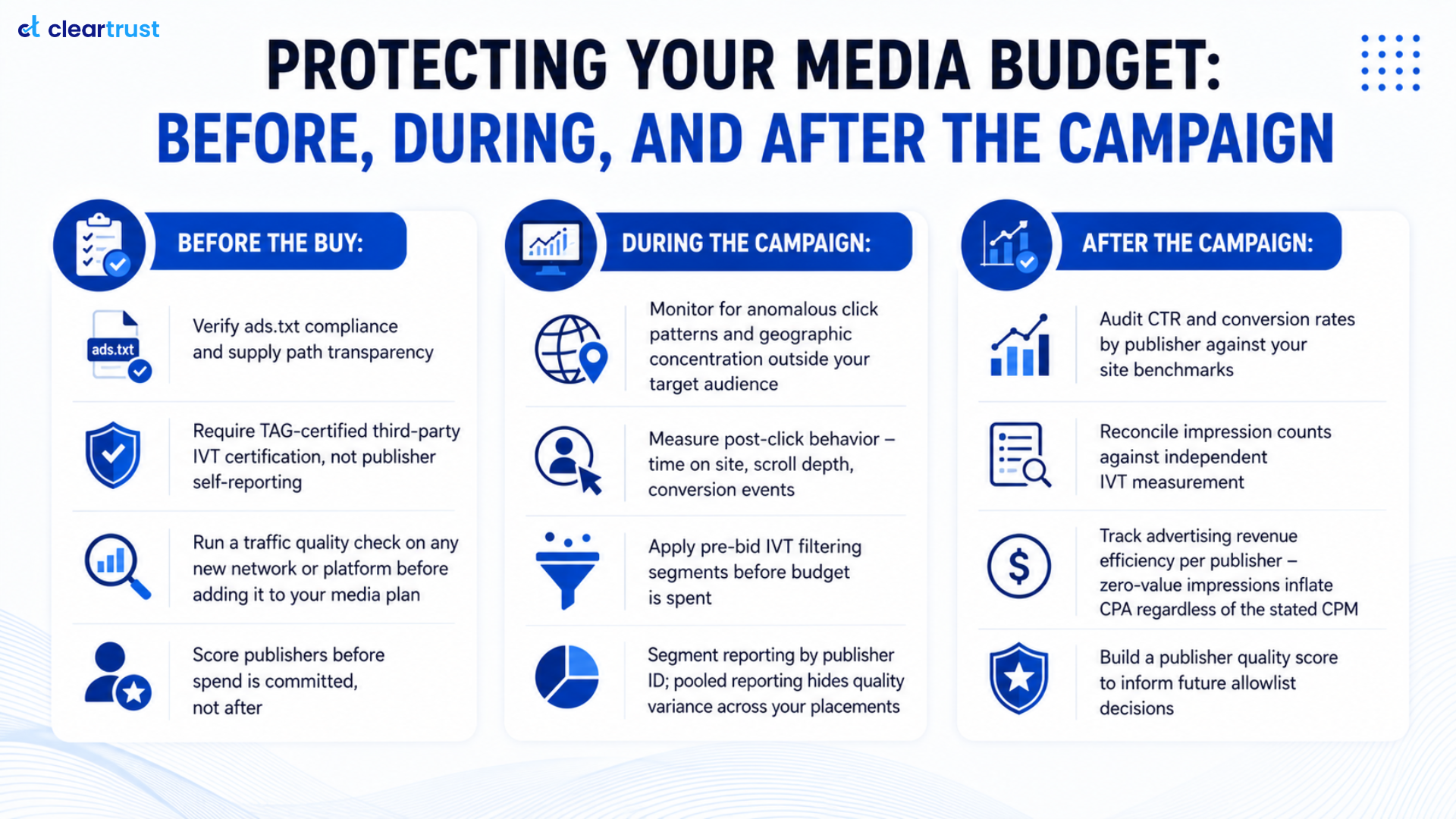
Before the buy:
- Verify ads.txt compliance and supply path transparency
- Require TAG-certified third-party IVT certification, not publisher self-reporting
- Run a traffic quality check on any new network or platform before adding it to your media plan
- Score publishers before spend is committed, not after
During the campaign:
- Monitor for anomalous click patterns and geographic concentration outside your target audience
- Measure post-click behavior - time on site, scroll depth, conversion events
- Apply pre-bid IVT filtering segments before budget is spent
- Segment reporting by publisher ID; pooled reporting hides quality variance across your placements
After the campaign:
- Audit CTR and conversion rates by publisher against your site benchmarks
- Reconcile impression counts against independent IVT measurement
- Track advertising revenue efficiency per publisher - zero-value impressions inflate CPA regardless of the stated CPM
- Build a publisher quality score to inform future allowlist decisions
Next Steps: Put This Framework Into Practice
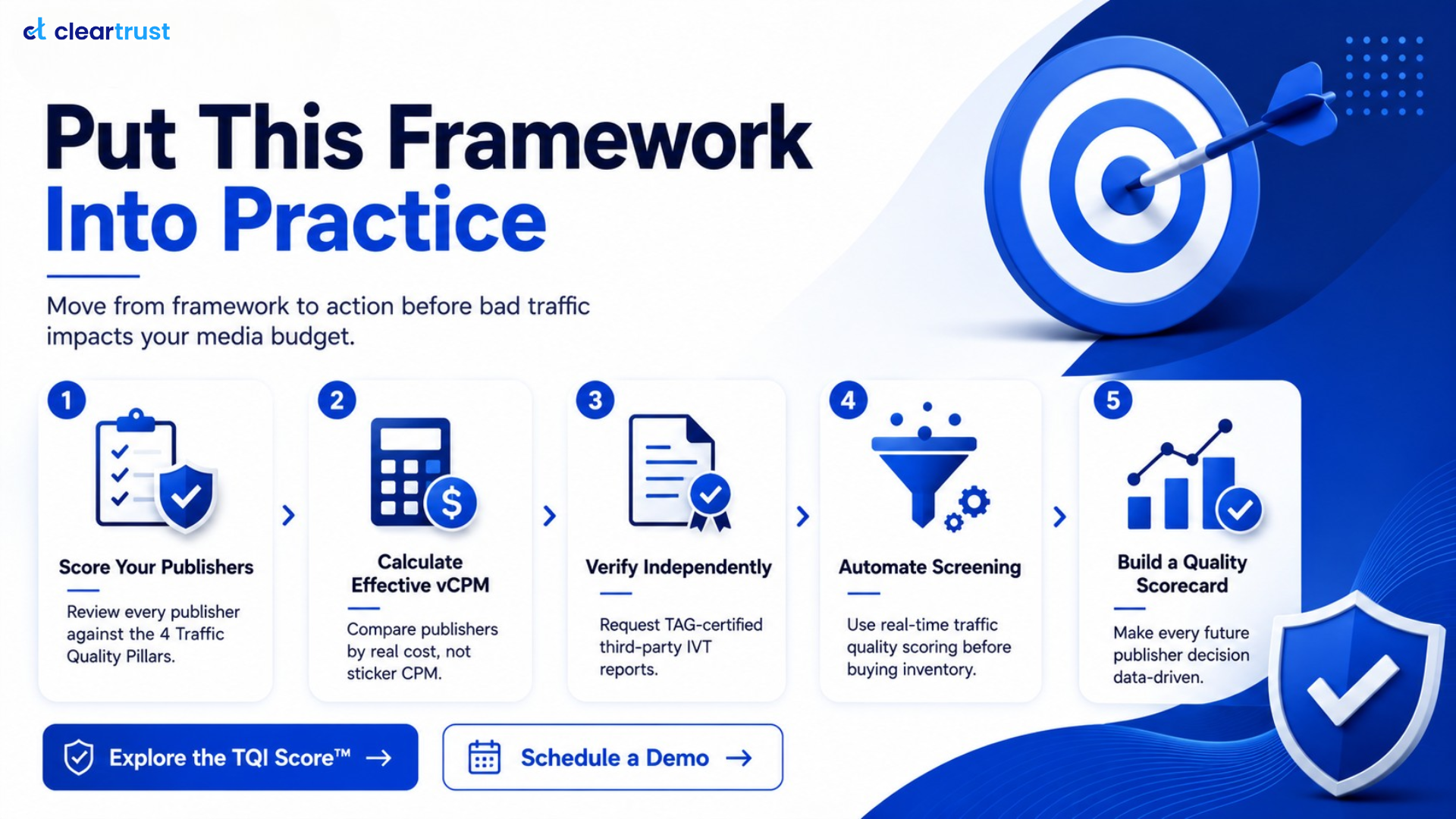
Running this checklist manually - publisher by publisher, campaign by campaign - works, but it means bad traffic is often caught after the budget is already spent. Here's how to move from framework to action:
- Score your current publisher list against the four pillars above - flag anything missing third-party IVT data as a priority review.
- Run the Effective vCPM formula on your top five publishers by spend. Rank them by real cost, not sticker CPM.
- Request TAG-certified IVT reports from any publisher you can't currently verify independently.
- Automate the screening. ClearTrust's TQI Score™ applies 150+ real-time filters covering bot signatures, invalid clicks and impressions, and unsafe placements to score a publisher before you commit spend rather than reconciling after the fact. It's TAG-certified and holds IAB UK and IAB Europe membership.
- Build a standing quality scorecard so every future publisher decision starts from data, not a media kit.
Explore the TQI Score™ → | Schedule a demo →
Frequently Asked Questions
What is the difference between ad fraud and invalid traffic? Invalid traffic covers all non-human traffic - harmless crawlers and malicious bots alike. Ad fraud is the intentional manipulation of ad systems to steal revenue. All ad fraud generates invalid traffic, but not all invalid traffic is deliberate fraud.
Why do sophisticated bots display high viewability scores? SIVT bots scroll pages, pause over ad units, and execute creative scripts to mimic human behavior - registering as fully viewable in legacy verification stacks. Behavioral analysis, not viewability data alone, is the reliable counter.
What is a good viewability rate for display ads? The MRC minimum is 50% of pixels visible for one continuous second. Premium inventory typically benchmarks at 70%+. Below 50% is a red flag; above 80% is characteristic of direct, well-managed publisher relationships.
How does ads.txt protect media buyers? The Authorized Digital Sellers (ads.txt) initiative lets publishers publicly declare authorized sellers. It doesn't stop a publisher from buying bad traffic themselves, but it blocks external fraudsters from spoofing their domain in bid requests.
How do I protect my budget from click fraud on an ongoing basis? Require TAG-certified third-party IVT verification before direct deals, check ads.txt compliance, monitor for anomalous click patterns, run pilot campaigns before committing full budget, and maintain a per-publisher quality scorecard you update after every campaign.