In 2026, connected TV has quietly gone from an emerging channel to the default way people watch television. According to Nielsen's Q1 2026 Ad Supported Gauge, streaming captured a record-high 46.6% share of ad-supported TV viewing this quarter, outpacing both broadcast and cable individually for the first time in the metric's history. CTV advertising is no longer the experimental line item it was a few years ago, it's a core part of every performance and brand budget.
But growth in connected TV spend hasn't come with growth in trust. Buyers are pouring more money into CTV ads than ever, while quietly admitting they're not fully confident in what they're actually paying for.
That gap between spend and confidence is the real story in CTV advertising right now, and it's one every media buyer, agency, and publisher needs to understand before their next campaign goes live.
The Confidence Gap: What the IAB's 2026 Report Reveals
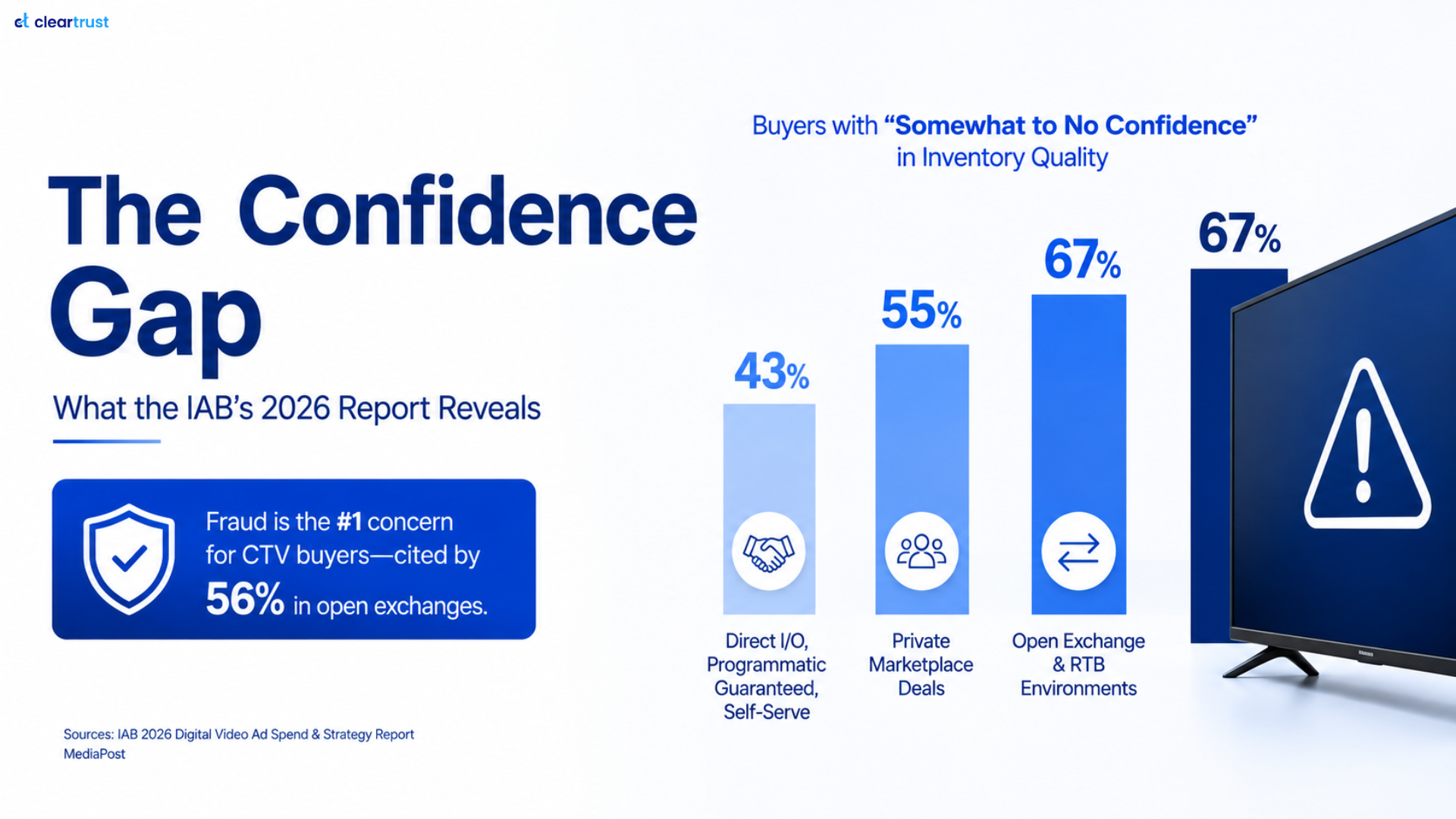
According to the 2026 IAB Digital Video Ad Spend & Strategy Report, even buyers using the most trusted CTV buying methods- direct I/O, programmatic guaranteed, and self-serve- report meaningful doubt about what they're getting. Forty-three percent say they have "somewhat to no confidence" in the quality of the inventory they're buying through these channels. That number climbs to 55% for private marketplace deals, and jumps to 67% once you move into open exchange and RTB environments.
Fraud is the single biggest driver of that mistrust. The report also found that buyers aren't currently willing to pay a premium to solve it - which puts pressure back on sellers and platforms to build fraud prevention into the cost of doing business, not treat it as an upsell.
MediaPost's coverage of the same report adds useful context on where that concern is concentrated. CTV ad spend is projected to grow 11% to $29.3 billion this year, but fraud remains the top concern for deals made in open programmatic CTV exchanges, cited by 56% of buyers - with unverified publisher or content source close behind at 48%.
Put simply: is CTV advertising worth it for advertisers? The growth numbers say yes. The confidence numbers say the industry still has real work to do before that spend is fully trusted.
How Do Bots Fake CTV Ad Views?
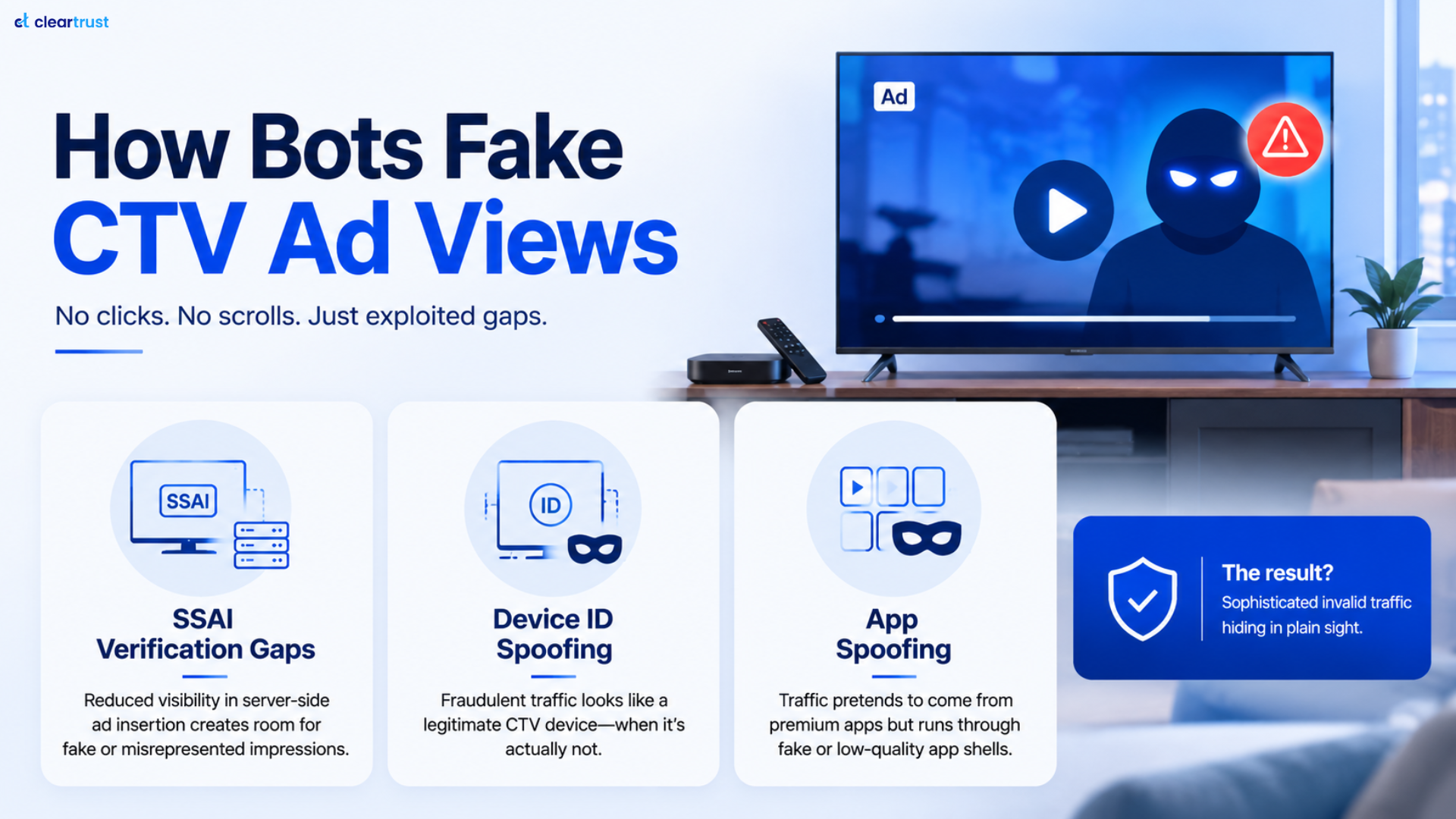
Unlike web or mobile advertising, CTV has no click to sanity-check against. There's no cursor movement, no scroll depth, no tap. That missing signal is exactly what fraud exploits, and it shows up in a few recurring patterns:
- SSAI verification gaps - server-side ad insertion assembles the ad into the video stream before it reaches the viewer's device, which makes traditional client-side verification harder to apply. SSAI itself isn't a fraud mechanism, but fraudulent actors can exploit that reduced visibility to generate or misrepresent impressions.
- Device ID spoofing - fraudulent traffic is dressed up to look like it's coming from a legitimate connected TV device or app, when it's actually generated by a data center or emulator.
- App spoofing - traffic claims to originate from a premium, well-known streaming app, while actually running through a low-quality or entirely fake app shell.
These tactics work because CTV, as a channel, still leans on ad tech infrastructure built for web-style verification - cookies, device IDs, ads.txt that wasn't designed for the streaming environment. That mismatch is exactly where sophisticated invalid traffic hides.
CTV vs OTT: Where Fraud Hides in the Gaps
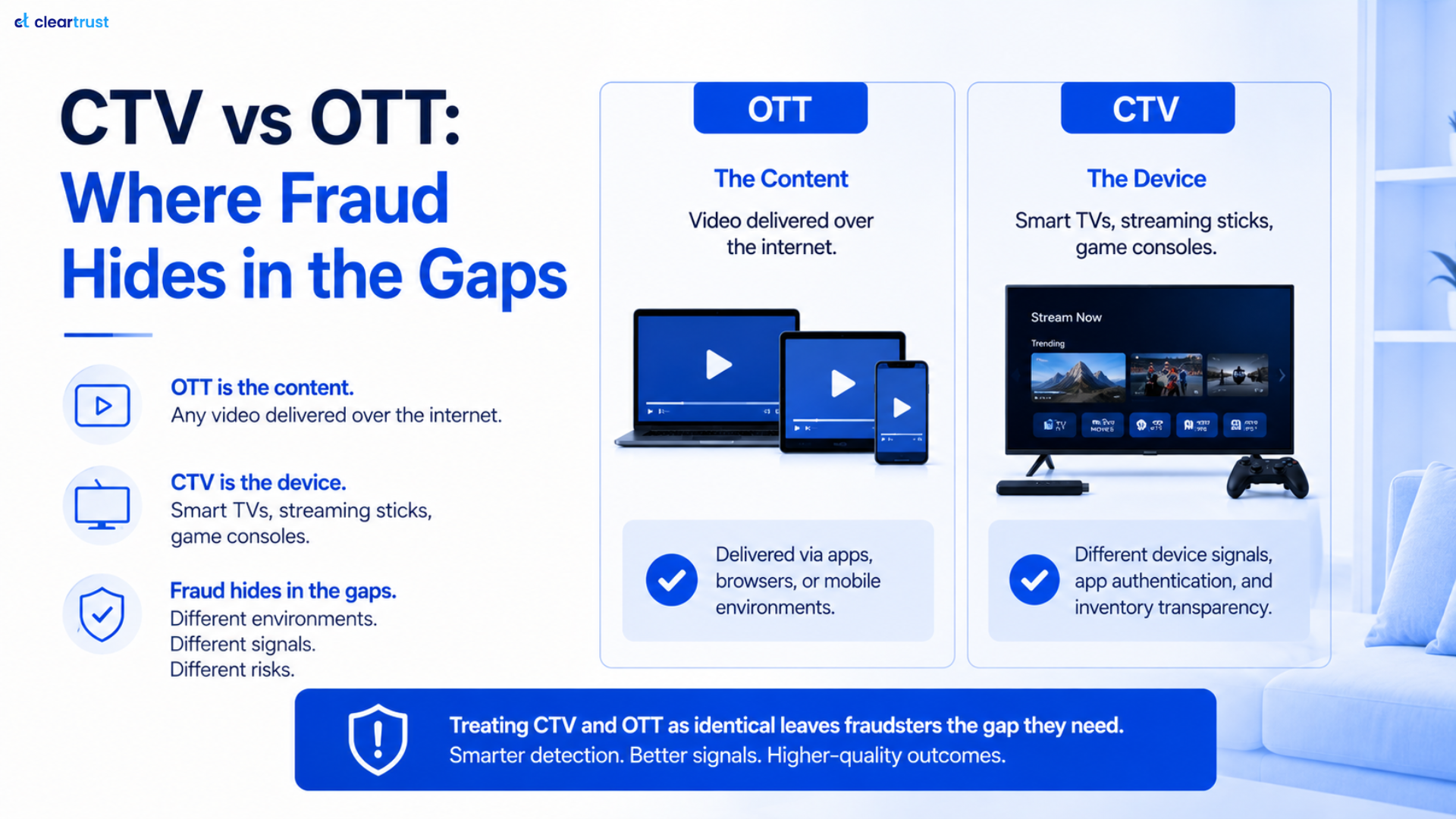
CTV and OTT get used interchangeably, but the distinction matters for fraud detection. OTT is the broader category - any video content delivered over the internet rather than traditional broadcast or cable. CTV specifically refers to the device: a smart TV, streaming stick, or game console.
Fraud detection strategies that work for OTT delivered through a mobile app or browser don't always transfer cleanly to the CTV device environment, because device-level signals, app authentication, and inventory transparency all behave differently on a television screen than on a phone or laptop. Any traffic quality strategy that treats CTV and OTT as identical is going to miss gaps specific to one or the other.
How to Detect CTV Ad Fraud
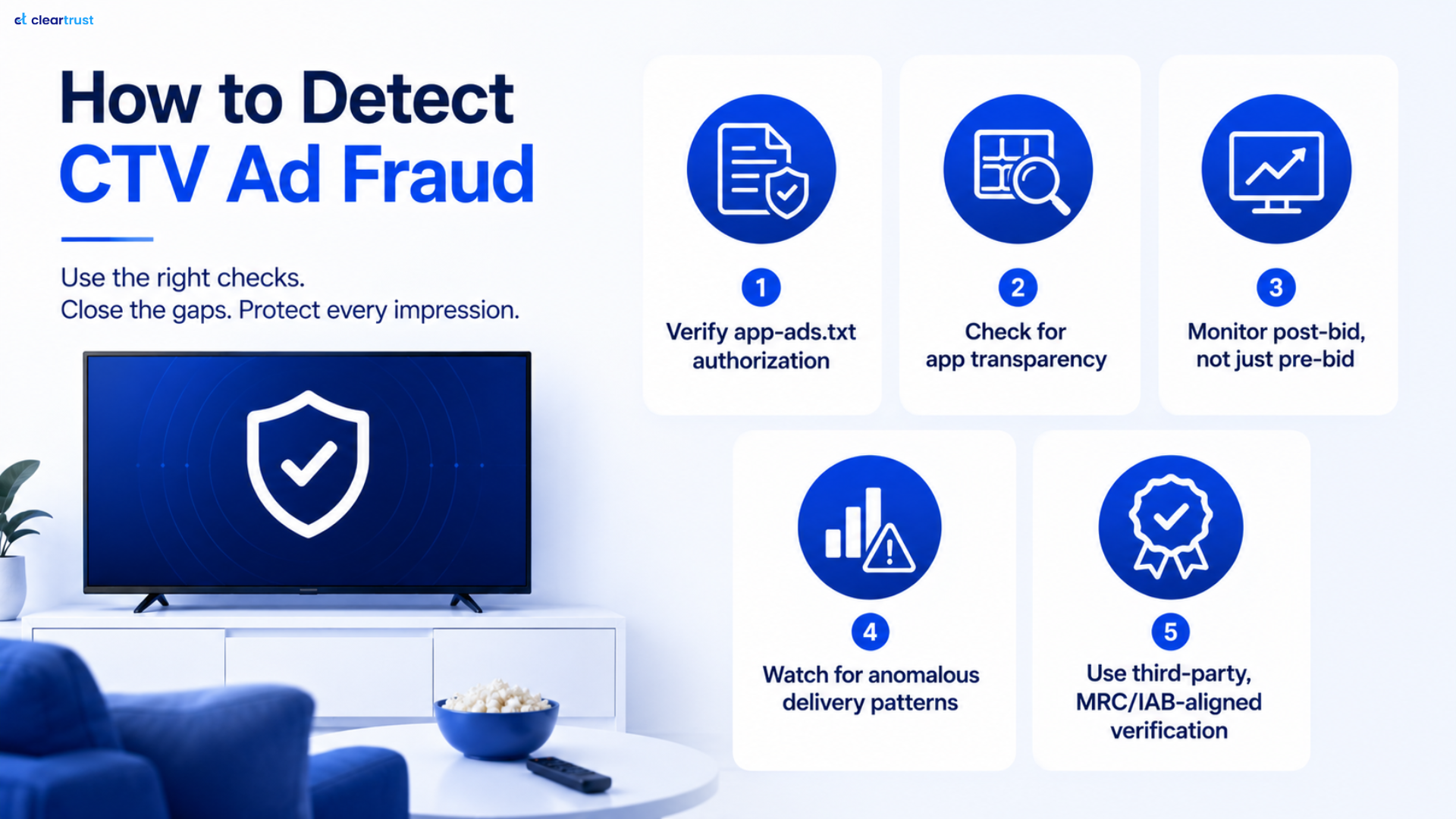
Detecting CTV ad fraud requires a different toolkit than desktop or mobile verification. A few practical checks matter most:
- Verify app-ads.txt authorization. Confirm the app or platform running your ad is an authorized seller, not just a claimed one.
- Check for app transparency. Know exactly which app, not just which platform your ad ran in.
- Monitor post-bid, not just pre-bid. Pre-bid filtering catches known bad actors; post-bid monitoring catches what slips through in real time.
- Watch for anomalous delivery patterns. A high volume of impressions with unusual completion rates, session behavior, or device-level patterns can indicate inventory quality issues that warrant investigation.
- Use third-party, MRC/IAB-aligned verification. Independent measurement, rather than self-reported platform numbers, is the only reliable check on inventory quality.
This is the practical core of CTV ad fraud prevention for media buyers, it's less about a single silver-bullet tool and more about layering pre-bid filtering, post-bid monitoring, and independent verification so nothing rides through on a single blind spot.
Connected TV Ad Viewability Issues You Shouldn't Ignore
Fraud isn't the only trust problem in connected TV advertising. Viewability issues sit right next to it, and they're easy to overlook because they don't always look like fraud on a dashboard.
A well-documented example: instances of ads continuing to register as delivered after a screen has been turned off or content has otherwise stopped playing. The issue is significant enough that a coalition of major streaming platforms and GroupM began working with independent measurement partners to establish a new industry viewability standard specifically to address it. When this kind of gap occurs, the impression still registers and the advertiser still pays, whether or not anyone was watching. This class of viewability gap affects video ad and video content delivery broadly, not just dedicated CTV apps and it's a growing concern across video advertising as budgets shift from traditional video advert formats into streaming environments.
For buyers running digital media strategies that blend CTV with other video advertising placements, the same discipline applies everywhere: don't assume an impression equals a viewer. Every advertisement video placement, CTV or otherwise, needs a way to confirm a real person was on the other end.
Is CTV Advertising Worth It? What This Means for Media Buyers
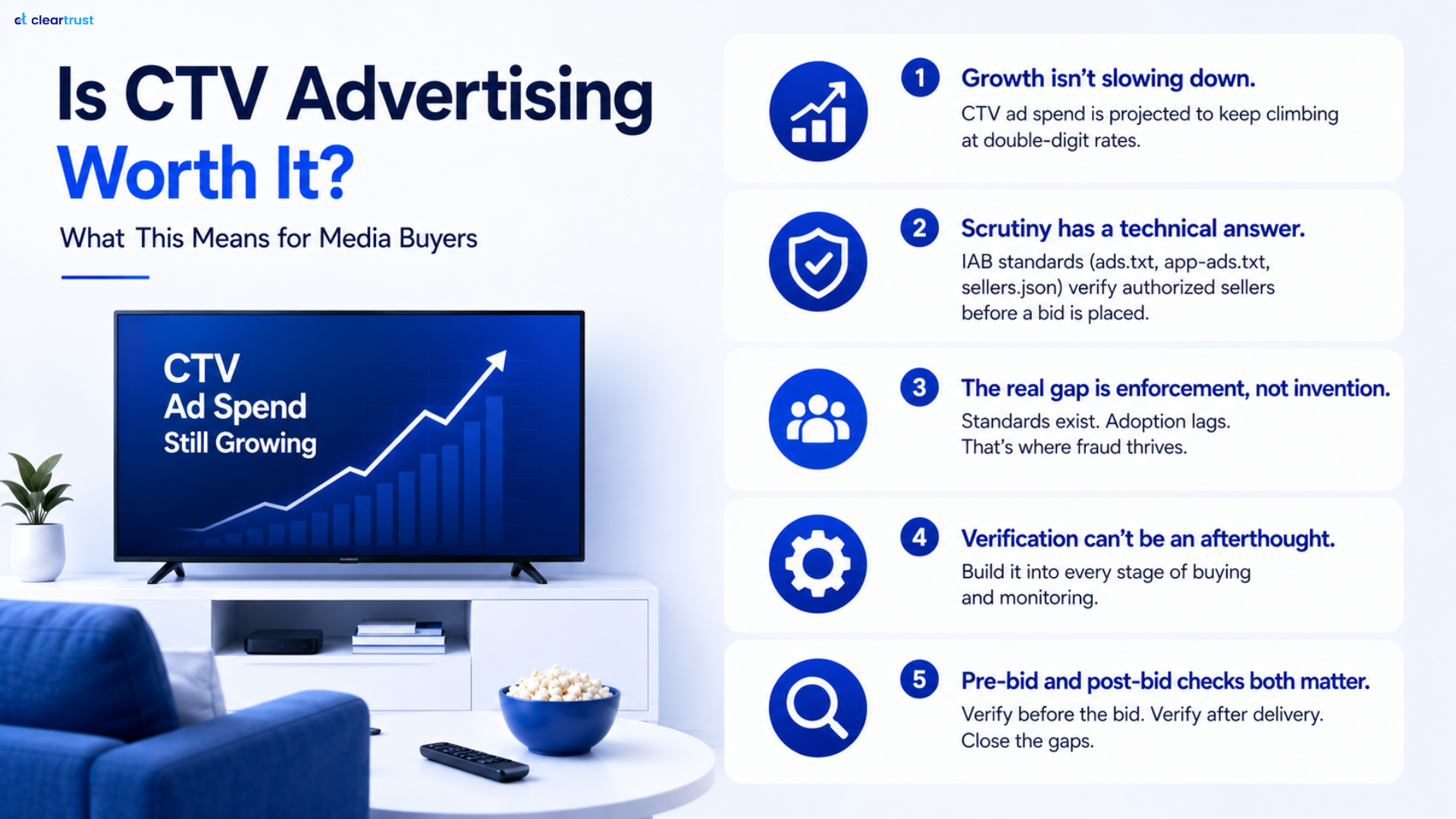
None of this means media buyers should pull back from CTV advertising - it means how they invest needs to change:
- Growth isn't slowing down. eMarketer's own forecasting confirms CTV ad spend is projected to keep climbing at double-digit rates over the next several years, even as the channel matures past its early hype phase. Digital advertising broadly is following the same curve.
- The scrutiny already has a technical answer. The IAB Tech Lab's supply chain transparency standards - ads.txt, app-ads.txt, and sellers.json exist specifically so buyers can verify who's actually authorized to sell a given piece of CTV inventory before a bid is placed, instead of discovering after the fact that spend went to an unauthorized reseller.
- The real gap is enforcement, not invention. These standards aren't new or experimental - they've been available industry-wide for years. Adoption still lags behind the pace of CTV ad spend growth, and that lag is exactly where fraud finds room to operate.
- Verification can't be an afterthought. For ad tech platforms, agencies, and performance marketing teams, it has to be built into how CTV ads, and connected TV inventory generally, get bought and monitored at every stage not bolted on after a campaign launches.
- Pre-bid and post-bid checks both matter. Confirming authorized-seller status before the bid is placed, then verifying actual delivery, viewability, and app authenticity after it runs, closes gaps that a single checkpoint at either end would miss.
How ClearTrust Helps
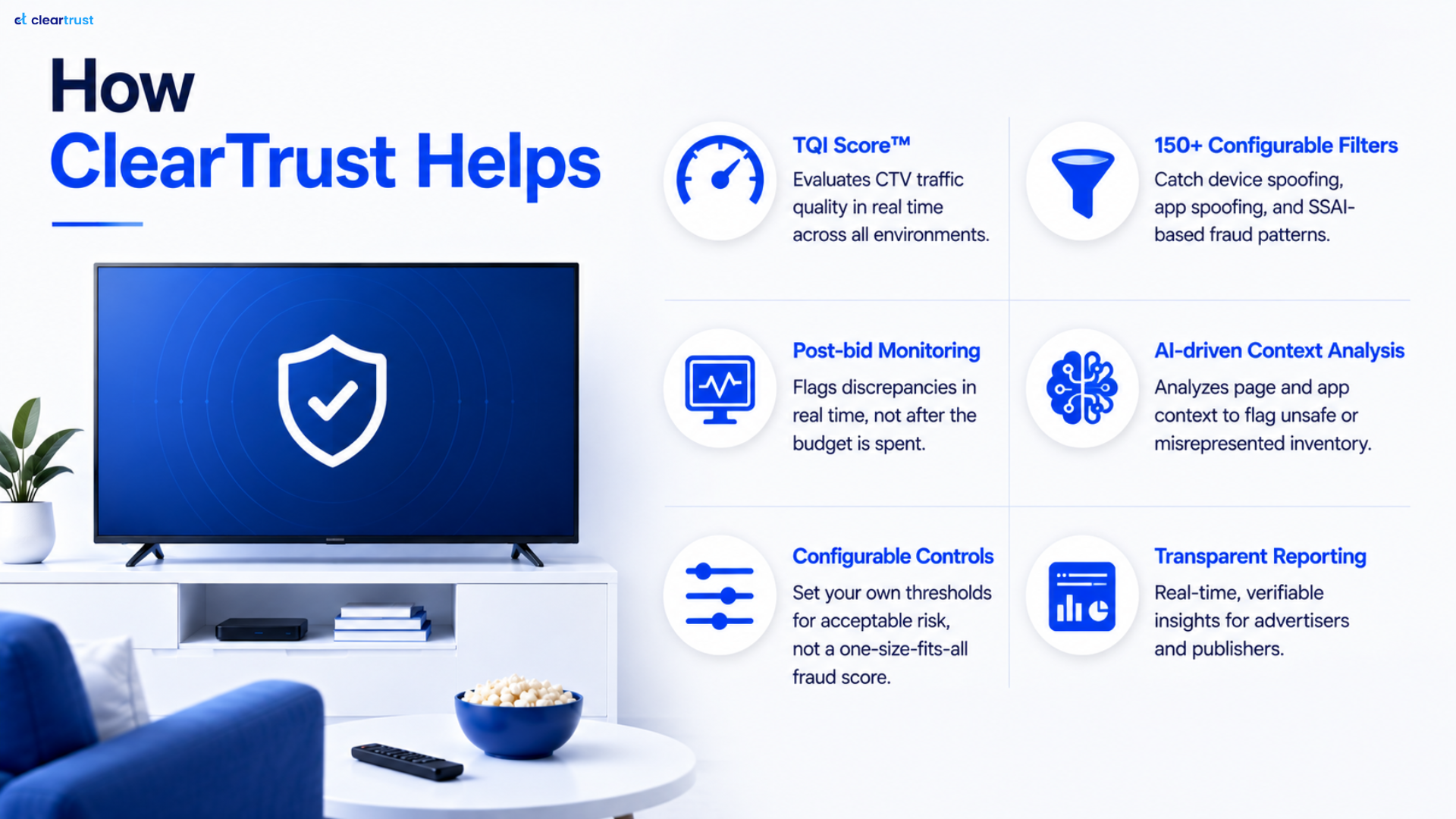
- TQI Score™ evaluates CTV traffic quality in real time, applying the same rigor across website, mobile, and CTV environments so buyers aren't relying on platform self-reporting alone.
- 150+ configurable filters catch device spoofing, app spoofing, and SSAI-based fraud patterns before they distort campaign data.
- Post-bid monitoring closes the gap pre-bid filtering can't - flagging discrepancies in real time, not after the budget is already spent.
- AI-driven page and app context analysis flags unsafe or misrepresented inventory, helping confirm your CTV ads are actually running where they claim to be.
- Configurable, granular controls let ad ops and brand safety teams set their own thresholds for what counts as acceptable risk, rather than accepting a one-size-fits-all fraud score.
- Transparent, real-time reporting gives advertisers and publishers a shared, verifiable view of traffic quality - the kind of transparency the IAB's own data shows buyers are actively asking for.
CTV advertising isn't going anywhere. The question isn't whether to keep investing - it's whether your traffic quality controls are keeping pace with your spend.
See how your CTV traffic scores before your next campaign goes live. ClearTrust's team will walk you through your current supply paths, flag where verification gaps exist, and show exactly how the TQI Score applies to your inventory before the budget is on the line, not after.
FAQs
What is CTV ad fraud?
CTV ad fraud is any deliberate attempt to generate fake impressions, views, or engagement within connected TV environments through bots, spoofed devices, spoofed apps, or misrepresented inventory so that advertisers pay for exposure that was never actually delivered to a real viewer.
Is CTV advertising worth it for advertisers despite the fraud risk?
Yes, CTV advertising continues to see double-digit spend growth because reach and engagement on the channel are real. The risk isn't a reason to avoid CTV; it's a reason to pair CTV ads with proper pre-bid and post-bid verification from day one.
How do bots fake CTV ad views?
Bots fake CTV ad views mainly through device ID spoofing, app spoofing, and exploiting the reduced client-side visibility in server-side ad insertion (SSAI) environments to generate or misrepresent impressions - all of which are harder to catch without a click signal to cross-check against.
What's the difference between CTV and OTT when it comes to fraud detection?
OTT is the broader content-delivery category, while CTV refers specifically to the device - a smart TV, streaming stick, or console. Fraud detection built for OTT delivered via mobile or browser doesn't automatically transfer to the CTV device environment, since app authentication and inventory transparency behave differently on each.
How can media buyers detect CTV ad fraud before it drains the budget?
Verify app-ads.txt authorization, confirm app-level transparency, monitor post-bid rather than only pre-bid, watch for anomalous completion and session patterns, and rely on independent, MRC/IAB-aligned verification instead of self-reported platform metrics.