.png)
Mobile App Ad Fraud Is Evolving: Your ROAS Is Paying for It
Published by ClearTrust | Partnership Spotlight Featuring insights from Ioana Manaila, Swaarm
Performance marketing has a problem nobody wants to say out loud: the traffic destroying your ROAS right now has probably already passed your fraud checks. It registered a clean install. It looked fine on the dashboard. And it spent your budget on users who were never going to convert.
This is what ClearTrust and Swaarm built their partnership to fix.
The Ad Fraud Your Filters Are Missing
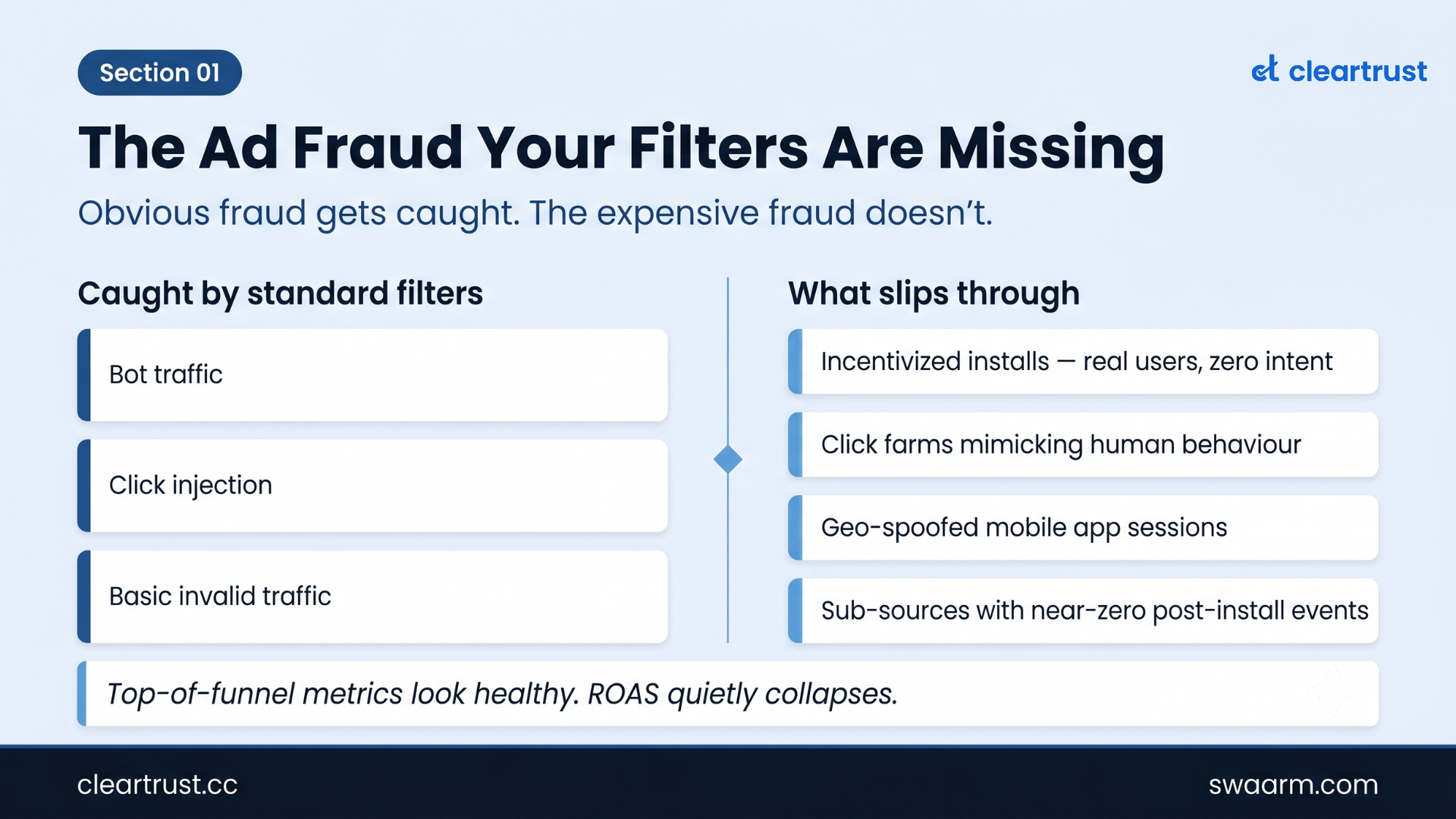
Bot filters are standard now. Click injection is widely understood. For most performance marketing operations running at scale, basic invalid traffic gets caught early.
What doesn't get caught is the traffic sitting just beneath that threshold — sessions that clear every filter but deliver nothing of value. Incentivized users who install once and disappear. Click farms running human-pattern behavior. Geo-spoofed mobile app sessions that satisfy targeting rules but miss every advertiser KPI. Publisher sub-sources padding click volumes while post-install events flatline.
If you want a full breakdown of how ad fraud actually works across these categories, ClearTrust has mapped it out in detail. The short version: the most expensive fraud is rarely the most obvious.
Ioana Manaila of Swaarm works with performance networks across mobile app, web, and search environments. She describes the problem plainly: top-of-funnel metrics look healthy while ROAS quietly collapses.
None of this shows up in your click-through rate. None of it flags in your install numbers. It only surfaces when you look further down the funnel, by which point the budget is spent, the billing cycle has closed, and in the worst cases, the advertiser is the one telling you there's a problem.
That scenario is where client relationships break.
The CPI Campaign That Looked Like a Win
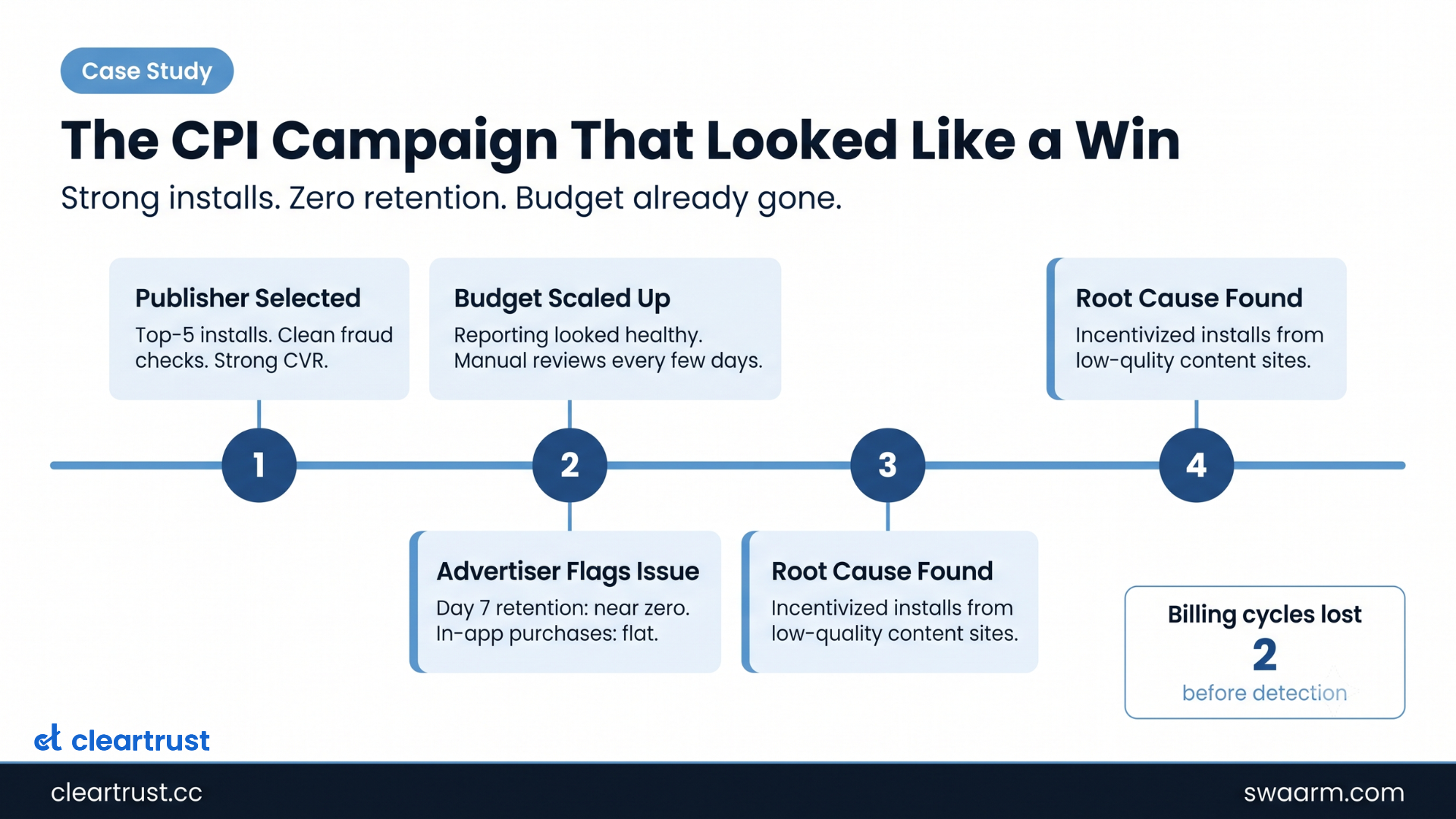
A mid-size performance network was running a CPI campaign for a mobile app gaming advertiser. One publisher stood out: top-five install volume, solid click-to-install conversion, clean across every fraud and invalid traffic check. The kind of publisher that earns a bigger budget allocation in the next cycle.
Two billing cycles later, the advertiser flagged it. Day 7 retention was near zero. In-app purchase rates were flat. The installs were through real devices, real activations, but the traffic came from incentivized placements on low-quality content sites. Users had completed the install as a micro-task for a reward. They had no interest in the game and never came back.
Because the network reviewed reports manually every few days and evaluated quality only at the click and install level, significant CPI budget was already gone before anyone caught it.
The shift to continuous, automated monitoring changed the outcome. The same traffic pattern, scored at the session level before conversion, would now trigger an automated rule and pause that source within hours.
The Operational Cost Hidden Inside Every Performance Marketing Team
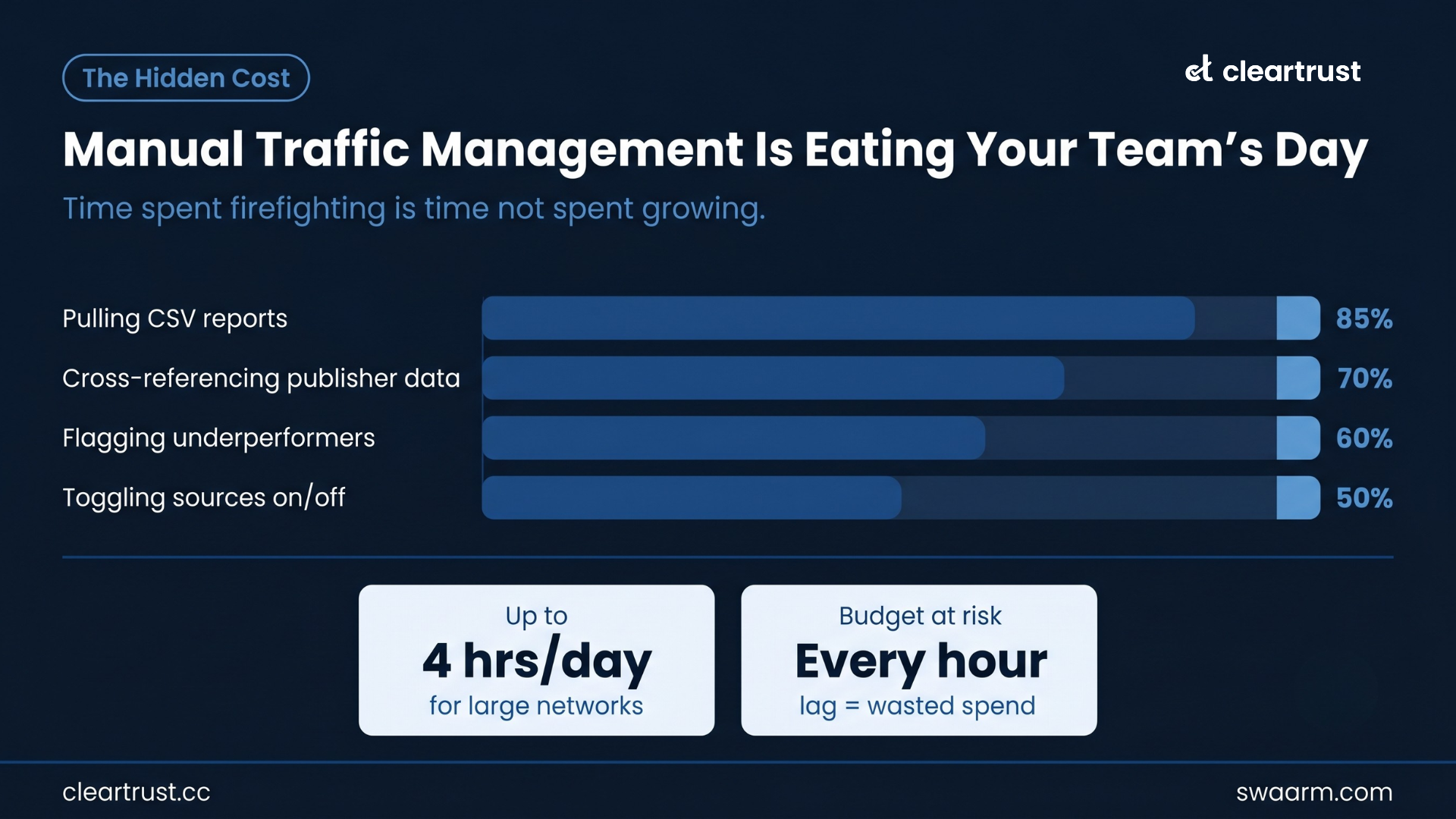
There's a second problem here that gets treated as a fixed cost of doing business: the hours that go into manual traffic quality management.
Before automation, many of Swaarm's clients were spending several hours a day pulling CSVs, cross-referencing publisher traffic, flagging underperformers, and switching sources on and off. For larger networks, that was half a working day, every day.
That time belongs in publisher relationships, campaign strategy, and growth. Instead it goes into maintaining a process that automation handles faster, more consistently, and without the fatigue errors that come with volume.
Every hour between a quality problem emerging and someone catching it in a report is an hour of budget going to sources that will never deliver. In a ROAS-sensitive performance marketing environment, that lag has a real financial cost.
How Swaarm Is Built for This
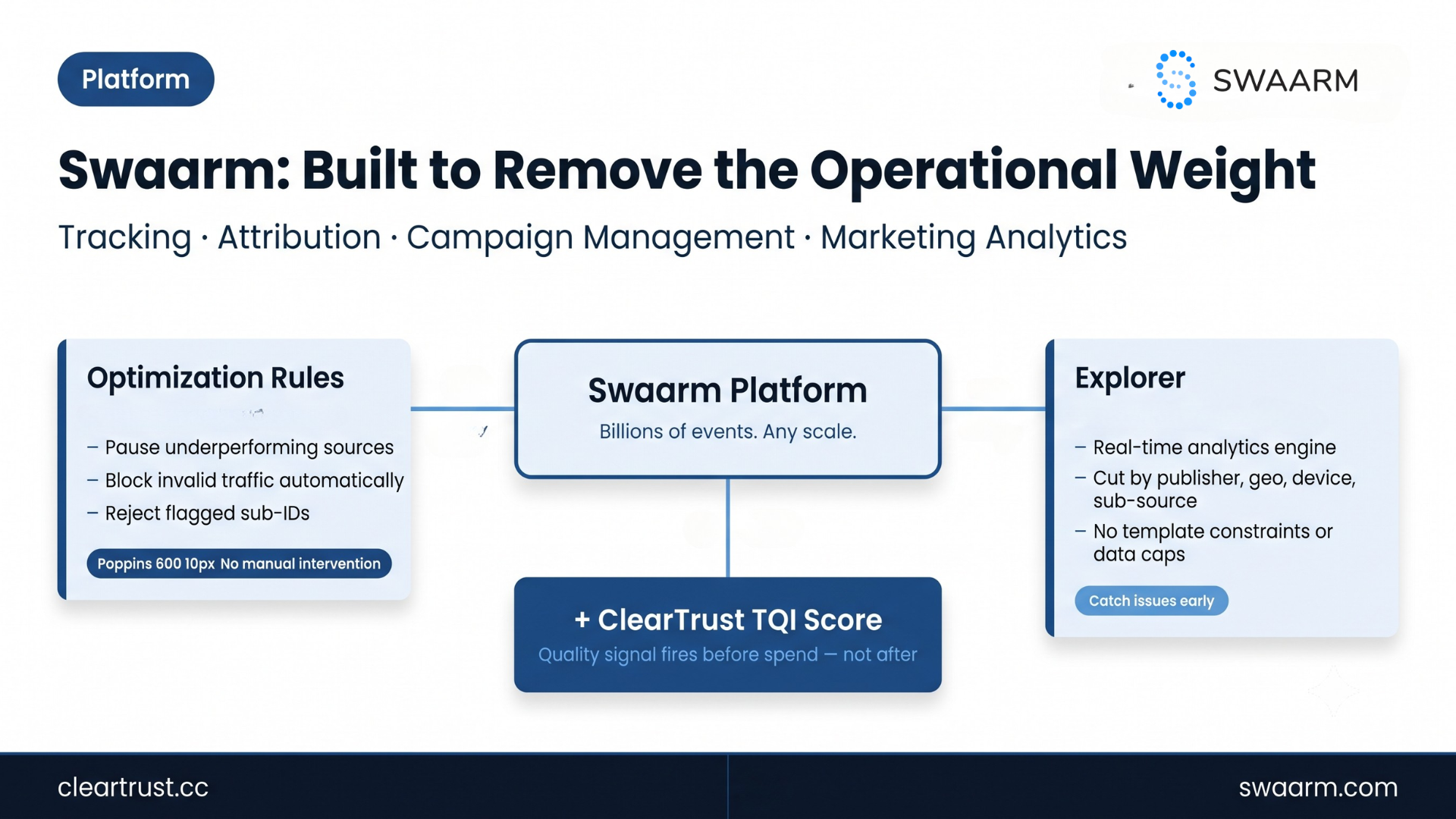
Swaarm's performance marketing platform is a full-stack martech solution covering tracking, attribution, campaign management, and marketing analytics — purpose-built to remove the operational weight that slows performance marketing teams down.
Founded in Berlin in 2020, Swaarm serves agencies, advertisers, and partner networks globally. The platform handles billions of events at a price point that gives mid-market and enterprise networks access to the same infrastructure without the typical enterprise contract.
Two features are central to the traffic quality problem.
Optimization Rules are the automation layer. They let clients act on performance signals automatically — pausing publisher traffic below conversion thresholds, blocking invalid traffic that misses targeting parameters, rejecting clicks from flagged sub-IDs. No manual intervention. Rules execute at scale across every active campaign.
Explorer is Swaarm's real-time analytics engine. Clients can cut traffic data across any dimension — publisher, geo, device, sub-source — without the constraints of pre-built report templates or data caps. It's how underperforming publisher traffic gets caught before it becomes an expensive line item.
Swaarm also supports search monetization use cases, giving networks that operate across both app install and search environments a single platform to manage quality and performance across channels.
What ClearTrust adds is the quality signal that makes Optimization Rules fire before spend happens, not after it's already done.
ClearTrust TQI Score: Quality Scored at the Click
The ClearTrust TQI Score™ is a session-level quality metric run across 150+ proprietary detection filters — bot traffic, click farm behavior, geo-spoofing, device manipulation, and behavioral anomaly patterns that standard invalid traffic detection doesn't reach.
Every session is scored between 0 and 10 at the moment of the click, before any conversion event, before any CPI budget is committed.
Most performance marketing automation rules are built on downstream signals: conversion rates, post-install event counts, retention rates, ROAS ratios. Those signals need data volume before a pattern becomes actionable. A publisher has to deliver enough low-quality installs for the Day 7 retention rate to read as anomalous. By then, the money is gone.
The TQI Score delivers a risk signal at the click — before spend, before a CPI is logged, before the session completes. When that signal feeds into Swaarm's Optimization Rules, those rules act on quality data in real time rather than waiting for performance data to confirm what the score already detected.
As Manaila puts it: decisions that used to take days now happen in milliseconds.
What Performance Networks Are Asking For
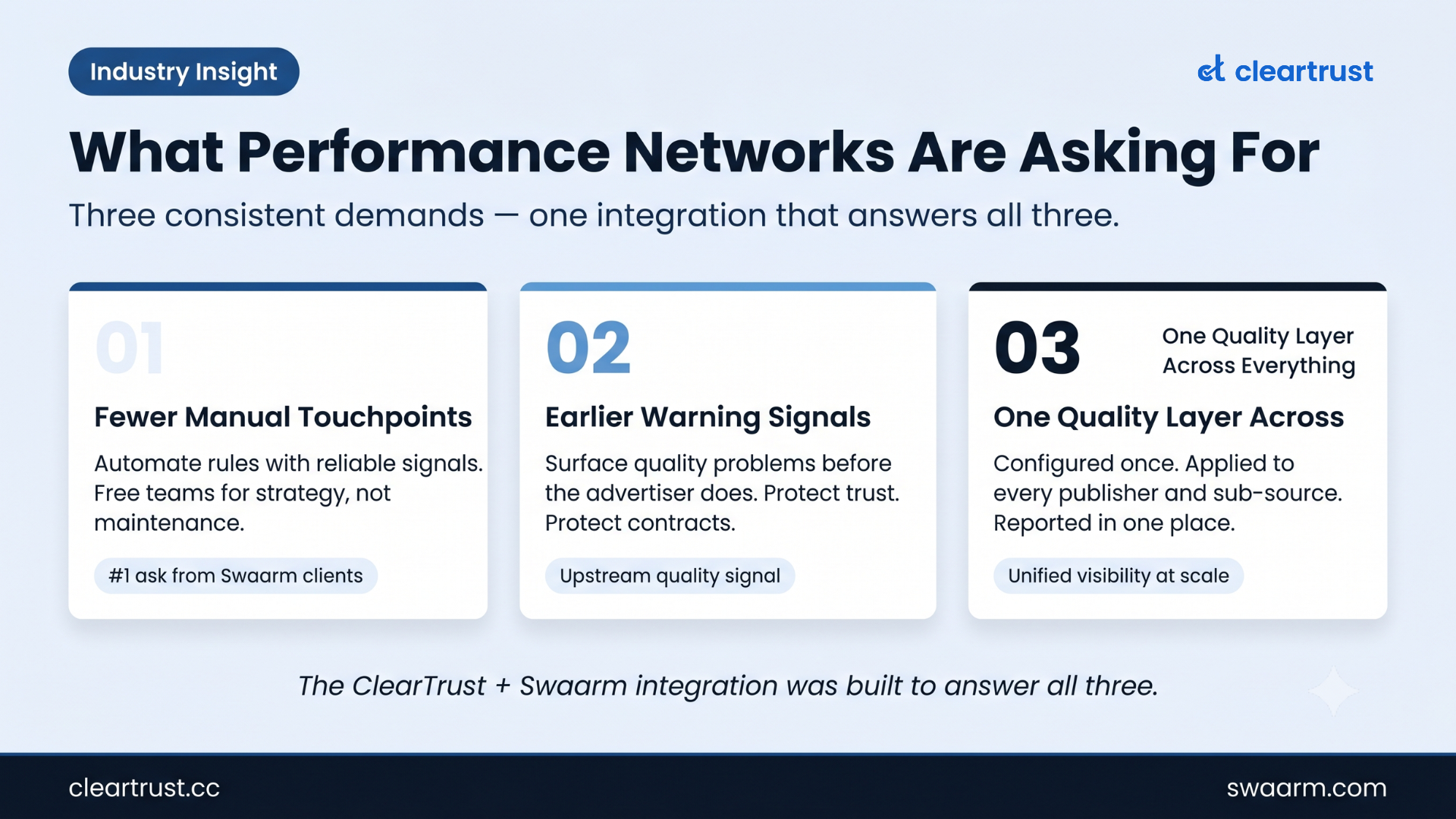
When Swaarm talks to clients about the future of campaign management, three requests come up consistently.
Fewer manual touchpoints. Even well-resourced performance networks still find teams pulled into firefighting — reviewing publisher traffic, adjusting caps, handling advertiser feedback on quality. The ask is always to push more of that to automated rules with reliable signals, so teams can work on strategy rather than maintenance. The ClearTrust + Swaarm integration makes that possible by moving Optimization Rules from the reporting layer to the request layer.
Earlier warning signals. The gap between a traffic quality problem emerging and an advertiser spotting it is where trust gets damaged and contracts get reviewed. Networks want to surface the problem first. The TQI Score delivers that upstream signal, identifying invalid traffic and low-intent sessions before they show up in conversion reporting.
One quality layer across everything. As performance marketing networks scale, they manage dozens of publishers and hundreds of sub-sources. Separate manual checks and third-party dashboards don't hold up at that volume. What clients want is quality scoring configured once, applied everywhere, reported in one place. For publishers especially, this kind of consistent, transparent scoring also builds the trust that sustains long-term network relationships.
Why Standard Ad Fraud Detection Has a Ceiling
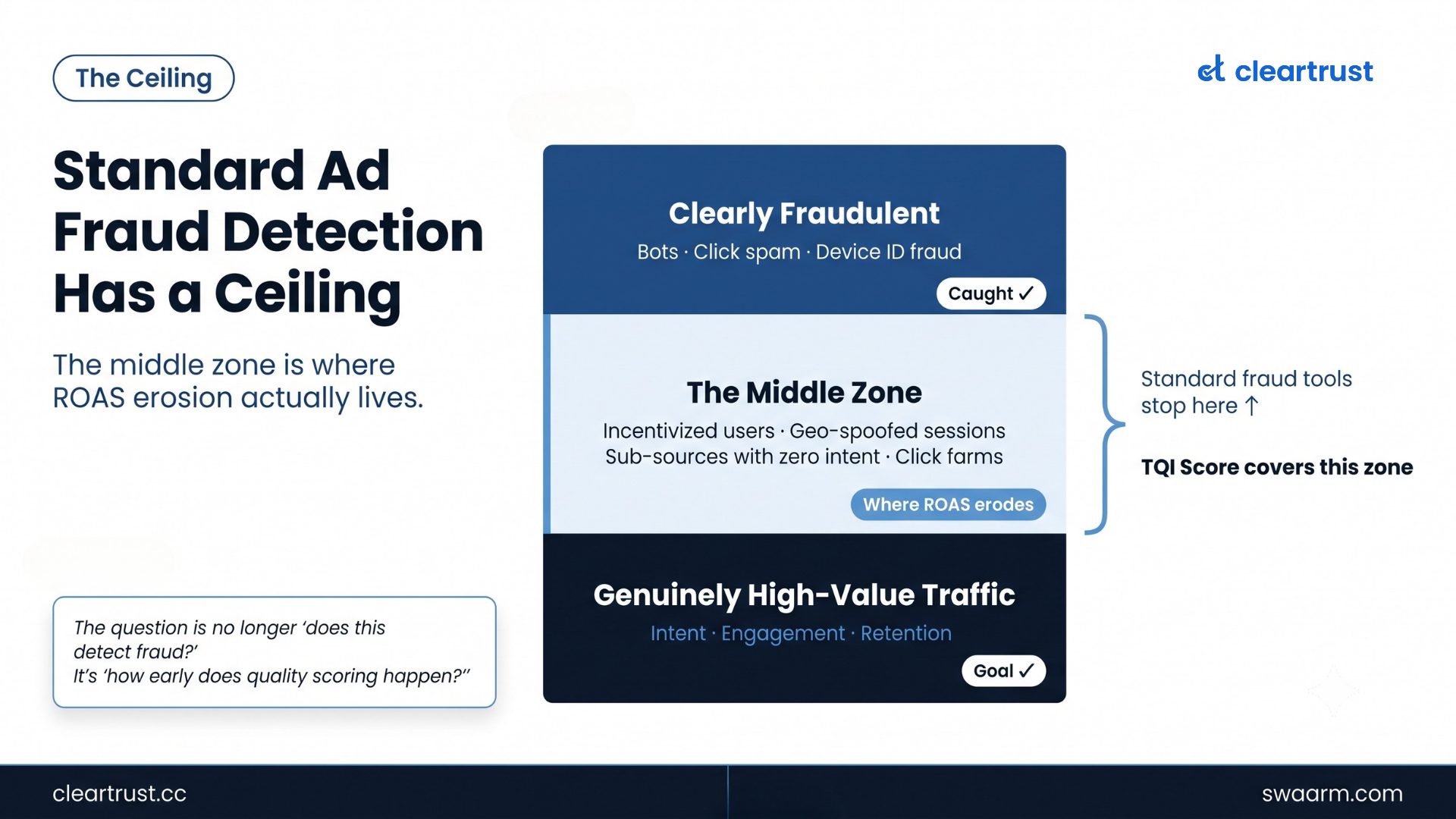
The performance marketing industry has invested heavily in fraud detection over the past decade. Most of it goes toward the obvious problems: bot traffic, click spam, device ID fraud, basic invalid traffic patterns.
The harder problem — and the one where ROAS erosion actually lives — is the middle ground between "clearly fraudulent" and "genuinely high-value." Real-but-misaligned traffic. Incentivized mobile app users. Geo-spoofed sessions. Publisher sub-sources that clear every quality check and still deliver nothing for the advertiser.
For performance networks, fixing this means fewer manual review hours, faster response to quality signals, and earlier detection of low-ROAS publisher traffic. It also means being the one who brings quality data to the advertiser, rather than the one receiving the complaint.
For martech buyers evaluating tracking and attribution platforms, the question has shifted. It's no longer just "does this detect fraud?" The question is: how early does quality scoring happen, and how fast can automation act on it?
See Your Traffic Quality Before the Budget Moves
If you run a performance marketing network and want to know what your publisher traffic quality looks like at the session level — before conversion events, before CPI spend, before billing cycles close — the ClearTrust TQI Score™ gives you that picture immediately.
Already on Swaarm for campaign management and attribution? The integration fits directly into your existing Optimization Rules setup.
Explore ClearTrust: cleartrust.cc
Book a Swaarm demo: swaarm.com
About ClearTrust
ClearTrust is a traffic quality management platform powered by the TQI Score™ — a real-time quality metric built across 150+ detection filters. Processing over one billion sessions daily, ClearTrust helps agencies, performance networks, advertisers, and publishers protect mobile app campaigns, eliminate invalid traffic, and defend ROAS at scale.
About Swaarm
Swaarm is a martech tracking and attribution platform for performance marketing, offering campaign management, marketing analytics, mobile app measurement, and automation tools via its performance marketing platform. Founded in Berlin in 2020, Swaarm serves agencies, advertisers, and partner networks worldwide.